On 5 November, the Faculty of Life Sciences is hosting the Autumn MINT Festival – an event designed to bring the complexity of the life sciences to life: DNA forensics in a packed lunch, microcosms in a glass of water, colour signatures in plants. This event complements the summer event organised by the Faculty of Technology and Bionics, which focused on breadth and attracted around 220 participants – 3D printing, rocket building, robotics. Now, in the autumn, the focus is on depth: no lecture-hall theory, but closely supervised practical work at laboratory benches, including access to equipment – a level of hands-on involvement that large-scale events rarely allow. Just over 25 pupils from grammar schools and comprehensive schools in the region are benefiting from this. The workshops were organised and funded by the zdi centre ‘cleverMINT’ in the district of Kleve. The zdi funding comes from the Ministry of Culture and Science of the State of North Rhine-Westphalia and the Employment Agency.
Prof. PD Dr.-Ing. Sylvia Moenickes, the new – and first – Dean of the Faculty of Life Sciences, opened the event. She outlined the university’s profile before drawing a personal parallel: from school pupil to professor. Moenickes’s field of expertise is environmental systems analysis. For her, ‘computer-aided simulation’ involves modelling complex ecological relationships: how do entire ecosystems change under stress? What happens when temperature and food regimes shift? This macro-perspective provides the framework for the programme over the next few hours. The workshops, meanwhile, focus on the micro-components: microbes in water, genes in food, pigments in leaves.
The team from the Faculty of Life Sciences is opening up its laboratories – and sharing its current research topics. What makes these two days special is that the teaching is not being delivered by ‘just any’ lecturers, but by researchers who translate their industry and laboratory experience directly into educational formats. The transition from cutting-edge research to the classroom is a deliberate one. Complexity is not simplified, but made manageable.
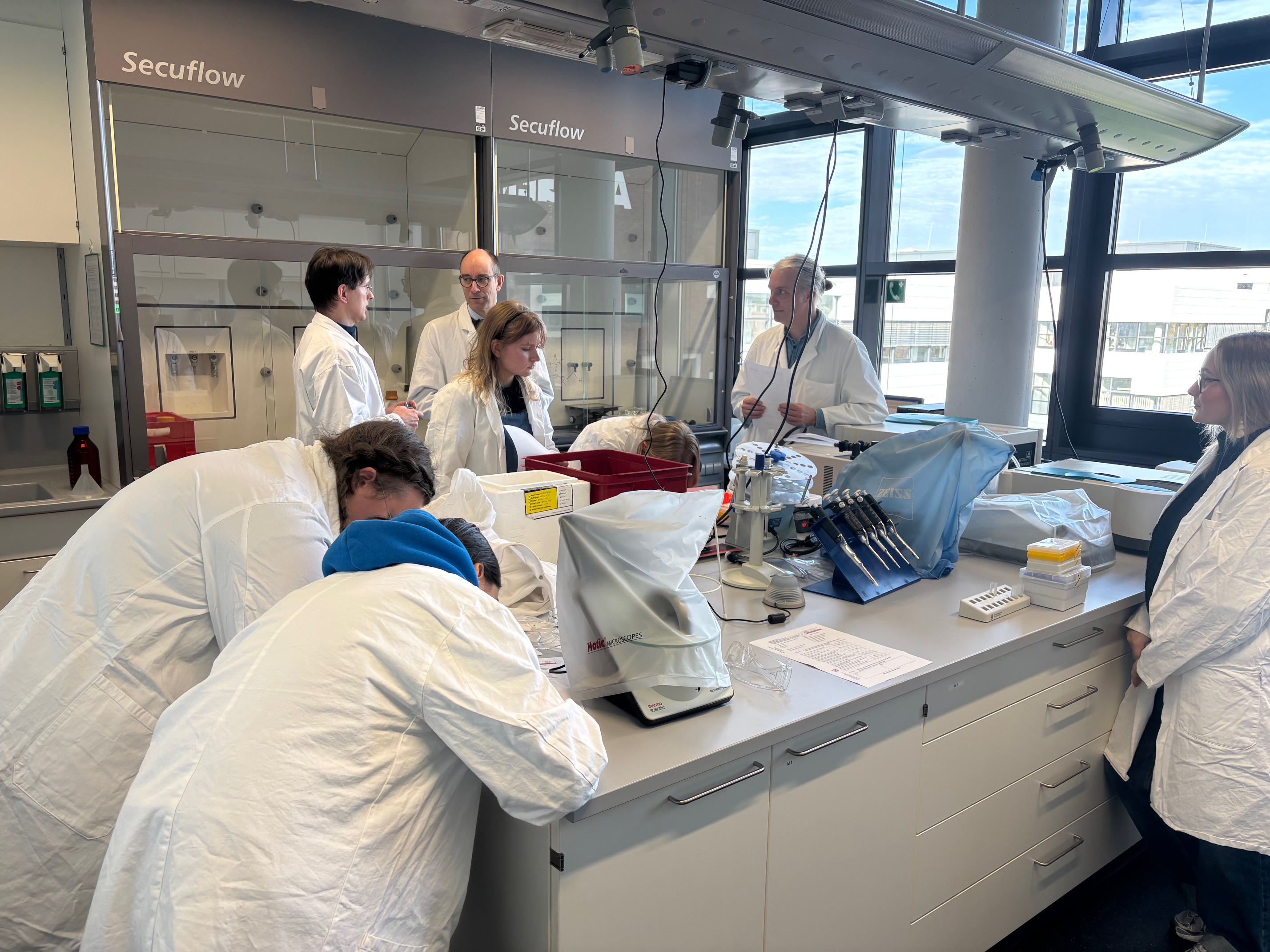
The ‘lunchbox check’ begins with a reminder of the 2013 horse meat scandal. The contents are not always declared. Under the guidance of Dr Nadine Merettig, a research assistant in biochemistry and microbiology, the buttered bread becomes a sample. DNA is extracted, amplified using polymerase chain reaction (PCR), and fragments are separated via gel electrophoresis. What previously sounded abstract becomes a sequence of precise steps: pipetting, loading, waiting, reading the results and, finally, a band that tells a story.
Merettig’s research focuses on foodborne pathogens and antibiotic resistance. For her, the workshop is not a school show, but everyday life on a smaller stage. The key lesson from this morning lies less in amazement than in the realisation that gathering evidence is hard work.
Next door, things are turning green. Dr Stefan Weber and Prof. Dr Peter Scholz are introducing the students to chromatography – or, more precisely, to the isolation of the green fluorescent protein (GFP). The group is working on an FPLC (Fast Protein Liquid Chromatography) system, a piece of equipment usually found in drug discovery laboratories. It clicks; valves open and close; a curve builds up on the screen. The theory behind separation methods is brought to life.
Scholz’s CV explains the calm with which practical work is carried out here, even when the equipment occasionally plays up: a PhD in Cologne, research stays at ETH Zurich and at the Skaggs Institute for Chemical Biology at the Scripps Research Institute in La Jolla – institutions that carry significant weight in biomedical research. Before joining the HSRW in 2009, he spent almost ten years in industrial and pharmaceutical biotechnology. For him, ‘building bridges to practice’ is not just a buzzword. The pupils see that science is a system of methods that one must – and can – apply.
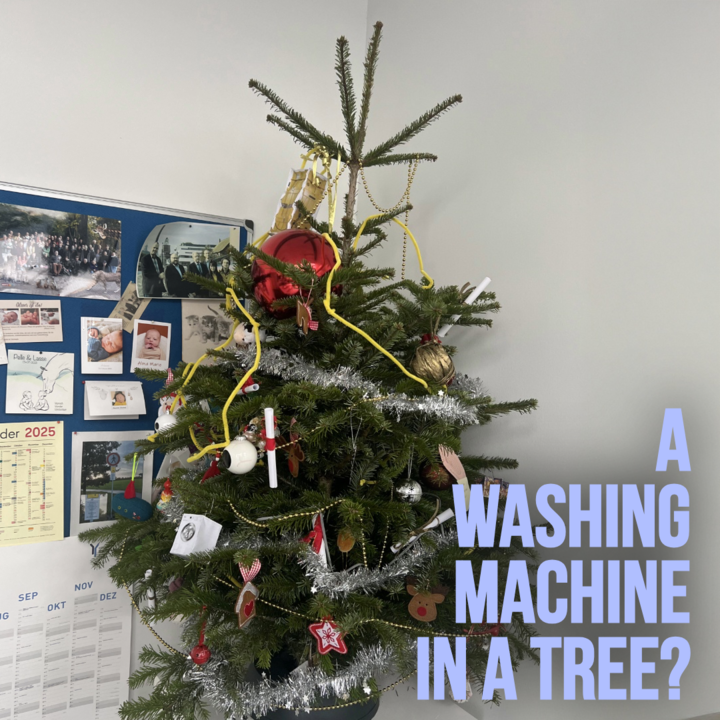
‘From dental plaque to the Stanley Cup’ is the title of the workshop on microbial biofilms, deliberately spanning the spectrum from the mundane to pop culture. A larger team leads the session: Prof. Dr Dirk Bockmühl (Hygiene and Microbiology), Ralf Lucassen (Diplôme d’Ingénieur, Biotechnology/Microbiology), Matthias Kudla (Microbial Biodiversity) and Nicole van Leuven, MSc in Microbiology, research assistant. The pupils take samples from both artificially contaminated drink bottles and their own bottles brought from home. They collect bacteria from the bottles, plate them onto agar and examine them under a microscope. Everyday objects such as reusable bottles become ecosystems. Bockmühl’s CV highlights his strong practical background: prior to his appointment at Rhine-Waal University of Applied Sciences (HSRW), he spent many years in senior roles in central research at Henkel, most recently as head of the international R&D platform ‘Hygiene and Allergies’. Today, Prof. Dr Bockmühl is one of the leading experts on the microbiology of everyday life, thanks to his authorship of popular non-fiction books such as *Keim daheim* and *Unsichtbarer Tod*, as well as his numerous media appearances. At the HSRW, he investigates microbial communities in the domestic environment, such as in washing machines, dishwashers and fully automatic coffee machines. “This topic really affects everyone,” he says, “and yet surprisingly little is known about it.” Van Leuven also conducts research into biofilms in hospital drains. For one hour, the pupils become researchers in the professor’s field of expertise. An added insight they gain is that hygiene is not a state, but a process.
Why plants are green – and why sometimes they aren’t – is the central question addressed by Prof. Dr Natalie Laibach. On the table lie samples of amaranth – purple and green – grown under normal conditions and under stress, as well as paprika powder. Pigments are extracted, separated using thin-layer chromatography (TLC) and analysed by spectrophotometry. The bands on the chromatography plate tell the story of an adaptation. Laibach holds the endowed chair in ‘Sustainable Land Use Systems’ and is committed to sustainable agriculture. Key milestones in her career include the Centre for Research in Agricultural Genomics (CRAG) in Barcelona, the University of Bonn, and the Fraunhofer Institute for Molecular Biology and Applied Ecology (IME). Her research ranges from plant metabolic engineering to the effects of environmental factors on metabolism. The workshop is the educational equivalent: ‘Colours of Life’ as an interpretation of plant adaptation, an introduction to the logic of resilient varieties.
The university does not view the festival as merely a showcase. The decision to study a STEM subject in upper secondary school is rarely based on enthusiasm alone. Guidance is needed, and structural barriers often have to be overcome. During the breaks, talent scouts from the Central Student Advisory Service are on hand. They form part of the NRW Talent Centre Network, funded by the Ministry of Culture and Science, and carry out outreach work in the districts of Kleve and Wesel.
The focus is on motivated pupils, particularly those who are the first in their family to consider university study, or who face financial and language barriers. The advice is personalised, confidential, free of charge and non-judgemental. It helps with choosing a subject and securing funding, as well as with finding work placements. Even the free lunch in the canteen is, in this light, more than just hospitality: it is a small act of inclusion. Being part of everyday student life for an hour, lowering the barriers to entry – that, too, is part of knowledge transfer.
At the same time, at the MINT Festival, the faculty presents the life sciences not as an unapproachable discipline, but as a field of pressing questions relevant to everyday life. In doing so, the faculty aims to demonstrate that infrastructure alone is not enough. Human capital is crucial: researchers with international and industrial experience who are willing to share their methods and perspectives. In this way, complexity becomes not a spectacle, but a gateway.
In the end, the Gelbox hums, a fluorescent band appears and a line dries on the chromatography plate. What remains is a sense of scale. A bridge is built between the pipette tip and the ecosystem. Anyone who has ever loaded a sample themselves may not understand everything, but they understand enough to ask the right questions. And that, in science as in life, is not a bad start.