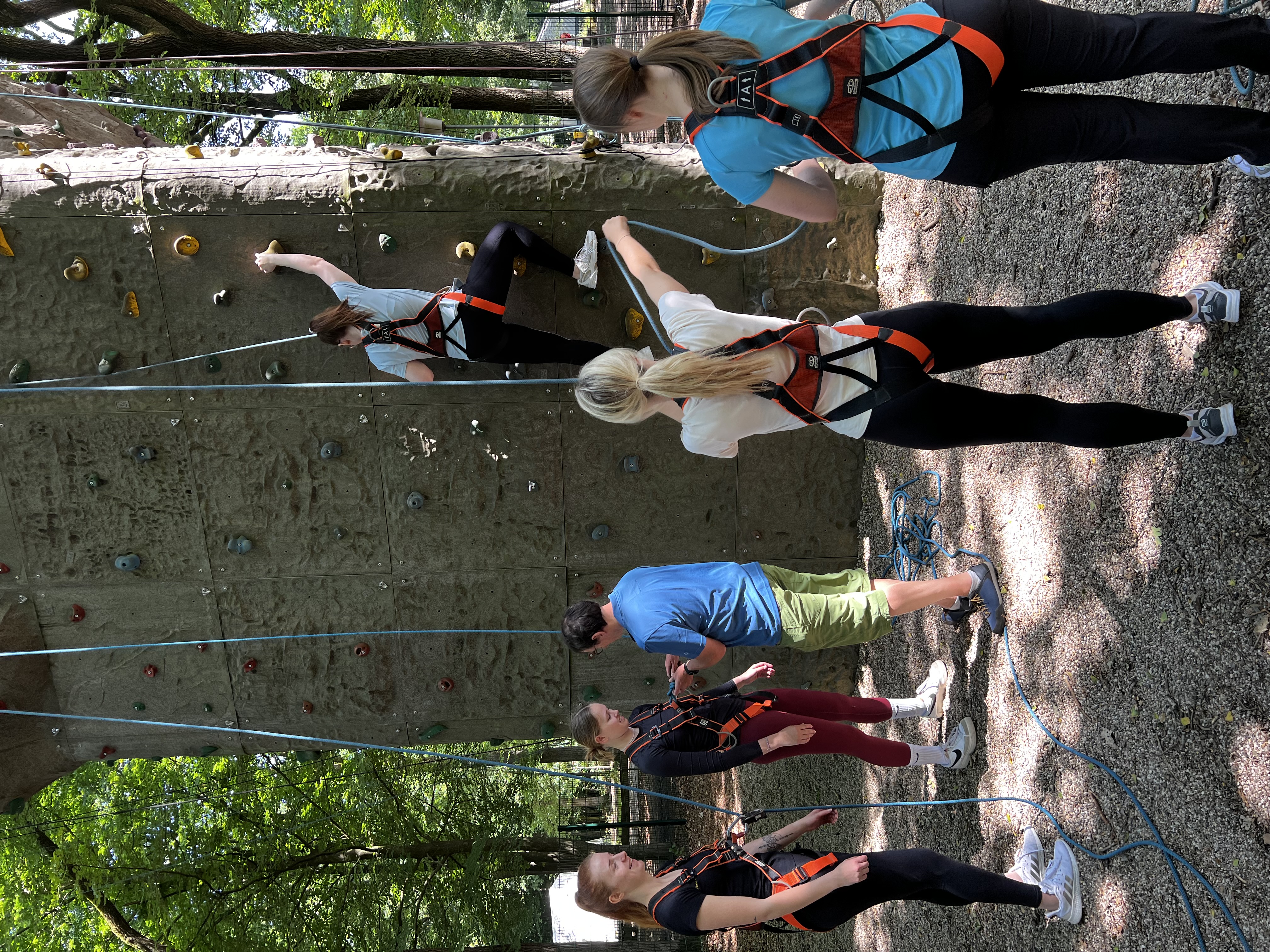
Skills that play a key role in addiction prevention – teamwork, mutual trust, taking responsibility and also having the confidence to ‘say no’ when one has reached one’s limits: students on the Master’s programme in ‘Health Sciences and Management’ were able to experience these first-hand during a joint climbing project.
The climbing stations were therefore designed in such a way that they could only be completed as a team. Whilst some students climbed the station, others took on the role of belaying from the ground. It was only the combination of physical activity and responsibility that made their shared success possible.
“Those climbing at the top must rely on the belay. Those working at the bottom bear responsibility for the team. At the same time, everyone learns that it is perfectly fine to stop a task – whether out of uncertainty or fear. This ability to ‘say no’ is a key component of addiction prevention,” emphasises Prof. Dr Robert Renner, Professor of Health Promotion and Nutrition and programme director. The students themselves also describe the experience as valuable. Alongside the physical challenges, personal limits were recognised and openly discussed.
“At the start, I was really scared, but the group motivated me and gave me confidence, so that I was able to overcome my fear. This experience has boosted my self-confidence,” said one student. Through the climbing project, the students experienced how prevention works and acquired skills that will also benefit them in their future careers.