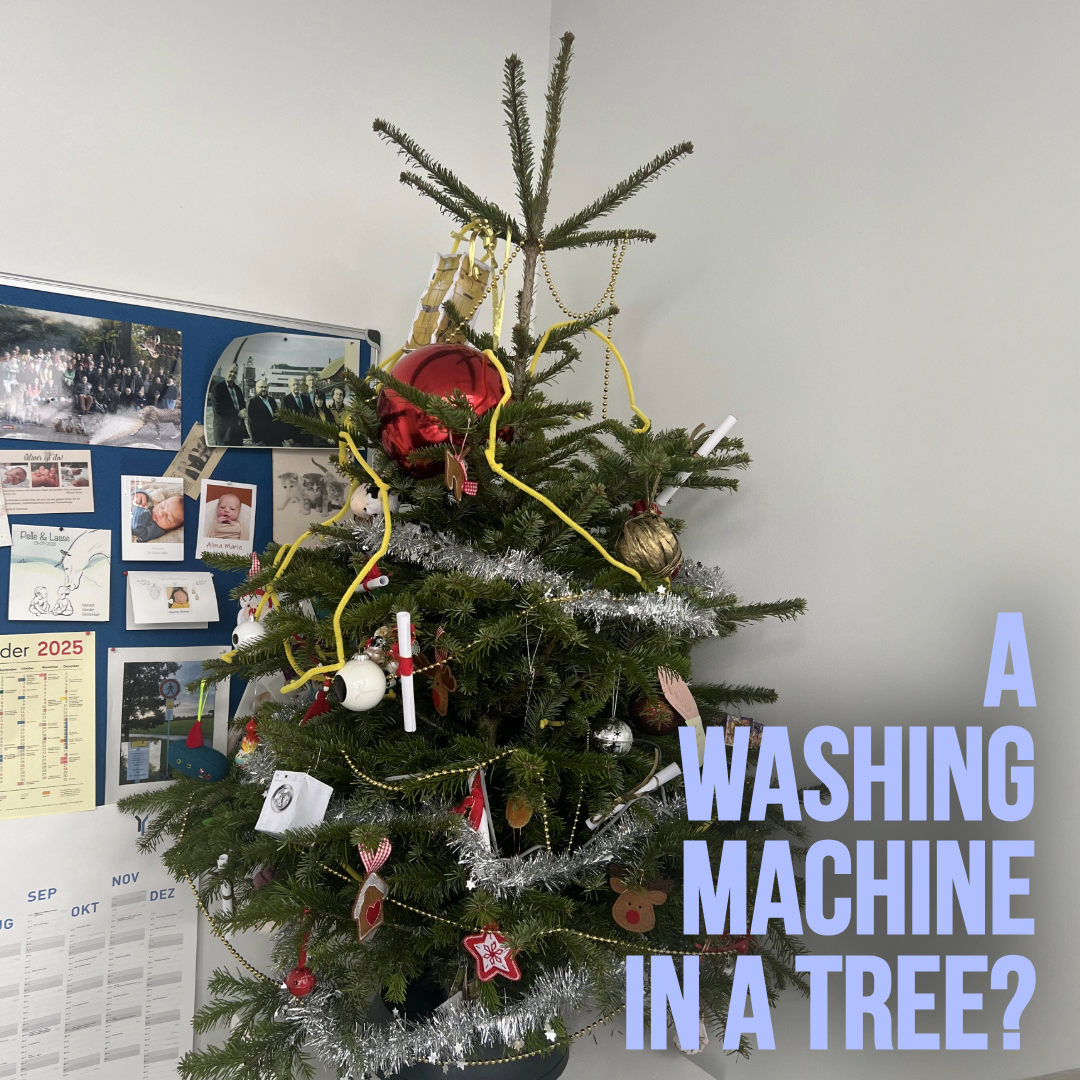
It is a lovely, if predictable, tradition: as the year draws to a close, fir branches take over the corridors of German universities. But in the staff room of the Faculty of Life Sciences at Rhine-Waal University of Applied Sciences, something is catching the eye amongst the branches this year that breaks with the usual canon of glass baubles and straw stars. Alongside the Christmas decorations hangs a miniature washing machine.
What at first glance appears to be a curious aesthetic incongruity is, in truth, a subtle reference to one of the most pressing issues facing modern households. This unusual Christmas tree decoration symbolises the work of the research group led by Professor Dr Dirk Bockmühl. In the Department of Hygiene and Microbiology, the focus is on that invisible grey area where energy efficiency and germ-free conditions compete with one another. Among other things, the researchers are investigating how textiles can be cleaned to microbiological standards even at low temperatures – the key to saving energy.
Anyone wishing to understand how far technology has come need only take a few steps further. On the second floor of Building 12 stands a historic washing machine from the mid-20th century, a wooden reminder of a more labour-intensive era. It is a technical memento mori: whilst water consumption was immense back then and operating it was back-breaking work, today’s scientists are striving to reduce the temperature in the drum by every single degree Celsius.
We would like to bring the year to a close with this sense of technological change and scientific continuity. We wish all students, staff and partners of the university a good start to 2026.