In a world where resources are finite and ecological resilience is reaching its limits, Germany’s focus on ‘end-of-pipe’ thinking is increasingly seen as inadequate. The general consensus is that the challenge lies not merely in recycling what is often still unavoidable, but in the intelligent redesign of production and consumption patterns that prevent waste from arising in the first place. This is where Prof. Pauling’s approach comes in.
Prof. Dr Simone Pauling, a professor at Rhein-Waal University of Applied Sciences, combines academic research with international industry experience. Before taking up her professorship, she worked on quality assurance and sustainability within global agricultural and food value chains and also served as head of research at an international poultry processing group, where she was deeply involved in the implementation of innovative and sustainable solutions. Today, her research lies at the intersection of resource-efficient production, environmental and animal welfare, and fair value creation.
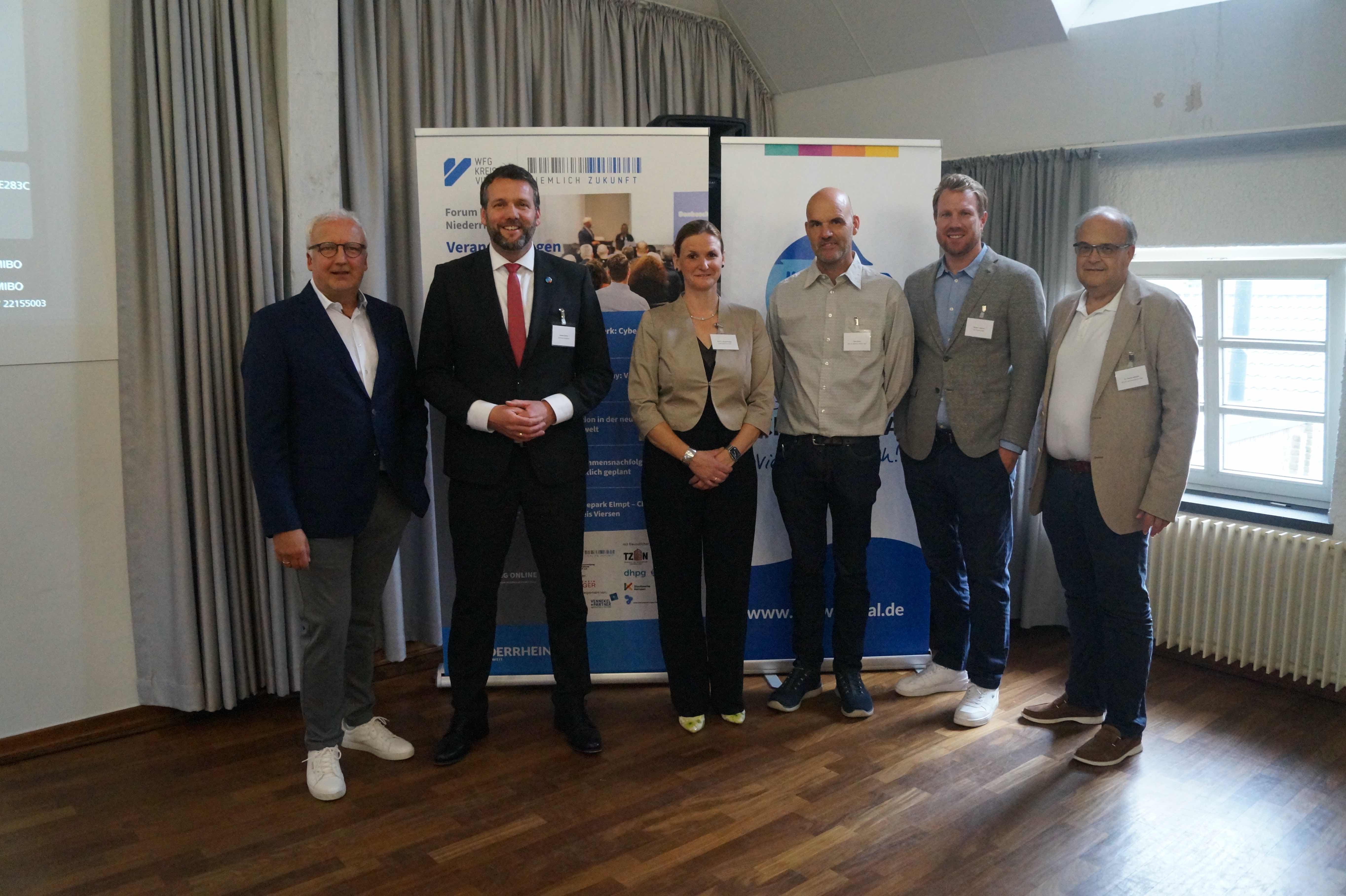
Her key message at the SME Forum in the district of Viersen was that the circular economy requires a fundamental shift in thinking, starting with product design, material selection and business model development. The aim, she said, is to establish “well-thought-out cycles from the outset” that expand and redefine established value chains. According to Pauling, this would not only enable resources to be used more efficiently and costs to be saved, but would also open up new business areas – underpinned by innovative ideas and practical examples that provided the SME entrepreneurs present with concrete food for thought. Small and medium-sized enterprises in particular face the challenge of adapting to such systemic changes. The Lower Rhine SME Forum’s agenda for 2025, which addresses not only the circular economy but also current issues such as cyber security and the transformation of the world of work, underlines the realisation that sustainability is no longer a niche concern, but rather an “economic necessity”.
The vision of a genuine circular economy – in which recycling is seen as just one component – could thus become a key driver of innovation for the Lower Rhine region and beyond. A shift in thinking that, ultimately, can strengthen not only the environment but also the region’s competitiveness.