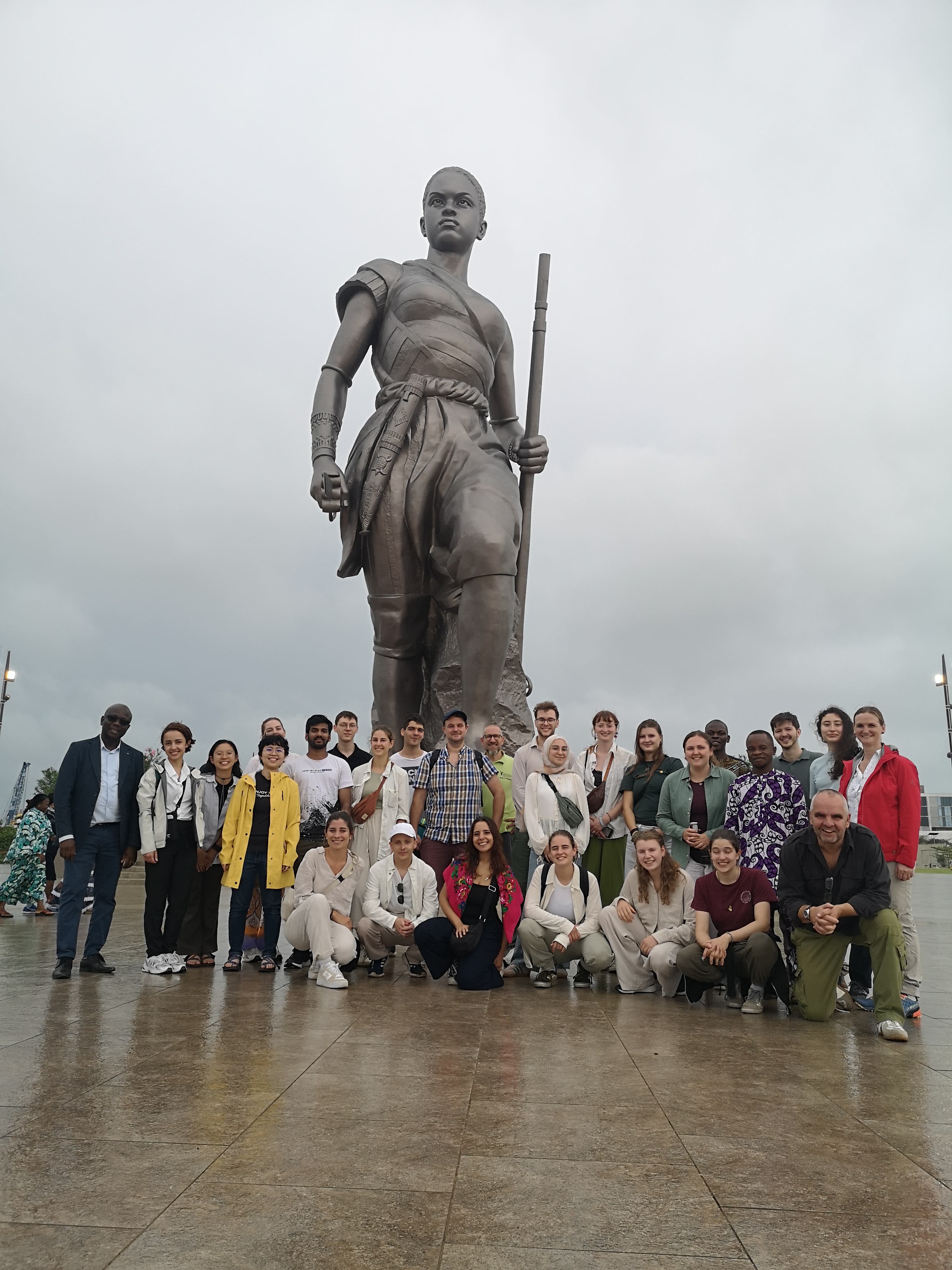
The contrast could hardly be greater: on the one hand, the campus of Rhein-Waal University of Applied Sciences in Kleve – clean lines, glass, concrete, knowledge set out in module handbooks; on the other, Cotonou, Benin’s economic hub – a cacophony of car horns, the scent of barbecues, damp earth, and mopeds zigzagging through the streets. Between them lie some 5,000 kilometres as the crow flies and a whole world of experiences, which 23 students and five lecturers from the Faculty of Life Sciences, Society and Economics are turning into their lecture theatre for twelve days.
This is no tourist trip, but an expedition into the concrete realities on the ground. At its heart lies something not found in any syllabus: a change of perspective. Professor Matthias Kleinke sums up the aim: learning that goes beyond theory. Testing assumptions, recognising nuances, sensing connections. What happens when an academic curriculum leaves the safety of the classroom and encounters the complex, contradictory, fascinating reality of West Africa? This journey provides the answers.
The university has maintained links with sub-Saharan Africa for many years. Benin offered a network that opened doors. A key figure is Achille Assogbadjo, who was at the HSRW as part of the Alexander von Humboldt Foundation’s prestigious 2023 Georg Forster Research Prize and is now a professor at the Université d’Abomey-Calavi. With him, a visit becomes an exchange: access to universities, projects and society – a conversation on equal terms rather than merely an item on the agenda.
The scientific bridge: the baobab. The baobab tree lies at the heart of the BaoFood and BaoQuality projects. These projects trace the entire value chain – ecology, genetic diversity, sustainable harvesting and the marketing of its nutrient-rich fruit.
The aim: to strengthen food security in arid regions and stabilise the incomes of local communities. Application-oriented research that combines ecology with economics – that is the DNA of the university. The field trip was deliberately designed to be interdisciplinary. Alongside students from almost all disciplines within the Faculty of Life Sciences, students from International Relations and the Gender and Diversity programme also took part. This mix provided a fresh perspective. Agriculture, development, traditions, climate change – not treated here as isolated topics, but as an interwoven network. The university, with its international outlook and practical focus, takes its mission out into the field for twelve days.
Around 45 kilometres north-west of Cotonou, on red earth and amongst palm trees, a project is taking shape that aims to reshape Benin’s future: the Glo-Djigbé Industrial Zone (GDIZ). Spanning 1,600 hectares, an industrial and logistics hub of rare ambition is taking shape through a partnership between the Beninese government and the pan-African developer ARISE IIP. The idea is as simple as it is radical: to put an end to the model of exporting raw materials cheaply whilst leaving the profits from further processing elsewhere. Benin wants to keep the subsequent stages of value creation within the country. Instead of raw cotton: ‘Towels for the world’. Already today, textile machinery is in operation and ceramic tiles are being produced – a practical lesson in development economics.
GDIZ takes an ecosystem-based approach: industrial facilities, commercial and residential space, logistics, its own container terminal, a lorry park, and electricity and water supplies. A ‘Guichet Unique’ brings together 13 authorities to streamline procedures. Key sectors: processing of cashews, soya and pineapples; textiles from spinning to garment manufacturing; wood processing; electronics assembly. A statement of economic sovereignty – and an invitation to re-examine old North-South narratives.
Tradition goes hand in hand with modernity. Anyone arriving in Benin with a large group quickly learns the protocol: first to the king, to announce their arrival and ask for his blessing. The courts are a riot of colour; the king sits beneath an elaborately decorated canopy – bearing insignia, not a ‘brand’ logo. Rituals form part of the proceedings: a shared shot of schnapps as a sign of respect.
These kings are not absolutist rulers. Their authority is social and communal. They mediate, arbitrate and offer advice – a system of justice that is easily accessible, culturally rooted and often closer to everyday life than state institutions. Their legitimacy is grounded in the spiritual: it is not hereditary succession that decides, but the oracle.
Just how complex these systems are was illustrated by a court featuring a king and queen who were not married and were never permitted to meet. The king had his own wife; the queen’s duties were primarily religious. Benin is a parliamentary democracy – and at the same time a country with a hybrid system of governance. Modern administration and traditional authority do not work against one another, but alongside one another. This creates local legitimacy and resilience that no central government alone can achieve.
Anyone coming from the Lower Rhine region initially looks upon Benin’s fields with some bewilderment. No neat rectangles, but rather diversity arranged in tiers: agroforestry. Orange trees at the top, with pineapples beneath; shade, moisture, biodiversity – a system that appears chaotic yet is highly efficient.
Markets are both a must-see and a textbook. There, ‘agricultural biodiversity’ is laid out before you: cassava, yams, maize; mangoes, coconuts, pineapples. Freshly cut sugar cane is sampled, and different varieties of pineapple are compared. Omnipresent: cashew trees, both as part of the landscape and as an export commodity.
Yet agriculture is under pressure. The rainy and dry seasons are shifting and becoming unpredictable; droughts and heavy rainfall are on the rise. In a country whose fields depend on the rain, this is a matter of survival. Development organisations such as GIZ provide support through water management and climate-resilient farming methods – adaptation as a daily practice.
The association pro dogbo e.V., founded in Kleve in 2002, builds a bridge to the homeland. In the Dogbo region, over 24 schools and training centres have been established in collaboration with local partners and the student initiative ‘Weitblick’ from Münster. In a bakery, a garage and a metal workshop, young people learn trades that provide a livelihood. Solidarity you can touch – and which shows just how closely the Lower Rhine region is linked to Benin.
Twelve days that linger in the memory – even beyond the picture-postcard scenes. Long journeys over bumpy tracks, rain pouring through the bus roof, minor health hiccups: everyday life on a trip through the tropics. What remains? For Professor Kleinke, two key insights. Firstly: the people of Benin. Their adaptability, zest for life and composure in the face of adversity. Nobody complains – a quiet contrast to the general mood in Germany.
Secondly: the group itself. Over twenty young people from eleven countries, travelling, learning, arguing, laughing. How effortlessly the world can function when you find a connection with one another. In times of polarisation, this tour group became a small alternative – proof that curiosity and respect are the strongest antidotes to prejudice. Ultimately, excursions like these are among the highlights of a degree programme. Although one professor’s suitcase didn’t arrive until the penultimate day, the real ‘baggage’ weighed more heavily on the journey home: a broader, more nuanced and permanently transformed view of the world – and of one’s own place in it.