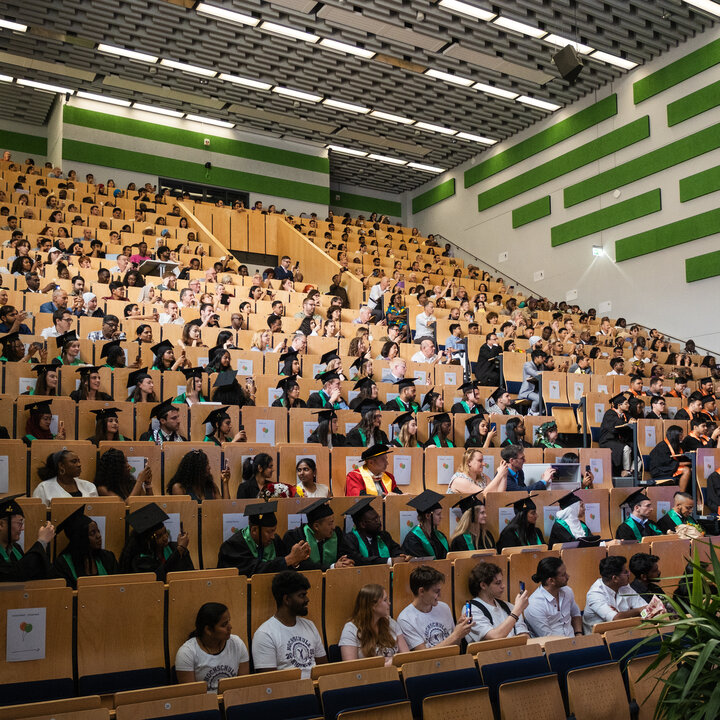
The event brought together a colourful and diverse group of around 100 students, alumni, researchers and university staff. The German participants were joined by guests from Sri Lanka, India, Norway, Poland and beyond – a fitting reflection of the global network that the degree programme has built up over time. The purpose of the evening was clear from the outset. Professor Matthias Kleinke, addressing both alumni from the first intake and current students, summed it up: “Our aim is to connect you, bring you together and celebrate the past 15 years.”
Over the course of the evening, Professors Florian Wichern and Matthias Kleinke traced the development of the faculty and the degree programme over the past 15 years, highlighting key milestones, growth and impact. They presented an unvarnished, data-driven account of the programme’s journey from its ‘chaotic’ beginnings to its current profile, underpinned by concrete figures and honest reflections. Prof. Wichern reported: “To date, we have around 227 graduates in Sustainable Agriculture – 104 men and 123 women.” He added: “We gave the 2018 curriculum a slight facelift and are planning for re-accreditation next year with a few adjustments.” With his characteristic dry humour, Prof. Kleinke commented on the programme’s continuity and change: “We’re changing a few slides – we’re fine-tuning the tractor that works well; we’re not rebuilding it, nor are we buying a new one.”
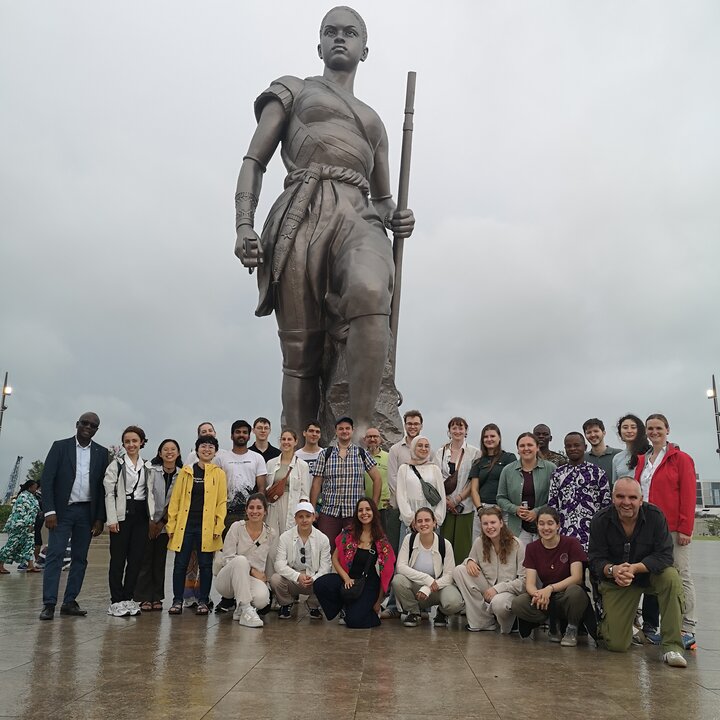
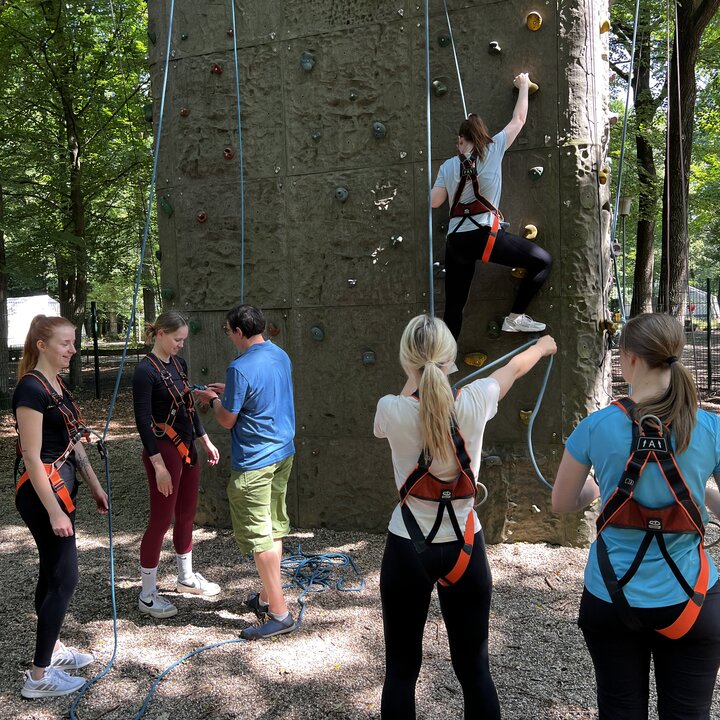
International field trips have proved to be a formative experience. Since 2015, when the first trip took place in France, the degree programme has maintained an annual tradition of study trips. “I’m glad we’ve managed to keep this up for 10 years now, with just a brief interruption in between, thanks to a little virus,” remarked Prof. Wichern. The most recent destination, Benin, marked “the first time we’ve made it to Africa”, thereby expanding the geographical and thematic scope of this practice-oriented learning. The memories are vivid: from “snow and freezing rain” in the highlands of Poland to a day in Albania when, as Prof. Kleinke recalled, “we were in the snow on a mountain peak one day and swimming in the Adriatic that evening”. Alongside teaching, research capacity has also grown significantly. Since 2021, the Sustainable Food Systems Research Centre has expanded to around 40 team members working across five continents, with a growing number of publications and active projects to its name, according to Prof. Wichern.
Growth has been steady, both in terms of enrolment figures and the increasingly international student body. Each intake comprises an average of 42 first-year students per year. A higher proportion of international students has characterised the most recent intakes; in the last two years, more than 80 per cent of students came from outside Germany. The faculty regards this global mix as an asset, but also aims to “welcome more students from Germany again” in order to strike a balance without diluting the programme’s cosmopolitan character. The outcomes following graduation highlight the programme’s impact. According to survey results, “60 per cent of respondents go on to study for a Master’s degree”, whilst “40 per cent find a job within four months”. The regional integration is also noteworthy: “A large number of people stay here in the region and find a job here too – 44 per cent, in fact.”
Once the presentations had finished, the atmosphere in the room shifted from slides to storytelling. At the buffet, which had been carefully prepared by student assistants, alumni, students and staff exchanged memories of fieldwork, discussed research ideas and reconnected with former fellow students. The organising team received heartfelt thanks for an evening that provided space for both reflection and new connections. Before saying their goodbyes, everyone gathered for a group photo and brought the evening to a close in the same spirit that has underpinned the degree programme for the past 15 years: being there for one another.