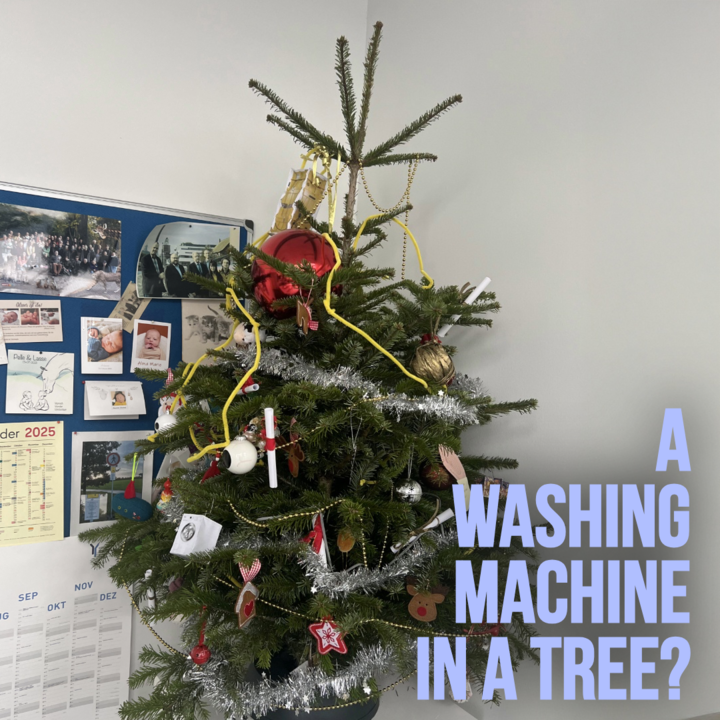
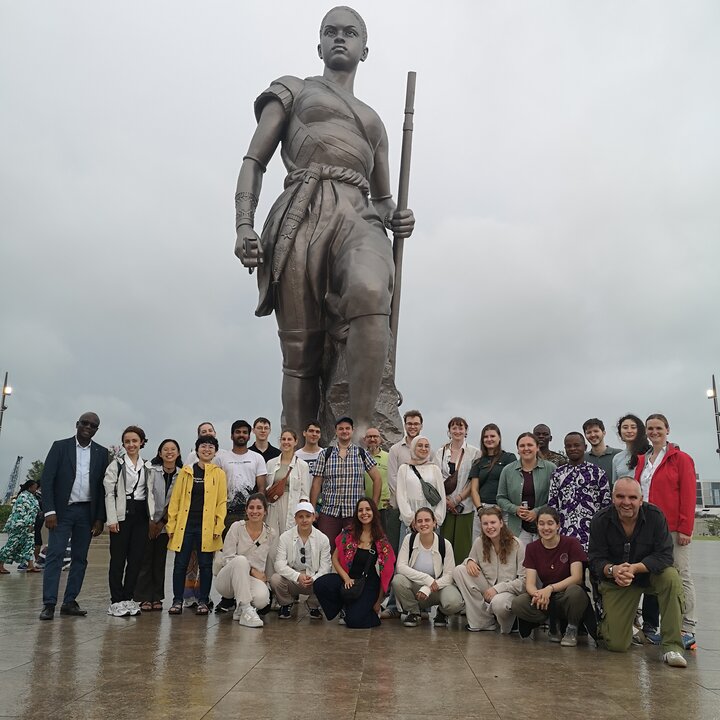
This is what one of the award-winning ideas looks like, which emerged in mid-October as part of Green Nudge Week 2025 at the Université Catholique de Lyon (UCLy). From 13 to 17 October, 21 students from six countries – including a delegation from the Faculty of Life Sciences at Rhine-Waal University of Applied Sciences – explored the city as a laboratory for sustainable behaviour, accompanied by lecturers from UCLy/ESQESE and in collaboration with the ONLYLYON tourism brand. The task: to design concrete, easily implementable ‘green nudges’ to promote more responsible city tourism.
The week followed a packed schedule: introductions to behavioural economics and the concept of nudging, an urban ‘Jeu de piste’ (treasure hunt), on-site observations, interviews with users, fine-tuning of graphics and a final pitch, during which six international teams presented their prototypes. The focus was on pressing issues in Lyon: safe routes for distracted pedestrians in the smartphone age, proper glass recycling in public spaces, the chaos surrounding e-scooter parking areas, the protection of local wildlife, and the question of how to stimulate interest in local products with short supply chains.
“The international collaboration was a new experience: so many different people, cultures and perspectives led to exciting discussions and a whole host of new ways of looking at things,” report HSRW students Gesa Günther and Olga Cazacu. And they add what is perhaps the most important sentence to sum up such a week: “We learnt a lot, laughed a lot and grew rather fond of Lyon.”
Learning in the city, not just about the city
At the end, all six working groups presented proposals that not only looked good but could also be put into practice in everyday life. Three of them received awards. Among the winning concepts was the project by bioengineering student Suzan Al‑Jaroudi, whose team focused on the bottles along the Saône:
“During the project week at UCly University in Lyon, our team developed an environmental initiative to tackle the problem of bottle litter along the Saône. Based on our field observations, we designed an interactive incentive: colourful recycling bins that light up and play musical notes when a bottle is dropped in. The idea behind this is to make recycling more visible, playful and appealing for locals and tourists alike, whilst at the same time strengthening their connection to the river and the city. The project was very enriching from both an academic and cultural perspective, and we are proud that it was awarded first place. “The experience was incredibly enriching and combined creativity, teamwork and sustainability.”
The two other working groups in which HSRW students were involved also received awards. Prof. Dr.-Ing. Rudolf Schumachers, programme director for Quality, Environment, Safety and Hygiene, was on site for the final two days: ‘What sounds like a competition felt, above all, like a marketplace of ideas – lots of small, clever interventions rather than one big solution.’
Nudging is the art of steering decisions in a more sustainable direction without coercion – through visibility, convenience or a little game. In a city like Lyon, which thrives on the river, on enjoyment and on a constant stream of visitors, rigid bans are often blunt instruments. Gentle nudges work where they connect with everyday life: on a walk along the river, in the impulse to pull out your smartphone, in the question of where to park your scooter.
Green Nudge Week showed how such impulses arise: through walking, observing, asking questions, and building and testing things together. The city responds when you listen to it – and sometimes it responds with music from a rubbish bin. For the students at HSRW, the exchange in Lyon served as a testing ground for international collaboration, applied sustainability and a promise of continued engagement: a return visit by the French students to HSRW is firmly scheduled for the end of March 2026. Then the roles will be swapped, and the setting will change. The tone, however, is likely to remain the same: friendly, welcoming – a nudge in the right direction.