

With us, you’ll study politics, economics and law in an international context. Seize this opportunity: start your English-taught Bachelor’s degree in International Relations, kick-start your international career and play an active role in shaping the future.
At a glance
Bachelor of Arts
Full-time
7 semesters
Restricted
Kleve
English
1 September
Why study International Relations, BA at Rhine-Waal?




What makes this degree programme so special?
Diogo Maia on the International Relations degree programme
A University, A Home
Student project
Career opportunities and prospects: Alumni share their experiences


Programme structure and content
A wide range of career opportunities is open to you, for example in the following areas:
- Local, regional and national government institutions, public administration and parliaments
- International organisations
- Political and management consultancy
- Journalism, public relations, market and opinion research
- Associations, political parties, foundations and non-governmental organisations
- Companies operating across borders
- Start-ups, lobbying, human resources
- Academia and research
By carefully selecting specific compulsory elective modules and practical projects, you can refine your profile with a view to your chosen career path.
Semesters 1–3: Fundamentals of International Relations
- Fundamentals of International Relations, Theories and Institutions
- Introduction to the international economy and international law
- Regional, particularly European, integration
- Peace and security policy, international cooperation
4th–5th semesters: Specialisation in International Relations
- Consultancy and Decision-Making
- Foreign and development policy and human rights
- Specialisation through specific elective modules and projects
6th semester: Practical specialist knowledge
- Semester abroad or Internship
7th semester: The final step
- Projects and simulations
- Career planning and strategies
- Bachelor’s thesis and Colloquium
To enrol on a Bachelor’s degree programme, you will usually need a qualification giving you access to higher education: a general university entrance qualification, a subject-specific university entrance qualification or a university of applied sciences entrance qualification (comprising both academic and practical components).
To apply for our Bachelor’s degree programmes, you need proof of English language proficiency at B2 level. We accept a German Abitur certificate or Fachabitur certificate as proof of B2 level. All applications from students with an international school education require one of the following language certificates. If you are unsure whether your certificate is suitable, please contact our Student Advisory Service – we will be happy to help.
You will also need proof of a pre-study work placement lasting at least 8 weeks, to be submitted by the time of re-enrolment for the 4th semester at the latest.
Application process
This degree programme has restricted admission. This means that there are only a limited number of places available. If the number of applications exceeds the number of places available, a selection process will take place. Places are allocated in accordance with the regulations of the federal state of North Rhine-Westphalia.
Following the selection process, you will receive either:
- a letter of admission or
- a letter of rejection.
If you are offered a place, you must enrol at Rhine-Waal University of Applied Sciences within the specified deadline (you will find instructions on how to do this in the letter of admission, which you can download from the university’s application portal). Only then is your place on the course secured.
Admission letters for degree programmes with restricted admission are usually sent out at the beginning of August.
Nummerus Clausus (NC)
For some degree programmes, admission is only possible with a specific (subject) A-level mark (Nummerus Clausus). The NC is set anew each year; figures from previous years serve as a guide.
Waiting list procedure
Sometimes, admitted applicants do not take up their place. In this case, the vacant places are allocated through the waiting list procedure.
This procedure usually begins in late August or early September. If you have applied by the deadline, you will automatically be included in the process.
Lottery
If places are still available after this, a lottery may also take place. The lottery procedure is used to allocate study places that remain available after the regular allocation process has been completed. Interested applicants can register for the lottery procedure via the university’s application portal by 1 September; places are then allocated by random selection from among all valid applications.
First, register on hochschulstart.de. There, you will be given an applicant ID (BID) and an applicant authentication number (BAN).
You can then use these details to apply via Rhine-Waal University of Applied Sciences’ Application portal.
First, register on hochschulstart.de. There, you will be given an applicant ID (BID) and an applicant authentication number (BAN).
You can then use these details to apply via uni-assist.

Campus
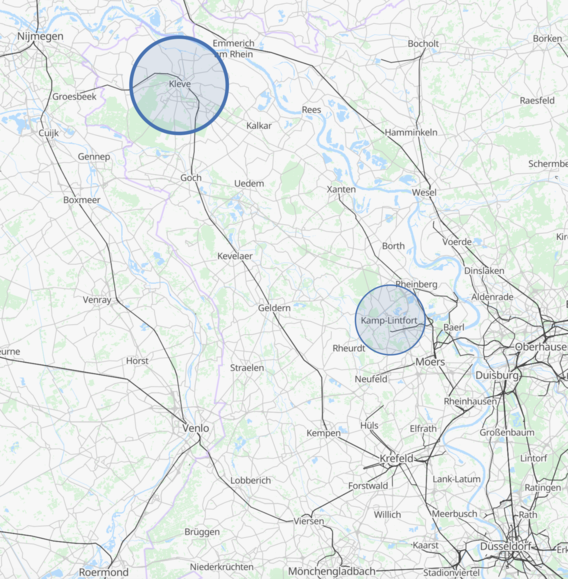
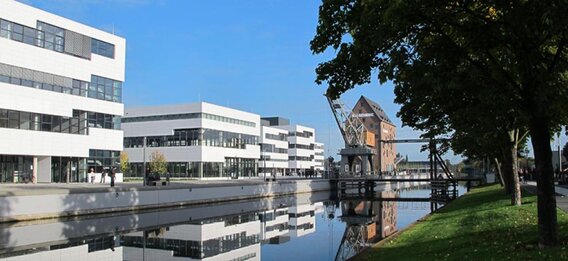
Kleve Campus
Related degree programmes



Student information

All about your studies
The Examinations Service is here to help you with the following matters:
- the final processing of your recognised academic achievements and Examinations
- organising your exam registrations via HISinONE
- Certificates of achievement, diplomas, final grade certificates and the certification of the aforementioned documents
- applying for approval to undertake your Bachelor’s or Master's thesis
- applying for your work placement or semester abroad
- the acceptance of your final thesis and its forwarding to the Examiners
- Issuing duplicate copies of your certificates and diplomas
Links and downloads
Examination catalogue/examination schedules
Examination regulations
page Examination Servicespage (including FAQs
) Examination Board page
General Services
Student Services can help you with:
- your application and the admission and selection processes for Bachelor’s and Master’s degree programmes
- Enrolment and Deregistration
- Re-registration for a new semester, leave of absence or exemption from mobility requirements
- matters relating to guest student status, second-degree student status or early-entry programmes
- changing degree programmes or joining a Semester of study at a higher level
- the issuance of official documents, such as Proofs of enrolment
- all queries regarding semester fees and payments
- Notifications to health insurance providers in accordance with legal requirements

Library
, University
Sports,University
Music, Language Courses