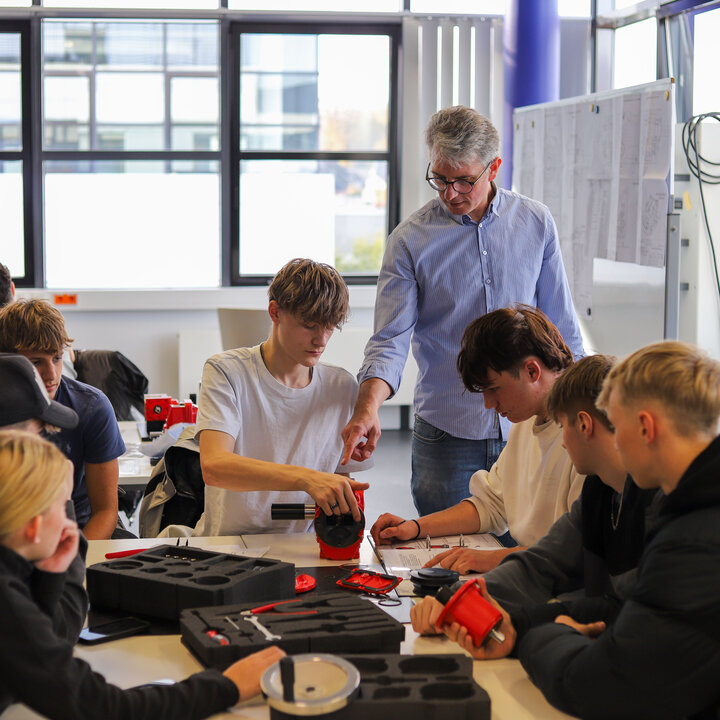
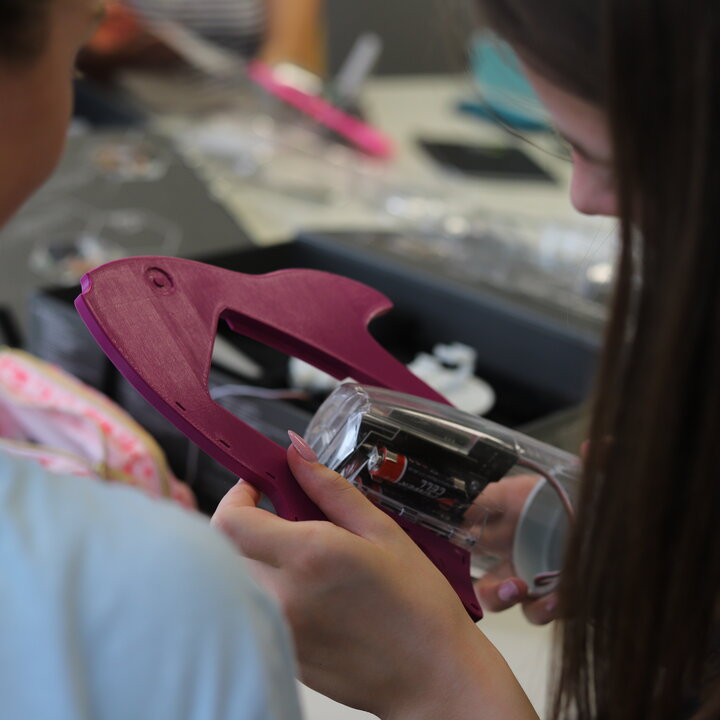
Together with Prof. Dr Alexander Struck, the pupils explored how a telescope works and, in doing so, experimented for themselves with various lenses of different ‘powers’ – as the young researchers called them – until they could see distant objects clearly through their homemade telescope. In the process, they also learnt which planets make up our solar system, why the North Star is always visible in the sky, and why the supermoon can be observed particularly frequently in the Lower Rhine region. Finally, the young researchers were given the chance to explore the sky through a real telescope. Barbara Maué, network coordinator of ‘Kinder forschen! – STEM Education for Sustainable Development at Rhine-Waal University of Applied Sciences’, told the children at the end of the event that, despite the many fascinating stars and planets in the sky, the Earth is ultimately the only planet on which humans can currently live, and that is why it is particularly important to take very good care of our home planet, the Earth.
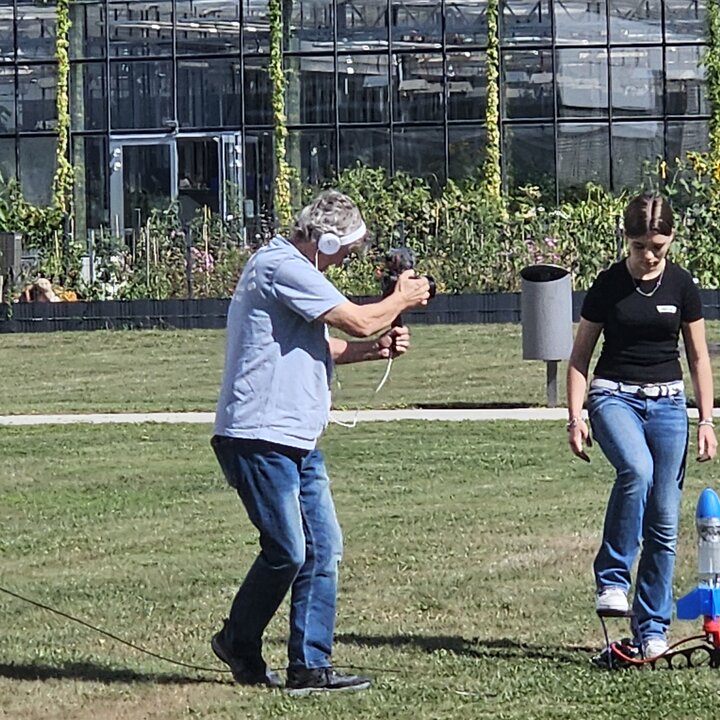
‘Adventure in Space – come along!’ is the motto of the MINTmachTage 2023, which thus ties in with the theme of the Year of Science, ‘Our Universe’. Back in the spring, teachers from nursery and primary schools had already learnt about various rocket designs, astronaut exercises and ideas for planetary exploration during a training course, and had explored these with the children through free-form research and research festivals. In collaboration with the German Aerospace Centre in Cologne, the network was able to organise an exciting digital and interactive space research show for several schools, with the grand finale taking place in the university’s physics laboratory.
Further information
1. Information on the name change of the regional network from ‘Haus der kleinen Forscher*innen’ to ‘Kinder forschen! – STEM Education for Sustainable Development at Rhein-Waal University of Applied Sciences’.
Since its foundation, the network has placed the child at the centre of its educational work – and with the change of name from ‘Stiftung Haus der kleinen Forscher*innen’ to ‘Stiftung Kinder forschen’, this is now even more literal and gender-inclusive. In recent years, the demands placed on educational specialists, teaching staff and management in nurseries, after-school care centres and primary schools have increased enormously, and childhood today is different from what it was ten or 15 years ago. The foundation, too, has continued to evolve, incorporating new subject areas and setting new priorities, such as education for sustainability, which now plays a key role in the foundation’s overall educational concept. Even with its new name, the network remains true to these ever-evolving objectives: the promotion of skills in mathematics, computer science, natural sciences and technology (STEM), as well as education for sustainable development, amongst children aged between three and ten. At the same time, the new name reinforces the clear and enduring core conviction: all children have a right to a good, early STEM education for sustainable development, regardless of their background, gender, religion or their parents’ income. The name ‘Stiftung Kinder forschen’ is intended to express this even more clearly.
Children today live in a world that is very different from that of ten or 15 years ago. Childhood is increasingly characterised by transformations and crises, occurring with ever-greater frequency and at ever-shorter intervals. Children are, of course, also aware of issues such as digitalisation, climate change, the energy crisis, pandemics and war. And it is to be expected that their entire future lives will be characterised by constant change. Through its educational programmes, the foundation supports educational specialists, headteachers and teaching staff in preparing children in educational institutions well for this life, taking their concerns seriously whilst at the same time showing them ways in which they can view the world with optimism. Just like adults, they need the crucial ability to deal constructively with change. They should find answers to their questions and experience a sense of self-efficacy by having an influence and being able to bring about change. The network improves educational opportunities, promotes interest in STEM subjects and provides professional development for teaching staff in this area.
2. Information about the nationwide ‘Stiftung Kinder forschen’
The charitable ‘Stiftung Kinder forschen’ (formerly: Haus der kleinen Forscher) has been committed since 2008 to improving the education of girls and boys of nursery and primary school age in the fields of science, mathematics, computer science, technology and Education for Sustainable Development (ESD). Through a nationwide professional development programme, it supports educational staff and teachers in fostering children’s spirit of discovery and providing them with expert guidance as they carry out research. In this way, the foundation aims to help improve educational opportunities, nurture the next generation of talent in the so-called STEM subjects (science, technology, engineering and mathematics) and enhance the professional development of educational staff.
The foundation’s partners are the Siemens Foundation, the Dietmar Hopp Foundation, the Dieter Schwarz Foundation and the Friede Springer Foundation. The Federal Ministry of Education and Research has been funding the foundation since 2008 – and has provided institutional funding since 2021. The foundation was established in 2008 as the ‘Haus der kleinen Forscher Foundation’ and was renamed the ‘Kinder forschen Foundation’ on 10 May 2023.
To reach nurseries, after-school care centres and primary schools throughout Germany, the ‘Kinder forschen’ Foundation works with over 200 local network partners, including the network at Rhein-Waal University of Applied Sciences.
The network partners are mainly educational institutions, towns and districts, trade associations and nursery providers. They organise and coordinate local training courses for educational specialists and teachers. Trainers then deliver the training courses in close consultation with the network partners.
The ‘Kinder forschen’ Foundation is based on the following view of children:
- Children possess a wealth of prior knowledge and skills
- Children want to learn of their own accord
- Children play an active role in shaping their own education and development
- Children are unique individuals
- Children have rights
These assumptions form the basis of our educational practice. Furthermore, the Foundation’s educational approach is shaped by the pedagogical principle of co-construction. This means that children and their educational support staff shape learning processes together. In successfully shaping such co-constructive learning processes, educational specialists and teachers view children as active creators of knowledge and culture. They need a very high level of willingness to communicate with the girls and boys, to adopt an inquisitive and reflective attitude towards their own learning processes and those of the child, but also the courage to bring their own open questions into the process.
3. Information about the Year
of Science The term ‘Year of Science’ refers to a theme which, since the year 2000, has been redefined annually by the Federal Ministry of Education and Research (BMBF) in collaboration with the ‘Science in Dialogue’ initiative, and which is examined and addressed from a variety of perspectives. Each Year of Science focuses on a scientific discipline or a current scientific topic. The Years of Science are intended to facilitate an exchange between science and the public: the aim is to foster greater public interest in science and empower people to engage in socio-political dialogue about research, whilst making developments in research more transparent and accessible. In addition to communicating the themes and scientific content, the Years of Science are designed to initiate and drive forward societal debates on developments in science and research. The Years of Science are characterised by numerous activities, including exhibitions, competitions and various dialogue formats. Since 2007, the BMBF has also been organising International Years of Science in cooperation with partner countries.