
An insight into the planning, planting and current state of research in a new agroforestry system comprising 71 standard apple trees and low-stem spindle trees.
HSRW – Anna-Lea Ortmann
An insight into the planning, planting and current state of research in a new agroforestry system comprising 71 standard apple trees and low-stem spindle trees.
The research project began in February 2024 at the Tropical Greenhouse with Teaching and Display Gardens at Rhein-Waal University of Applied Sciences (HSRW) in Kleve. A total of 264 annual plants and six different varieties of apple rootstock, ranging from vigorous to weak-growing, were planted. An apple rootstock is the root system, together with part of the stem, onto which a scion variety is grafted. A drought stress experiment was carried out from June to August 2024. The 256 apple rootstocks that survived were grafted in January 2025, with the assistance of LIKK e. V. (Landschaftspflege im Kreis Kleve), onto the cultivars ‘Zabergäurenette’ and ‘Rheinischer Winterrambur’ and transplanted to a nursery. In November 2025, a selection of the apple trees was planted on the four rootstocks – Bittenfelder, Antonovka, M9 T337 and G214 – in agroforestry strips on agricultural land belonging to two Agroforestry Real-Lab partnership organisations.
During a site visit organised as part of an agroforestry roundtable in June, farmer Hendrik van Aken from the Berkhöfel organic farm and Anna-Lea Ortmann, a PhD student at our agroforestry real-world laboratory, answered questions about planning, planting and the current state of research.
Anna-Lea: In the field trial, we are comparing rootstocks at sites with different soil types. The Berkhöfel site in Goch-Keppeln, with its clay-silt soil, offers the trees optimal conditions. In stark contrast to this is the site on the Monreberg in Kalkar: there, the soil is sandier and pushes the cultivated apple to its limits in times of climate change.
Hendrik: For me, there were actually several reasons. Over time, the rows of trees grow to form a windbreak. The first row is intended to break the wind, whilst the second row provides shade. On another side of the plot, a new hedge was planted as part of the Interreg VI project ‘Boundless Landscape’, in collaboration with the Nature Conservation Centre in the district of Kleve. Species including blackthorn, hazel, cherry plum, white willow and elderberry will, in the long term, form a ‘highway’ for beneficial insects. Thanks to the new hedge, the two agroforestry strips and an existing hedge, I have succeeded in connecting various biotopes. Another positive side-effect is that the field is now enclosed on three sides and better protected against extreme weather conditions.
However, the two tree strips here do indeed have an aesthetic quality as well. The land belonging to the farm is due to be redesigned. In future, the two tree strips will connect to a further avenue of fruit trees. And last but not least: I do not wish to lose the field’s agricultural status. That is why the two tree strips, which practically cross the field, have been laid out as agroforestry. I do not plan to fell the trees in future, but the option of converting the agroforestry strips into pure arable land should remain.
Anna-Lea: According to both scientific definitions and our ‘Agroforestry Real-World Laboratory’ definition, a single strip of trees on the site is sufficient: agroforestry means the combination of arable farming/permanent grassland with woody plants and/or livestock rearing on a single site. And that is how it was implemented here: 71 standard and dwarf spindle apple trees were planted on the plot in two tree strips, each approximately 175 metres long. On the second trial plot, there are 55 trees in a single strip stretching 390 metres. An additional tree strip or hedge may be planted here in subsequent years as required. This is because agroforestry systems are sometimes planted in stages, for example to incorporate the experience gained into the establishment of further strips.
Anna-Lea: The layout was based on the ‘Bleiber-Weicher’ system. The ‘Bleiber’ are the standard trees, and the ‘Weicher’ are the low-stem spindles. In the field trial, the standard trees are planted 14 metres apart. In the first row, there are five low-stem spindle trees between each pair of standard trees. We expect the standard trees to reach a crown diameter of up to 12 metres, so the 14-metre spacing gives us slightly more room than is usual for a pure standard tree plantation. Nevertheless, in about 10 years’ time, the first low-stem spindle trees will have to make way for the standard trees – starting with the spindle trees growing directly next to the standard trees, as these would impair the standard trees’ crown development in the long term. If one looks at empirical evidence from Bleiber-Weicher systems (of which there are not many), common mistakes in establishment and management include: firstly, planting distances that are too narrow; and secondly, removing the suckers too late. Here, we are testing exactly when and how the removal of the suckers should sensibly take place in our case; this is therefore also part of our joint practical research. The spindle trees mature earlier, but also yield earlier and bridge the period when the standard trees are not yet producing. In the second row, only standard trees were planted for comparison.
Hendrik: The tree strips were positioned so that there is a headland of almost 18 metres on either side. I have sown grassland in the tree strips. The area is currently being kept short by sheep grazing. The wild fruit from the newly planted hedge is to be harvested and processed in the farm’s own distillery.
Anna-Lea: It will take a few more years, however, before we can harvest a decent crop of apples: about 15 years for the standard trees. For the dwarf trees, we expect a full yield after about five to six years.
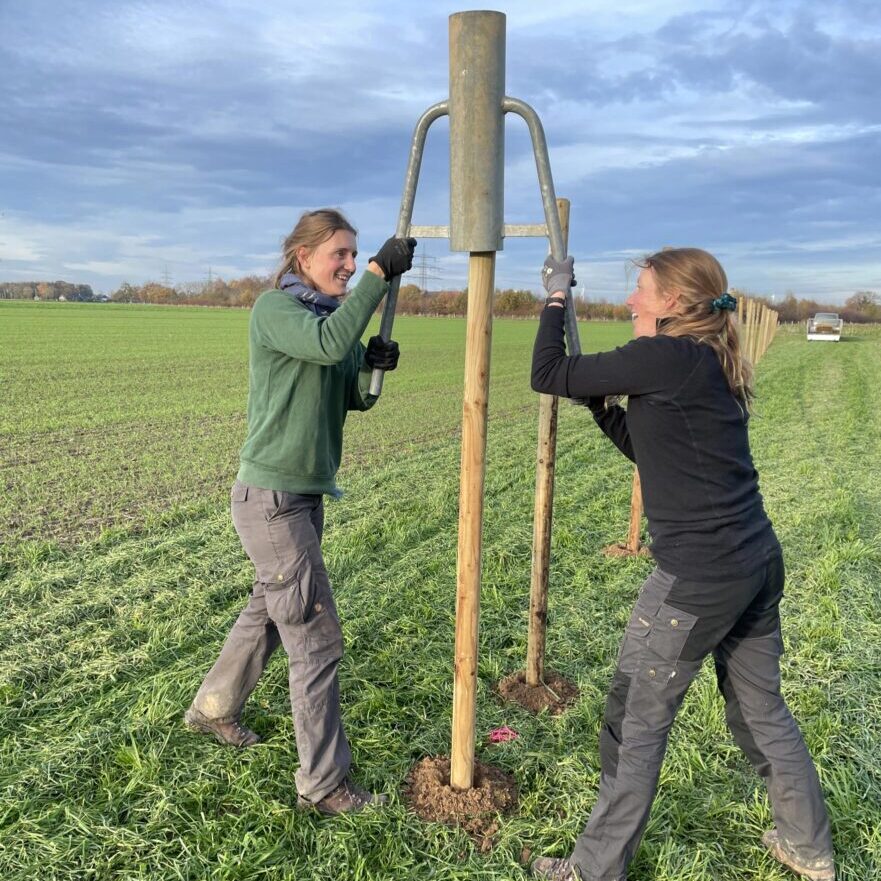
Putting up the fence.
Anna-Lea: Protection against browsing was a key part of the planning. Sheep love the leaves and, in particular, the young apple tree bark. Then there are roe deer and hares. So we need a multi-faceted browsing protection system, which is, of course, also a cost factor. Whilst for the standard standard-stem row we fitted conventional individual tree protection consisting of Knappfix plastic trunk guards, Casanet wire mesh and two stakes, the low-stem spindles in the Bleiber-Weicher row required a different system. To protect the spindles with their lower crown bases, we decided to fence off the Bleiber-Weicher strip as a whole. We erected the fence – as a barrier against roe deer and sheep – using wooden posts.
Hendrik: Exactly, in the end we opted for a wire mesh fence, i.e. the pasture fence consists of thin wires that conduct electricity. But be careful: if vegetation grows right up to the bottom wire, it will no longer conduct the electricity effectively. At a height of 30 cm, the lowest strand is set just high enough to prevent sheep and roe deer from slipping under the fence. At the same time, it is high enough to allow the sheep to graze close to the tree trunks. This saves work when it comes to managing the undergrowth.
Anna-Lea: At least during dry weather and periods of drought – particularly in the first two to three years – the trees should be watered and the tree pits kept clear to reduce competition for water with the undergrowth. The current drought is making it difficult for the trees to establish themselves. Hendrik now has extra work involved in watering them.
The young trees need to be trained – that is, pruned – during the winter. Once the standard trees have grown into mature trees, maintenance pruning every few years is sufficient – provided that the apple trees were trained as young trees to have a crown structure suitable for cultivation. As is usual in agroforestry: more work is required at the start to establish the trees, whilst yields only come later. It is important to take the long-term labour requirements, as well as labour costs, responsibilities and the availability of service providers, into account right from the planning stage.
Hendrik: Regarding keeping the tree pits clear: from my experience with existing agroforestry strips on other plots, I find that weeding by hand is the best solution, at least once, if not twice, a year.
Hendrik: Ideally, you should clear a circle of about one metre around the trunk of a standard tree, and about 50 to 60 cm around the trunks of dwarf trees. Grass in the root zone of young apple trees has two major drawbacks: it smothers the roots and steals water and nutrients.
Anna-Lea: Following studies on the rootstocks – which were still ungrafted in 2024 – under drought stress in the HSRW’s tropical greenhouse, the rootstocks grafted in spring 2025 are now being studied over the long term under cultivation and field conditions. The main focus is on how the trees develop on the various rootstocks in different site conditions, and which rootstocks are better able to withstand periods of drought in the long term. With the two rootstock varieties, Zabergäurenette and Rheinischer Winterrambur, we can also make observations on various combinations of rootstocks and scions.