
Since 2024, Pedro Ribeiro has been visiting primary schools with the STREEN reading app. What do the children themselves say about using STREEN?
HSRW – Luisa Rottes
Since 2024, Pedro Ribeiro has been visiting primary schools with the STREEN reading app. What do the children themselves say about using STREEN?
Since 2024, the team led by Pedro Ribeiro, a research assistant in the sub-project ‘Digital Showroom: Assistance and Participation’, has been visiting primary schools in the Lower Rhine region with the STREEN reading app. The team’s starting point and motivation stem from the inadequate reading skills of primary school children. The specially developed app aims to change this and to involve children in Years 3 and 4 directly in the app’s ongoing development process. To this end, the app has so far been used at three schools as part of LeseLab working groups, usually for one school term at a time.
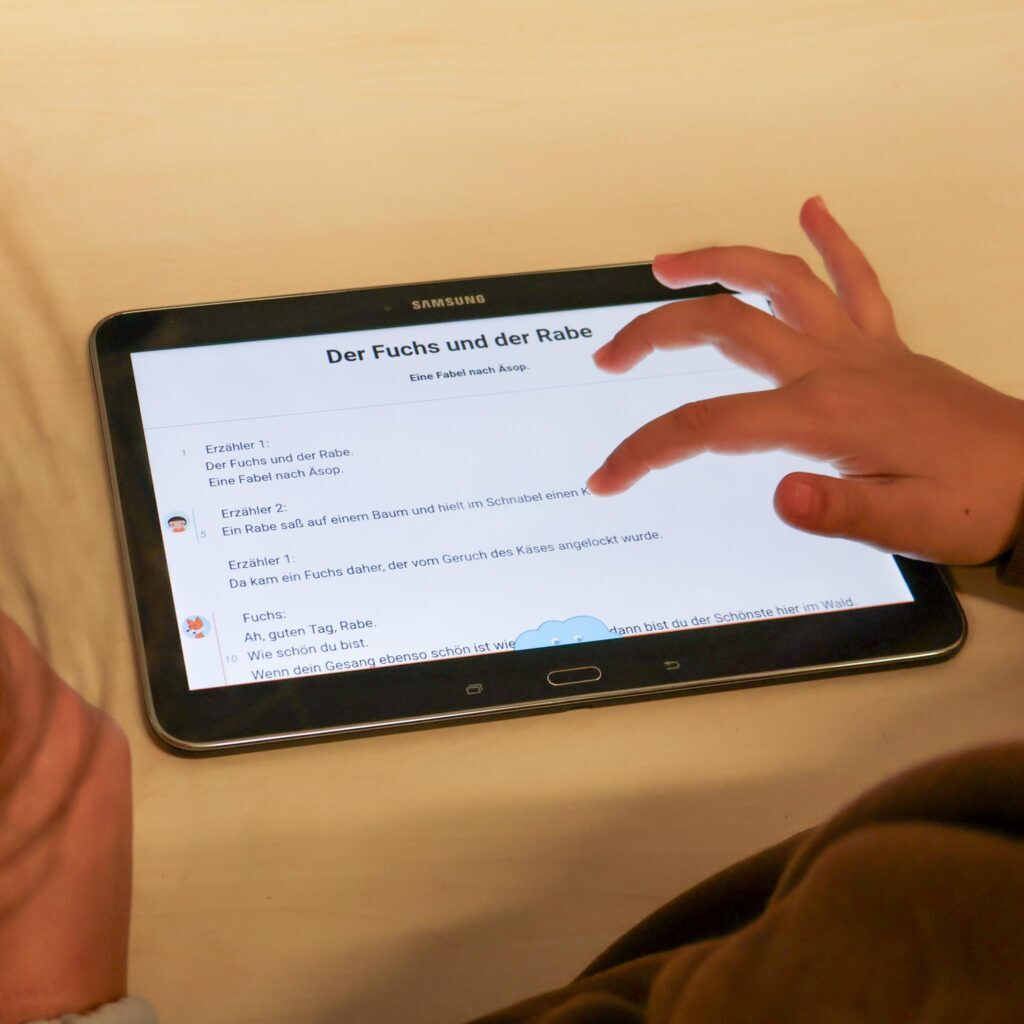
In the STREEN app, selected stories can be read and customised. This means that the children read a story in small groups and create suitable images. For example, if a story featuring a fox and a raven is being read, corresponding images of the fox and raven, as well as backgrounds and effects, can be selected from the app’s gallery. A new image is created for each section of the story. The story is then read aloud in what is known as a ‘reading theatre’, and the images created are displayed in the classroom on a screen or smartboard. If the small groups create different images for the same passage of text, this encourages discussion about the story they have read.
What do primary school children themselves say about working with STREEN? We asked the LeseLab club at the Ernst-Reuter School in Kamp-Lintfort.
“I’m reading a bit faster and learning that reading can actually be fun sometimes,”
sums up one child, describing what has changed since joining the reading club. Another adds: “Reading is now … cooler for me. And easier.” In particular, the children emphasise the feature of creating their own stories, working independently on a tablet and reading out different roles in the reading theatre. Their vocabulary is expanding through working with STREEN –
“I understand more words that I didn’t know before” –
and their self-confidence is boosted, as many children feel more confident reading aloud:
“The way I read aloud has changed, and so has my volume.”
Alongside active reading practice, another key objective is to further develop the app using feedback from the children. This feedback is actively gathered within the club through observations, feedback sessions and brainstorming sessions.