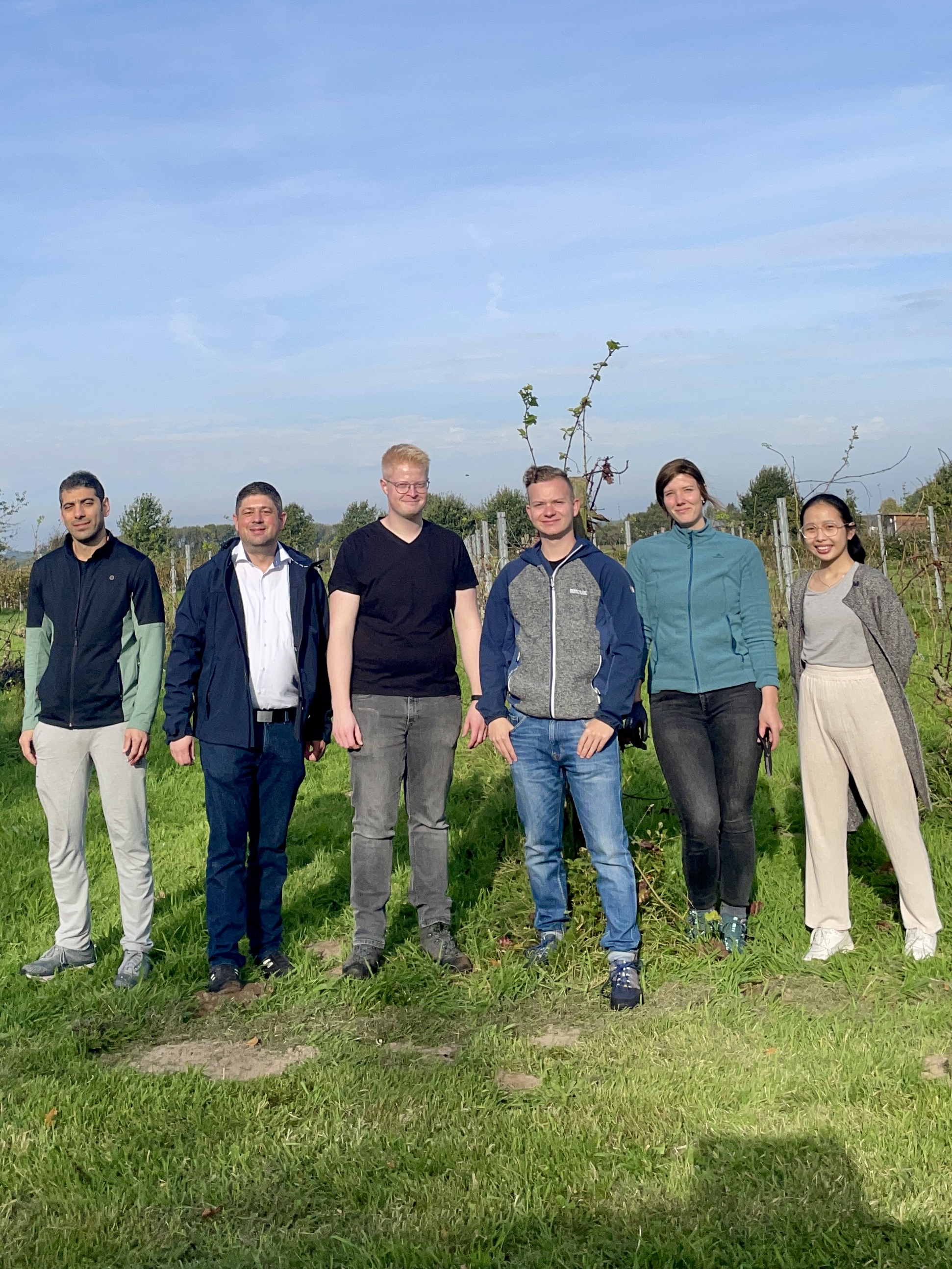
Master’s students produced a rosé wine from grapes sourced from a Dutch vineyard, which had been donated to them for their research project. Despite the low sugar content, they succeeded in producing a wine of acceptable quality, whilst experimenting with various methods and storage conditions. The project highlights the programme’s emphasis on practical training and its regional ties. Next, the aspiring food scientists plan to produce a brandy from the leftover grapes.
Prof. Dr Florian Kugler, Head of the degree programme and project supervisor: “Due to the slightly low glucose content, the winegrower was unable to use the grapes himself and therefore donated them to the degree programme for use as part of the so-called ‘Applied Research Project’, an integral part of the Master’s degree curriculum. We were delighted to receive this donation, as it enables us to offer students the opportunity to take charge of the raw material’s journey from harvest to end product largely on their own initiative; furthermore, it once again highlights the close, reciprocal ties between the Master’s programme in Food Sciences and the region.”
The students’ task was now to produce a palatable rosé wine from the raw material, despite its relatively low glucose content. Various treatment methods employed during production, as well as different storage conditions (in stainless steel or wooden barrels), yielded interesting results at an initial tasting. The students were impressed not only by the beautiful light red hue, which came into its own particularly after the layer filtration of the fermented must, but also by how clearly the woody notes were perceptible due to the fermented must being aged in an oak cask. Prof. Kugler: “I am delighted by the great commitment and enthusiasm with which the students are carrying out this wine project, and to do so in a region that has only begun to make headlines for its wine-growing in recent decades. As a native of southern Germany who grew up in a wine-growing region of Württemberg characterised by sloping vineyards, I was rather hesitant to use the term ‘vineyard’ at the start of the project, as the vines that the students were permitted to harvest are situated on a fairly flat area and are just about 13 metres above sea level. In fact, however, the term ‘vineyard’ is also used for flat areas.”
The project is also supported by Dr Marc-Kevin Zinn, who offers advice and practical assistance, drawing on his experience of alcoholic fermentation in the production of spirits and his additional qualification as a fine spirits sommelier. In a subsequent stage, he will work with the students to mash and ferment the grape marc residues and produce a grape marc brandy from them. We can’t wait to see the result!