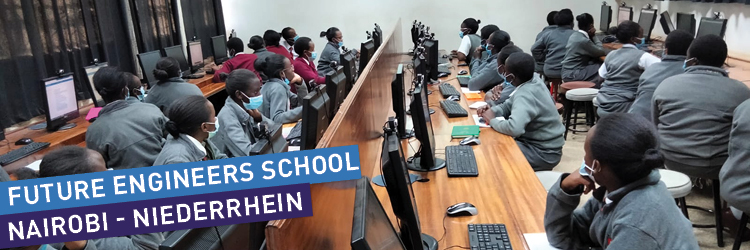
At the end of last year, 30 technology-enthusiastic schoolgirls from ‘Kenya High School, Nairobi’ took part in the first series of digital workshops organised by Rhein-Waal University of Applied Sciences. During the live video link-up from the Lower Rhine to Nairobi, the pupils learnt some of the basics of engineering.
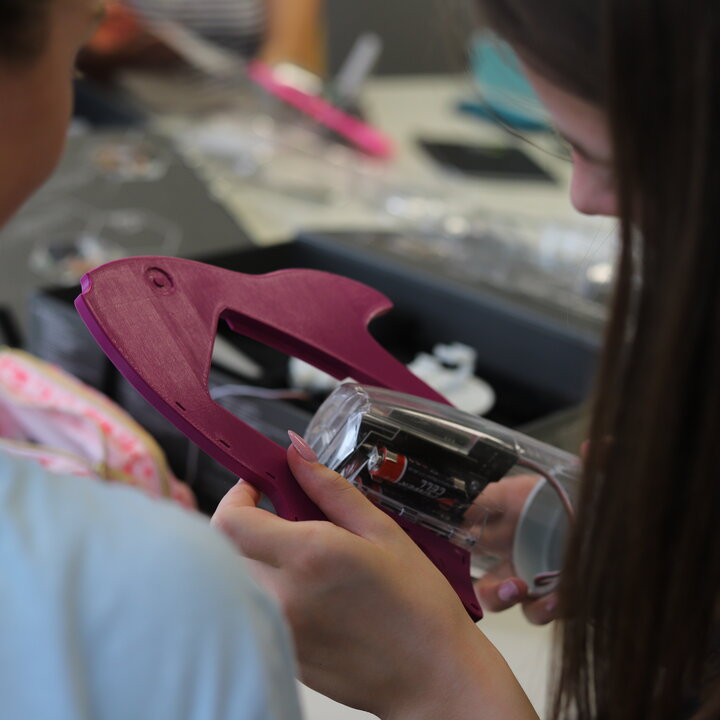
“Creative and interesting” and “a chance to make the world a better place” – the participants in the first “Future Engineers School” are thrilled by the fascinating insights into the world of engineering. At the end of last year, 30 technology-enthusiastic female secondary school pupils from “Kenya High School, Nairobi” took part in the first series of digital workshops organised by Rhine-Waal University of Applied Sciences. During the live video link from the Lower Rhine to Nairobi, the pupils learnt how components are manufactured, how the “Internet of Things” (IoT) and automation work, and how to build their own soft robots. Over the course of a varied seven-week programme, research assistants and professors from the Faculty of Technology and Bionics, supported by colleagues from the Faculty of Life Sciences, provided insights into their work and demonstrated the wide range of activities involved in an engineer’s role. Last but not least, there was also useful information about studying in Germany and very personal insights from a student of biomaterials science.
Background:
Since 2017, the Faculty of Technology and Bionics has been running a series of workshops for young schoolgirls in the Lower Rhine region to inspire more women to pursue STEM studies. The exchange with the Kenyan school was the first of its kind and took place as part of a project funded by the German Academic Exchange Service (DAAD). ‘Networking and Training Measures Based on the Model of the German University of Applied Sciences’ is a collaborative project involving five universities (Rhein-Waal, Flensburg, Reutlingen, Mainz, Furtwangen) led by Prof. Dr Oliver Serfling, Professor of Economic Policy and Development Economics at the Faculty of Society and Economics at Rhein-Waal University of Applied Sciences, and ran for four years. The overarching aim is to support the establishment of the first university of applied sciences in Kenya in order to meet the local demand for highly qualified, practical training for young people.