
Design and Interaction, MA
For digital media developers
Are you interested in both new technologies and the field of design? Can you picture yourself studying in English in a creative, interdisciplinary environment? Then this master’s degree programme is perfect for you as it weaves together the study of digital design, user-oriented design and media technology into a single degree. Here you’ll explore ways how to convey complex information visually, design interactive systems and scenarios, and tell dynamic and multi-layered stories through different digital media. So, come hone your skills and push your creativity to its limits.
At a glance
Master of Arts
Full-time
3 semesters
Unrestricted admission (no Numerus Clausus)
Kamp-Lintfort
English
1 September
1 March
Why study Design and Interaction, MA at Rhine-Waal?
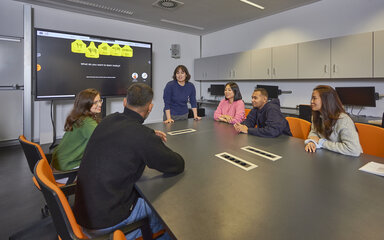
What makes this degree programme special?
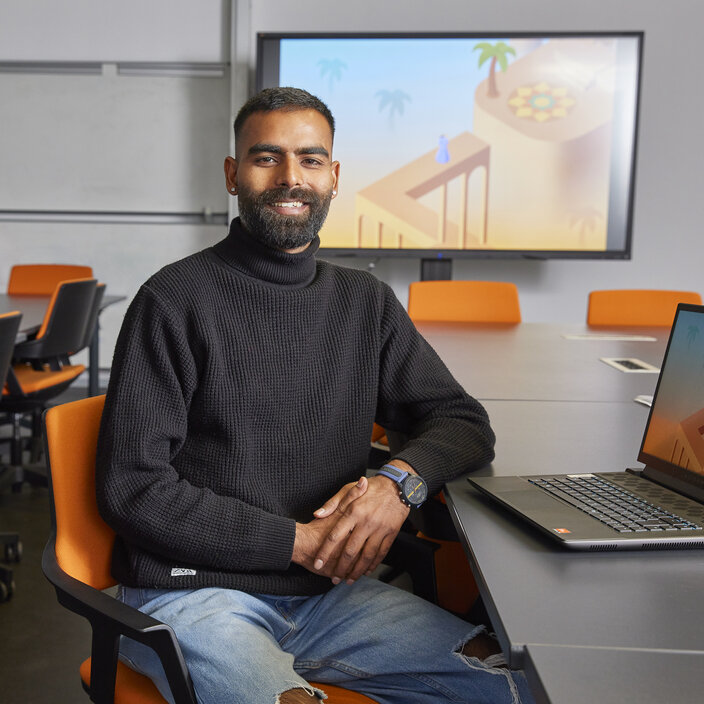
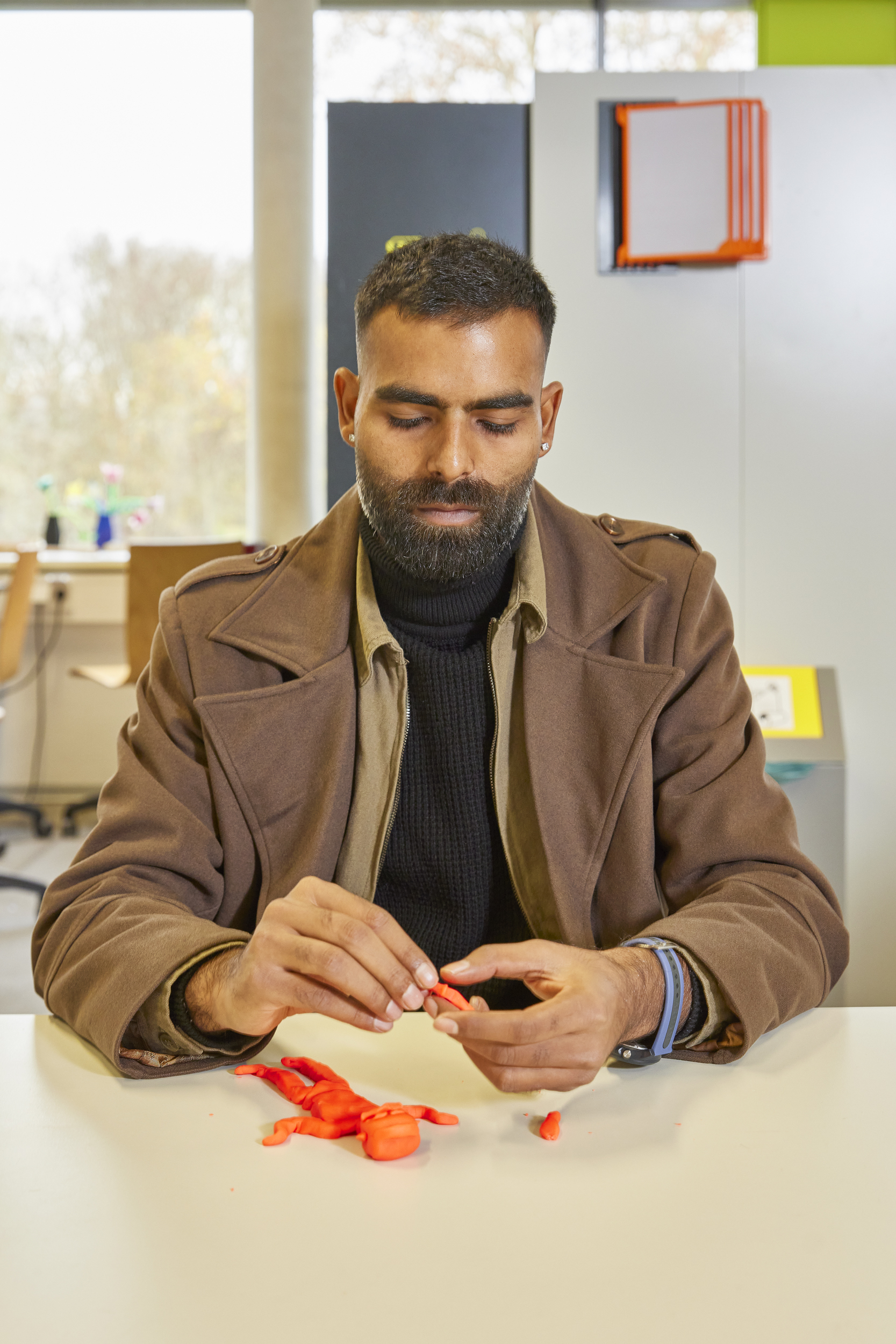
Devprakash Chiyyarath Manoj shares his experiences.


Programme structure and content
The world of design and interaction is constantly evolving, with the boundaries between individual disciplines becoming increasingly blurred. Few fields are changing as rapidly through new media, tools and emerging technologies. After graduation, you’ll be ready to work on innovative products, services and new forms of interaction, developing into a creative specialist in user experience.
To prepare you for this fast-moving field, the programme helps you build a broad and versatile skill set while developing your own professional profile. You’ll learn to approach challenges with confidence and critical thinking, preparing you for a wide range of career paths – whether freelance or employed, in an agency or a company.
The design, conceptual, methodological and technological skills you gain throughout your studies will prepare you for roles at the intersection of design, technology and creative thinking – exactly where new ideas, tools and forms of communication emerge.
Your Master’s degree takes three semesters to complete. Right from the start, you’ll take part in intensive workshops where you can assess and reflect on your current skills and get a clear overview of what to expect throughout the programme.
The first two semesters focus on project-based seminars. You’ll work on projects suggested by the programme or choose your own topics. Along the way, you’ll learn how to understand the wider context, develop concepts and solutions, present your ideas clearly and turn them into prototypes – both creatively and technically. Additional modules will help you build key skills in design, methodology and technology. In your second semester, you’ll also receive intensive support as you take the first steps towards your Master’s thesis. You can also choose two elective modules from other subject areas. This gives you the specialist knowledge you need for your projects, lets you explore your own interests in greater depth and helps you work towards your career goals.
These modules are available during the first two semesters:
- Advanced Design
- Human-Computer Interaction
- Digital Culture and Ethics
- Creative Computing
- Workshop Thesis Development
- Electives
In your third semester, you’ll focus on your Master’s thesis. This usually combines the practical development of a prototype with a design and/or technical focus and a written component. Alternatively, you can choose to complete a research-based theoretical thesis without a practical component.
One of the key advantages of studying Design and Interaction in English is the programme’s international focus.
Design and digital technologies are globally connected – users, tools, trends and challenges cross borders and languages. Studying in English prepares you for international projects, multicultural teams and a global working environment. Working with fellow students from different countries and backgrounds will broaden your professional perspective and strengthen your intercultural skills.
In fields such as user experience, interface design, creative computing and human-computer interaction, English is not only the language of the workplace but also the standard language of research, professional practice and development. Throughout your studies, you’ll naturally build the confidence to communicate and work effectively in an international environment.
Why do I have to submit a project idea?
The project idea helps us to assess whether you – for example, with a design background – have an interest in and skills relating to digital media or human-centred technologies. Conversely, applicants with a technical background can demonstrate whether they have creative potential or an interest in design processes.
I’m a design professional, proficient in Photoshop and perhaps another programme, but I’ve had little to do with digital media or technologies. Is that enough?
No. Your application should demonstrate that you actively engage with concepts and the development of digital media and interactive technologies – whether in practice or in theory.
Does the description of my project idea have to include images?
No, images are not compulsory – but they can help to illustrate your ideas more clearly.
Do I have to implement my project idea later in the Master’s programme?
Not necessarily. The idea should, in principle, be feasible within the Master’s programme, but you are not bound by this. Your interests may evolve over the course of your studies.
What are examples of good or less convincing project ideas?
An unsuitable example would be a technically extremely complex idea that you are unlikely to be able to realise. If, on the other hand, you have experience with AI, for example, you could combine an exciting design question or an innovative interaction approach with AI – what matters is feasibility and creative potential.
How many project examples should I submit?
Enough to give a clear picture of your design skills – at least three, but no more than ten projects.
Are the layout, language and design of the documents also assessed?
Yes. The design, linguistic expression and visual presentation of your project ideas are taken into account in the assessment.
I studied a subject without any design content, but have done a lot of design work in my spare time. Can I still apply?
Unfortunately not. Although we welcome a diverse range of backgrounds, you must be able to demonstrate that you have already successfully completed academic modules with a design component.
I studied architecture – can I apply?
Yes, you can apply. It is important that you can demonstrate a particular interest and skills in the field of digital media.
I studied Media Informatics – is that sufficient?
The Media Informatics curriculum at HSRW contains sufficient design elements – your degree is therefore suitable. Other curricula are assessed on a case-by-case basis, but usually meet the requirements as well.
Can I submit my documents via uni-assist?
No. The correct email address for submission is MDI-FKU-Aptitude(at)
Admission is determined through an application process.
To be eligible for the Master’s programme in “Design and Interaction”, you must meet the following requirements:
- A first professional degree (e.g. B.Sc., B.A., Diplom or equivalent) from a relevant Degree programme comprising at least 210 ECTS credits or seven standard full-time semesters in a design-related subject. Alternatively, you may also be admitted with a degree in Computer Science or related subjects, provided your studies included design-related content. If you have only studied for six semesters (at least 180 ECTS), you must provide evidence of additional coursework or complete it during your Master’s programme – in consultation with the programme.
- If you do not yet have a final grade certificate, a provisional final grade certificate and/or a current transcript of records or other relevant documentation will suffice.
- You must also provide evidence of sufficient English language proficiency at level B2 of the Common European Framework of Reference (CEF) or equivalent.
- You must also demonstrate your artistic and creative aptitude relevant to the programme. Further information on the aptitude assessment can be found here.
Detailed information on the admission requirements can be found in the Examination regulations and the aptitude assessment regulations for the degree programme.
Application process
Aptitude test
To be admitted to the Master’s degree programme in Design and Interaction, you must successfully complete an aptitude test in addition to the standard application procedure. This assessment evaluates whether you possess the personal and academic aptitude required for the degree programme.
Important: You can only be admitted to the degree programme if you pass the aptitude assessment and also apply via the applicant portal.
Insights



Campus
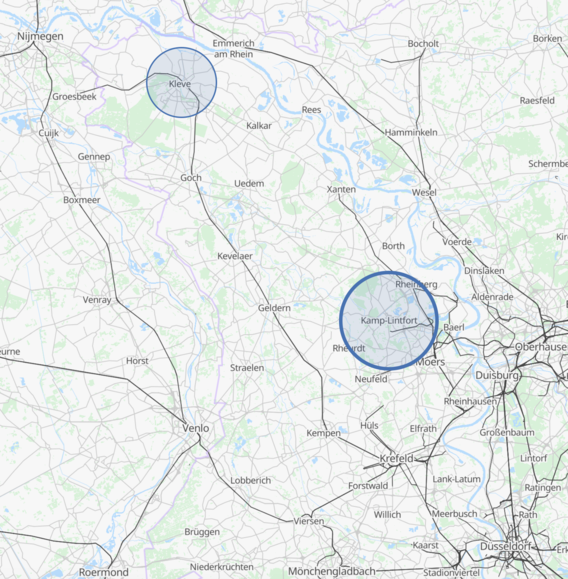
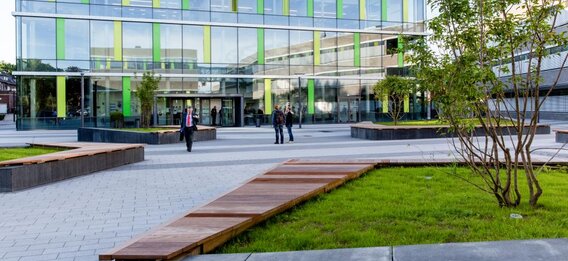
Kamp-Lintfort Campus
Related degree programmes

Student information

All about your studies
Bridging courses are intensive courses designed to help you prepare for your degree before your studies begin. Participation is voluntary and no credit points are awarded. You can use the courses to refresh your existing knowledge and fill in any small gaps before starting your studies.
The courses are held before the start of the winter semester, usually in September. The upcoming course programme will be available at the link below in due course.
The office of the examination board is the central point of contact for all questions and inquiries regarding examinations at your Faculty (Faculty of Communication and Environment).
Office of the Examination Board
On their website you will also find an overview of your first points of contact for various examination-related matters.
Overview
There is also a central Examinations Service for the entire University. It handles the administrative implementation of decisions made by the Examination Board and manages examination-related processes.
Examination Service
Your Faculty of Communication and Environment and the University’s central services offer advice and support throughout your studies – whether you need help with academic matters or personal challenges.
Advice and support services offered by the Faculty
Do you have any questions about your degree programme or exam-related matters? Are you experiencing issues with lecturers, or are you looking for personalised advice? Here you’ll find an overview of the key points of contact within the Faculty of Communication and Environment.
Services offered by the Faculty
Central advisory services
The university’s central advisory services are here to support you with a wide range of topics during your studies and beyond. Whether you need help with finding academic literature, developing a business idea, dealing with mental health challenges, studying with children or a disability, or have questions about anti-discrimination, you’ll find the right contacts and support for different situations in your studies and everyday life.
Central student services
The Central Student Services team is your main point of contact for organisational and administrative questions about your studies. They can help you with applications and admission, enrolment and deregistration, re-registration and leaves of absence, changing degree programmes, as well as questions about semester fees, certificates or health insurance notifications.
Contact
Programme Assistant
Ms Elena Quasten
Tel: 02842/908259680
elena.quasten(at)
Office hours (room number 02 00 455)
Monday–Thursday: 10.00–12.15 and by appointment
Monday, Tuesday, Thursday: 13.30–15.00 and by appointment