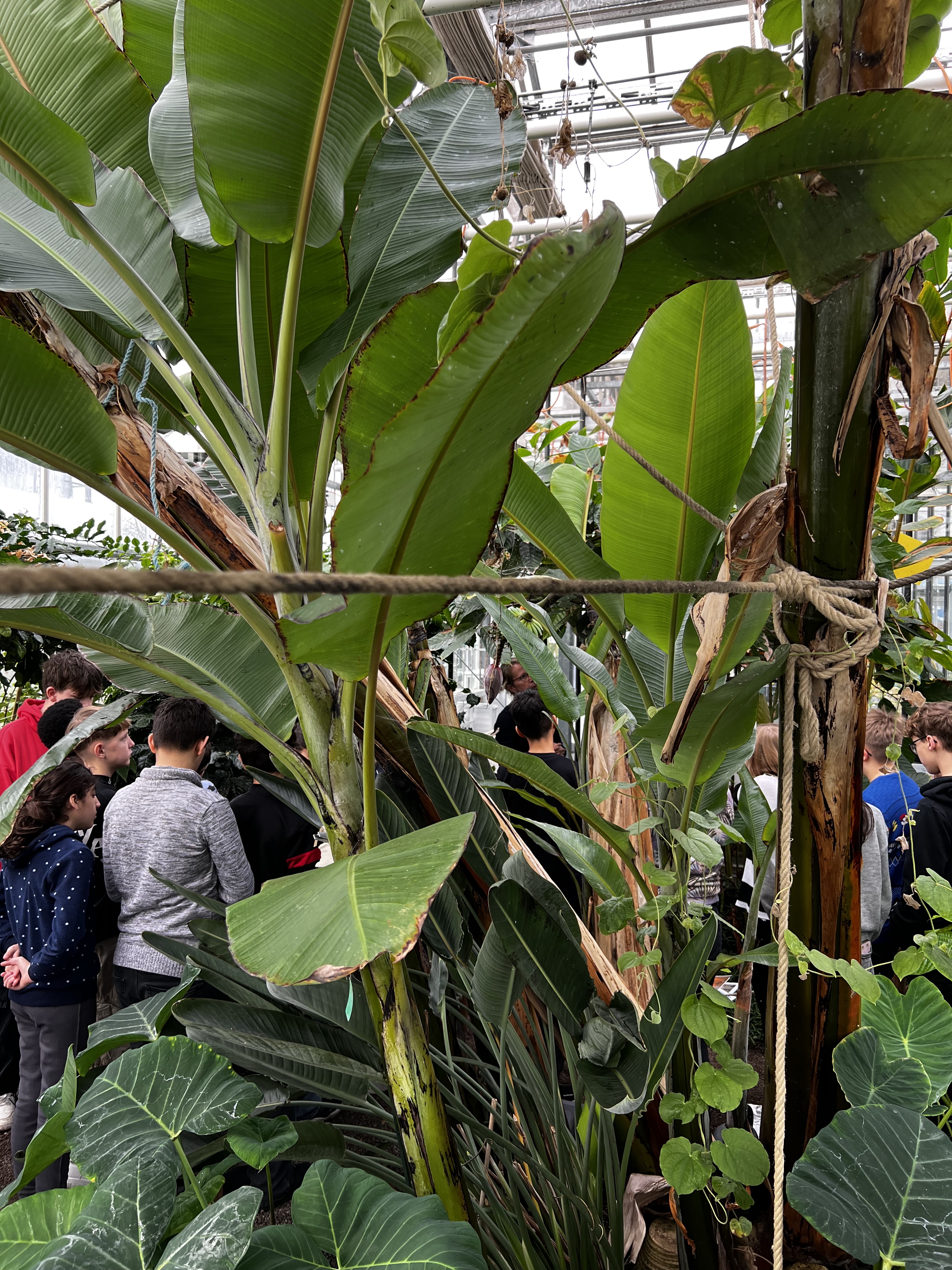
On a rainy February morning, the chill of the Lower Rhine swept through the streets of Kleve, but anyone who stepped inside the Tropenhaus at Rhein-Waal University of Applied Sciences instantly left winter behind. Here, a different climate prevailed: warm, humid air caressed the skin, whilst the earthy scent of plants and damp leaves filled the room. Over two days, three Year 7 classes from Willibrord Grammar School – a total of ninety pupils – made their way, full of curiosity, through the dense greenery, between towering banana plants and lush cocoa trees, to listen to the words of horticultural engineer Doris Winkels. Their school trip was an expedition into a living classroom, an encounter with an ecosystem that lies thousands of kilometres away and yet is of crucial importance to their everyday lives.
The Tropical House, a living research laboratory, forms part of the Faculty of Life Sciences and combines science with practical teaching. Prof. Dr Natalie Laibach, an expert in sustainable land use, guided the young people through the exotic plant life. She showed them banana trees whose leaves reached almost to the glass roof, and let them feel the rough surface of a cocoa pod. “These plants are not just objects of research,” she explained, whilst the irrigation system hummed quietly in the background. “They symbolise the fragility of our ecosystems and the global climate interdependencies.” The pupils learnt that the tropical rainforest is a world unto itself, self-contained: constant temperatures between 23 and 27 degrees Celsius, humidity that creates a fine mist, and rainfall levels many times greater than those in Central Europe. Instead of distinct seasons, there is an alternation between wet and dry periods.
“I would never have thought that a cocoa bean would smell so earthy,” remarked one pupil in wonder as she carefully held an opened pod in her hands. Such direct sensory experiences are invaluable to Winkels: “We want the pupils not only to understand the rainforest, but to really experience it,” she emphasised after the tour. And so the young people explored the fascinating plant life of the Tropical House – from the pineapple plant on the floor right up to the vanilla vines winding their way up through the foliage, safely sheltered under glass and defying the cold, wet winter weather.
The visit concluded with a talk by Björn Flockau, a qualified geographer, who spoke about the ecological and economic aspects of tropical agricultural systems. The pupils took a particular interest in agroforestry as a sustainable alternative to monoculture. Whilst large-scale cocoa plantations can contribute to soil erosion and the loss of biodiversity, mixed cropping can mitigate these negative consequences: trees provide shade, their roots stabilise the soil, and the microclimate remains stable. A seemingly simple approach with far-reaching ecological benefits.
The young people had another ‘aha’ moment in the field of bionics. The so-called ‘lotus effect’ – the water-repellent surface of lotus leaves – serves as a model in engineering for self-cleaning materials. They were amazed to discover that they could also observe this principle in their own gardens – for example, in nasturtiums or cabbage leaves. They came to realise that science often begins with careful observation.
But this day at the Tropenhaus was not a one-off experience. Previous year groups from other schools in the districts of Kleve and Wesel had already explored the biodiversity of the university garden under the guidance of Prof. Dr Jens Gebauer. Garden projects and sustainability clubs are regular visitors here, enabling pupils not only to understand nature in theory, but also to experience it with all their senses. And so, a seemingly ordinary, rainy February morning on the Lower Rhine repeatedly becomes the starting point for a journey – into the world of the tropics and, hopefully, towards a deeper understanding of our environment.