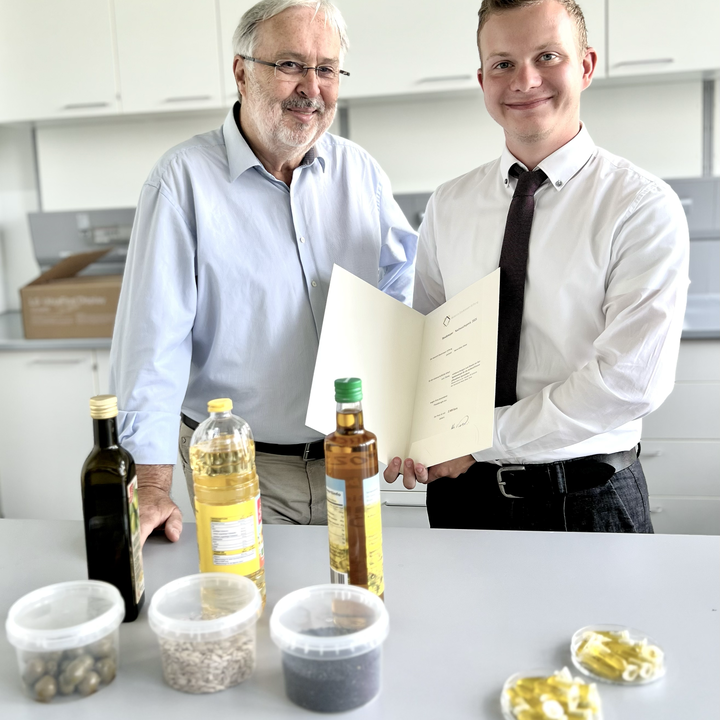
To mark the end of his three-month research visit to our university, supported by the Alexander von Humboldt Foundation, Prof. Dr Khalid Khan, a researcher at PMAS-Arid Agriculture University in Rawalpindi, shared valuable insights into his research into biochar. Khan, who works in the Department of Environmental Sciences at his home university, offers exciting perspectives for the ongoing research at our university.
Prof. Dr Khan, whose work is funded by the Alexander von Humboldt Foundation, focuses his research on the development and application of biochar to improve soil quality, particularly in arid agricultural areas. Biochar, produced through the pyrolysis of biomass, is an advanced form of charcoal that has the potential to both increase soil fertility and significantly reduce environmental impact.
In his detailed presentations, Prof. Khan highlighted the results of various studies in which he used different raw materials, such as sugarcane filter cake, rice husks and cattle manure, to produce biochar. Each of these biochar variants exhibited unique properties that are of great benefit for specific agricultural applications, such as increasing soil fertility or improving the soil’s water-holding capacity.
His findings show that biochar can not only play a key role in improving soil quality but also helps to reduce greenhouse gas emissions in agriculture by acting as a carbon sink.
The work of Prof. Khan from the Department of Environmental Sciences offers fascinating insights into the diverse potential applications of biochar and presents innovative solutions to some of the most pressing challenges in modern agriculture and the environmental sciences. With further research and development, biochar could play a key role in establishing sustainable agricultural practices on a global scale.
At the end of this enlightening and inspiring visit, the Faculty of Life Sciences would like to express its deepest gratitude to Prof. Dr Khalid Khan. His dedication and commitment to research in the field of biochar have not only opened up new avenues for soil improvement but have also provided valuable impetus for our own research projects.
His work represents a significant contribution to the scientific community and opens up promising prospects for future developments in the fields of agriculture and environmental protection. It offers new approaches for our own projects in the fields of soil sciences and waste utilisation, thereby contributing to the further development of our scientific work. His work bears witness to the close scientific ties stretching from Pakistan to the Lower Rhine region, thereby underlining the importance of international collaboration in research.