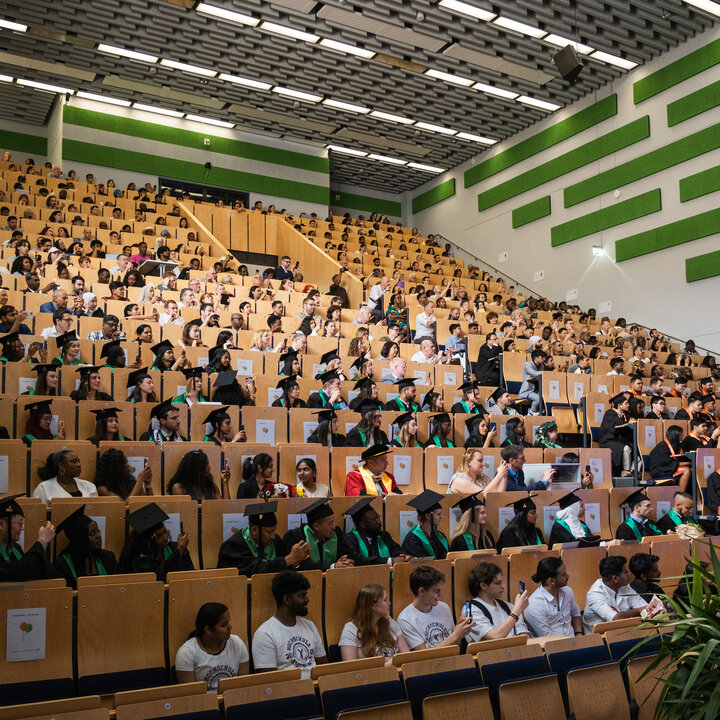
Through the University Award, the Kleve District Economic Development Agency, in collaboration with the savings banks and cooperative banks in the Kleve district, promotes cooperation between the regional business community and the HSRW. The annual award ceremony is intended to highlight outstanding examples of ‘best practice’.
This year’s University Award ceremony honours a project in which Ipsen and the HSRW jointly developed software that determines, in one second, the optimal energy source for heating goods in the industrial furnaces produced by Ipsen. These hybrid heating systems, used to harden steel, can utilise both traditional fuel gases – namely natural gas and propane – as well as hydrogen in combination with electric heating elements. The intelligent control of the processes makes it possible to utilise sustainable energy sources to the optimum extent, despite their highly fluctuating availability.
Short pathways for knowledge transfer
Dr Martin Hellwig, who spends 50 per cent of his time in the development department at Ipsen and the other half as a research fellow at the Faculty of Technology and Bionics at Rhein-Waal University of Applied Sciences, is responsible for the project. For him, the 50-50 split offers a major advantage: “I can engage extensively with the research topics at Ipsen and gain deep insights into the systems there, whilst at the same time maintaining constant contact with the university to exchange ideas with my colleagues here. The challenge of simulating the plants and optimising energy use requires expertise in various fields. This is where I draw on the faculty’s resources. As a result, the ‘pathways’ for knowledge transfer are particularly short.”
At the awards ceremony, District Administrator Gerwers echoed the jury’s views: “We were impressed by the fact that the company is utilising its enormous technical expertise to develop viable concepts for the future in collaboration with the HSRW.” Gerwers presented Paul van Doesburg, Managing Director of Ipsen International GmbH, with a hand-signed print by the poster artist Wilhelm Schlote. Ipsen’s CEO, van Doesburg, promised not only that the artwork would be given a place of honour within the company, but also that Ipsen would continue to work on developing innovative products.
Dr Martin Hellwig commented: “The project is not yet complete. With the validation of the digital twin, we have reached an important milestone. The next task is to integrate it into Ipsen’s planning software and to develop a suitable optimisation strategy for the use of renewable energy. However, it is also becoming clear that further opportunities are emerging as development progresses. For example, the simulation of the system can also be used to optimise processes or analyse the energy flow within the furnace. Another project that has emerged from the collaboration is the identification of components using image analysis via AI.”
The prize money of 7,500 euros was accepted on behalf of the Faculty of Technology and Bionics at HSRW by Prof. Dr Dirk Nissing.