The DDC AWARD, presented by the German Designer Club, is one of the most prestigious design awards in the German-speaking world. The competition recognises projects that combine design quality with a sense of responsibility towards the environment, culture and society. In addition to aesthetic and conceptual criteria, an Impact Jury also assesses the social impact of the submitted works.
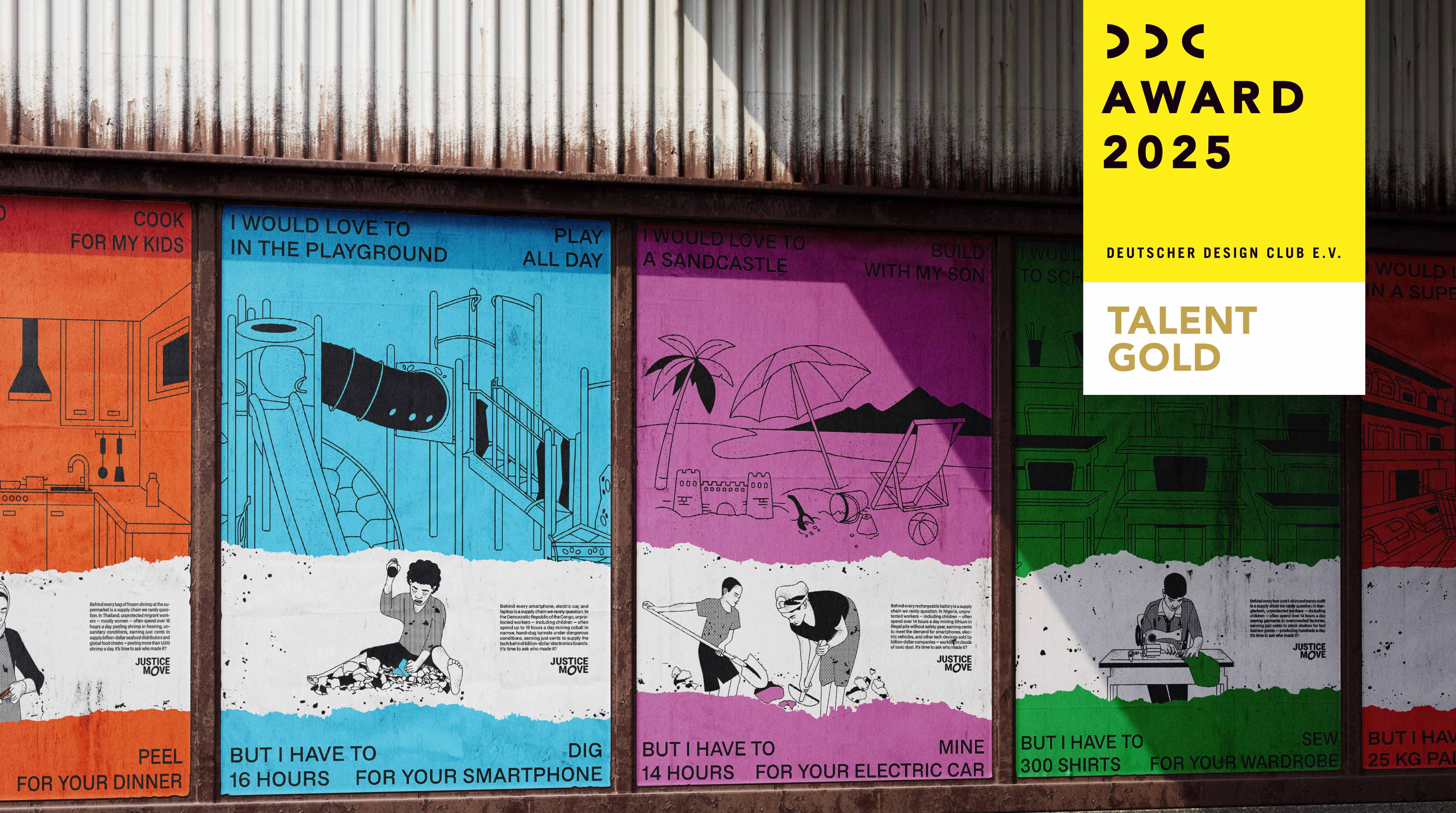
Amal Hamed – “Ask Who Made It!” (Gold, Cross-media), see cover image
Amal Hamed’s cross-media campaign “Ask Who Made It!” focuses on global supply chains across various industries – from fashion and electronics to everyday goods. The campaign highlights the social and environmental conditions under which products are made and encourages consumers to critically question their own choices. Interactive visualisations, in-depth research and a clear communication strategy combine to create a powerful overall picture. Hamed received the Gold Award at the DDC AWARD 2025 for this project.
Valeriia Kapustina – “Acker Stadt Palast – Visual Identity & Seasonal Campaign” (Bronze, Identity/Branding)
Valeriia Kapustina was recognised for a realistically crafted season campaign for the Acker Stadt Palast in Berlin – a venue on the independent scene for contemporary music theatre, performance, dance and new music. The visual identity she developed combines a modular design system with striking, distinctive and eye-catching illustrations that provide a unique and incisive visual interpretation of each of the venue’s productions. The jury praised the campaign’s conceptual clarity, design precision and professional applicability. Kapustina was awarded the Bronze Prize for this work.
The Information and Communication Design degree programme is characterised by international perspectives, interdisciplinary collaboration and close interaction between students and lecturers. This academic culture provides the framework within which projects are developed that address social issues and are relevant both nationally and internationally.
“We are particularly delighted that Amal Hamed and Valeriia Kapustina, two young designers who combine social responsibility, conceptual depth and creative excellence, have been honoured. The diversity of our international students and the close interaction within the Degree programme enable themes and perspectives that extend far beyond the regional level and result in work that is relevant both nationally and internationally. The two award-winning projects impressively demonstrate the potential that lies within this diversity,” says Nicolas Markwald, Professor of Communication Design at the Faculty of Communication and Environment.
These awards fit perfectly with the philosophy of Rhine-Waal University of Applied Sciences. As an internationally oriented and interdisciplinary university, HSRW promotes a learning culture in which social responsibility, diversity and sustainability are central values. In the field of design in particular, it is evident how students take up these values and translate them into their own projects. The award-winning works clearly demonstrate how young designers translate topics of global relevance – from supply chains to cultural participation – into compelling design solutions. In doing so, they not only enhance the visibility of the Degree programme but also strengthen the university’s position as a place where social initiatives are launched and innovative perspectives are developed.