
Jannis Menne, a research assistant at Rhine-Waal University of Applied Sciences, is investigating the behaviour of fattening and laying geese in grazing areas under different weather conditions.
HSRW - Catrin Senger
Jannis Menne, a research assistant at Rhine-Waal University of Applied Sciences, is investigating the behaviour of fattening and laying geese in grazing areas under different weather conditions.

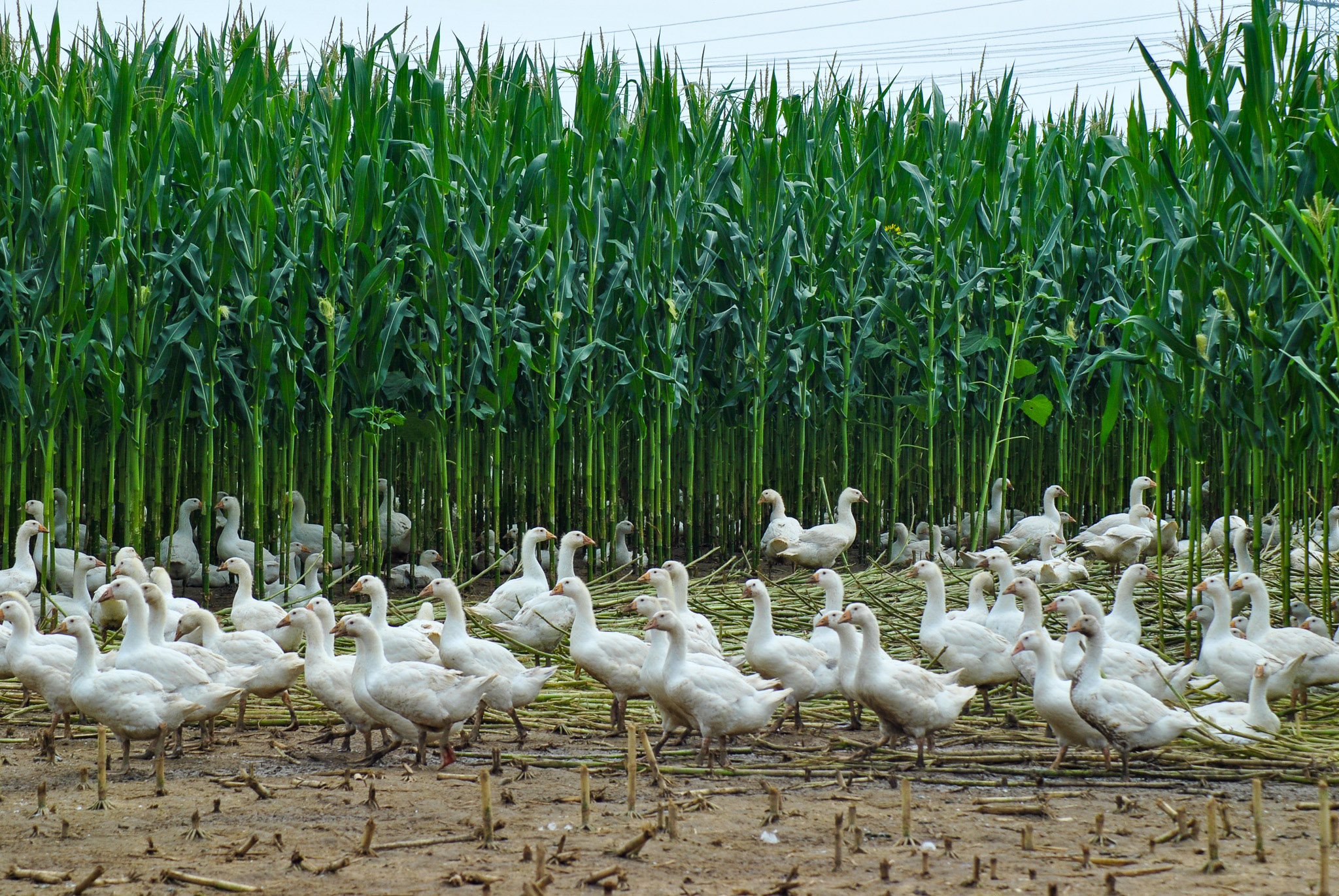
At Gänsepeter in Rommerskirchen, Peter Eßer and his son Sebastian Eßer let several thousand geese graze: sometimes on grassland, sometimes on grassland with fruit trees, or on arable pasture with crops such as maize.
The aim of this practical research is to adapt grazing to climate change, such as increasingly warmer summers, and thereby promote greater animal welfare.
The type and structure of a pasture influence how geese move about on it. “Geese are very mobile grazers. The birds are curious and make full use of the pasture areas,” says Jannis Menne, a research assistant at the HSRW. However, the geese’s behaviour is also influenced by the weather. This is precisely where the research comes in: the aim is to investigate how pasture structures and environmental conditions, such as intense and prolonged heat, affect the animals’ behaviour. Just like humans, geese seek out cool places when temperatures are high. To this end, Jannis Menne is developing and testing digital methods under practical grazing conditions that can be used to reliably record and analyse the behaviour of geese. The research is being carried out as part of his PhD thesis, based at the Agroforestry Real-World Laboratory of the TransRegINT funded project at the HSRW.
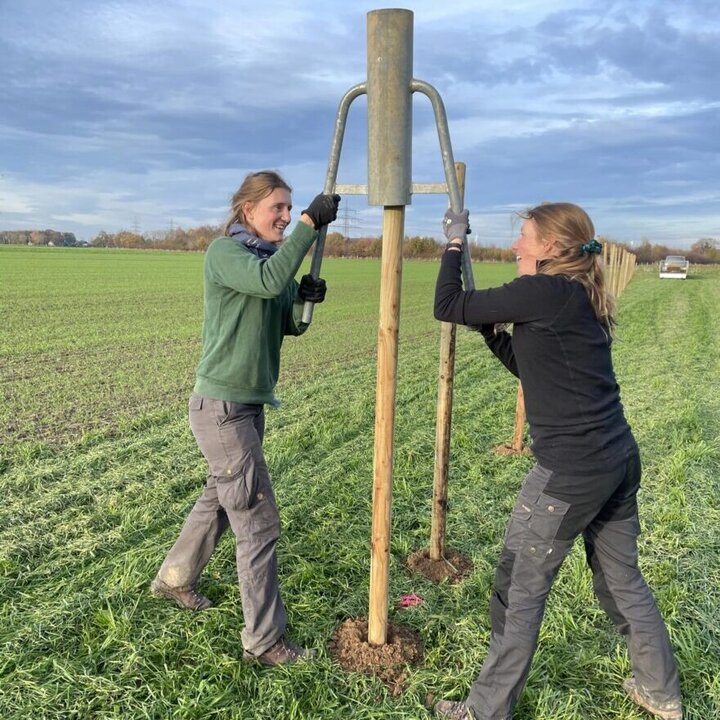
For several years now, Gänsepeter has been letting his geese graze in maize fields. These fields serve as a source of food, a place for the geese to keep themselves occupied and a place of refuge; in summer, they also provide shade. To provide further structure and shade, a so-called agroforestry system was planted on a pasture last year: poplars are planted in rows alongside arable crops such as maize or grass. The poplars are now over four metres tall and can provide shade for the first geese. To collect data on the various pasture structures, Jannis Menne is placing sensors in the maize, on a grassland area, and in and between the new rows of poplars. Equipping all areas in this way allows for an accurate comparison at a later stage. The sensors measure air temperature and relative humidity. From this, a heat stress index can be calculated.
The goose pastures are also surveyed by drones flying at an altitude of 80 to 120 metres to take photographs and subsequently analyse where the geese are located on the pasture. A striking example: in hot weather, the otherwise agile geese rest in the shed or right on the edge of the shade cast by buildings and trees until temperatures drop again. The experiment began in 2025, with further drone flights scheduled for this year. The drone footage will then be compared with the sensor data: what impact do different pasture structures have on the microclimate? And how, in turn, does this influence the geese’s behaviour and their distribution across the pastures?
The aim of this practical research is to improve animal welfare on pastures despite the noticeable changes in the climate. Jannis Menne expects the rows of poplars to have a positive effect on the use of the pasture. The trees and shrubs divide up the pasture areas and create zones where the geese find both shelter and, as the trees and shrubs grow, an increasing amount of shade. Furthermore, the trees’ evapotranspiration and the shade they provide could contribute to a more favourable microclimate. The findings and experience gained will benefit farmers when designing grazing areas for their livestock. And, ultimately, of course, the geese as well.