
Optimised infiltration capacity in horticulture: woody plants as a potential solution.

HSRW – Samuel Lemmen
Optimised infiltration capacity in horticulture: woody plants as a potential solution.
Agroforestry combines woody plants with arable farming or permanent grassland – and, optionally, with livestock farming – on a single plot of land. The benefits include greater crop and species diversity, protection against erosion and water conservation, as well as a favourable microclimate. Agroforestry can also be implemented in innovative ways in horticulture. Our Agroforestry Real-World Laboratory team at Dercks Gartenbau GmbH in the Lower Rhine region is researching how olive trees and berry bushes perform in a drainage basin adjacent to production areas.
At first glance, agroforestry and pot plant cultivation do not seem to go together: trees and shrubs in the open-field areas would not only interfere with the irrigation systems, but falling leaves and seed dispersal could also become a problem. However, infiltration basins situated alongside the production areas offer an opportunity to integrate woody plants. These basins serve to compensate for sealed surfaces and allow excess water from irrigation to seep away. Peter Dercks of Dercks Gartenbau GmbH knows from experience that infiltration swales are also useful in the context of heavy rainfall events. Influenced by past episodes of heavy rain, he has created larger infiltration swales than required by regulations. The basins at the nursery in the Lower Rhine region, where lavender, perennials and heather mixes are grown in pots, are traditionally planted with grasses and wild herbs – planting with woody plants is not normally envisaged.
Motivated by the anticipated benefits of integrating woody plants – such as soil aeration and the resulting improvement in infiltration capacity, filtering capabilities and greater biodiversity, Peter Dercks and Samuel Lemmen, a research assistant at the Agroforestry Real-World Laboratory, nevertheless set about exploring the topic of agroforestry in pot plant cultivation. With success: the Lower Water Authority of the District of Kleve granted permission for the use of an infiltration basin for such an agroforestry system, provided that it is scientifically monitored and the findings are shared.
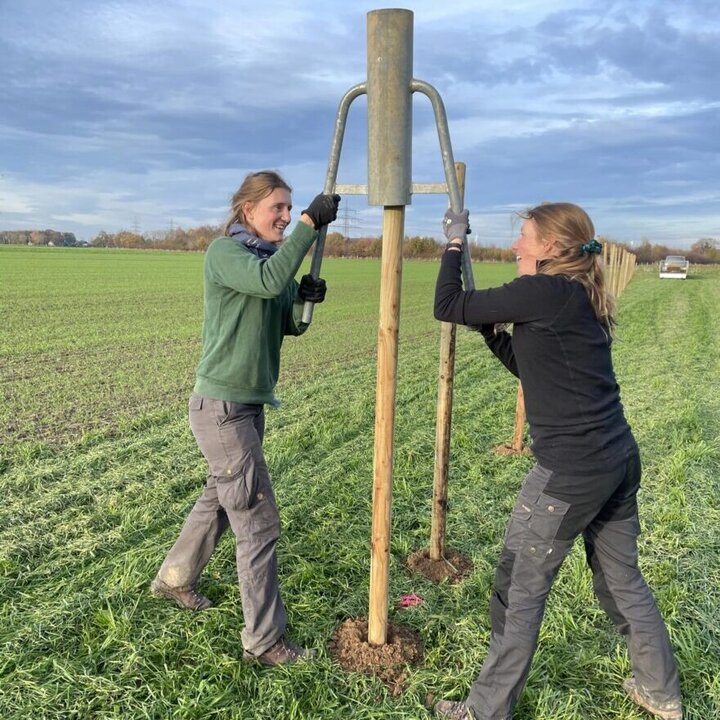
In May 2025, around 30 olive trees were planted at intervals of approximately five metres across the 840 m² site. In August, various berry bushes – including blueberries, redcurrants, raspberries and gooseberries – were added. But why olive trees, exactly? Planting them in an infiltration basin may seem counterintuitive, given that olive trees are naturally found in regions with low rainfall. However, even olive trees cannot survive without water and also possess many characteristics well-suited to the site: Their silver-grey leaves are comparatively small and are shed regardless of the season. Olive trees have deep roots, which loosen the soil, allowing water to penetrate more easily, distribute itself more effectively and seep away more quickly. This also filters the water before it enters the groundwater. There is no risk of seed dispersal, and the trees remain relatively short, meaning the quality of the crops in the planting areas is not adversely affected. Nevertheless, they provide protection from the dry easterly wind and prevent the potted plants in the planting area from being displaced by the wind. Agroforestry also benefits biodiversity. Compared to the potted plants, these trees and shrubs are permanent and thus provide a refuge for insects, for example.
Rhein-Waal University of Applied Sciences is supporting the agroforestry project through, amongst other things, infiltration experiments. To this end, double-ring infiltrometers are used to measure the soil’s infiltration rate – in other words, how much water penetrates the soil within a given time. “We won’t likely be able to draw any conclusions for several years – after all, the olive trees’ roots first need to develop. In the long term, the roots will form channels in the soil, and if the experiments are repeated under the same conditions, the water should infiltrate more quickly,” says Samuel Lemmen. He is also taking multispectral images using drones: “We want to find out how the olive trees are faring after heavy rainfall or periods of severe drought. These specialised images reveal differences in the plants’ vitality, health and stress levels. We also need to find out whether the potted plant cultivation is affected in any way.”
For those involved, the agroforestry system they have established serves as a model: “Agroforestry systems in traditional arable farming are supported; however, an agroforestry system like the one we have established here is not, as we are unable, for example, to maintain the required minimum distances in the infiltration basins. I want to lead by example and show that integrating woody plants is also possible in horticulture and has positive effects. Perhaps this will pave the way for funding opportunities in the future,” says Peter Dercks.