
Open the drawer, pop someone in, close the drawer. People are quickly judged on their appearance and pigeonholed. It happens completely automatically and is hard to control – isn’t it?
Johannes Baeumer/HSRW
Open the drawer, pop someone in, close the drawer. People are quickly judged on their appearance and pigeonholed. It happens completely automatically and is hard to control – isn’t it?
To counteract precisely this kind of stereotyping – particularly at a time of growing social division – and to promote openness and diversity, Rhine-Waal University of Applied Sciences has introduced the DiversityParcours® to its Kleve campus. This gave staff, lecturers and students the opportunity to combine knowledge, self-reflection and exchange for a whole week.
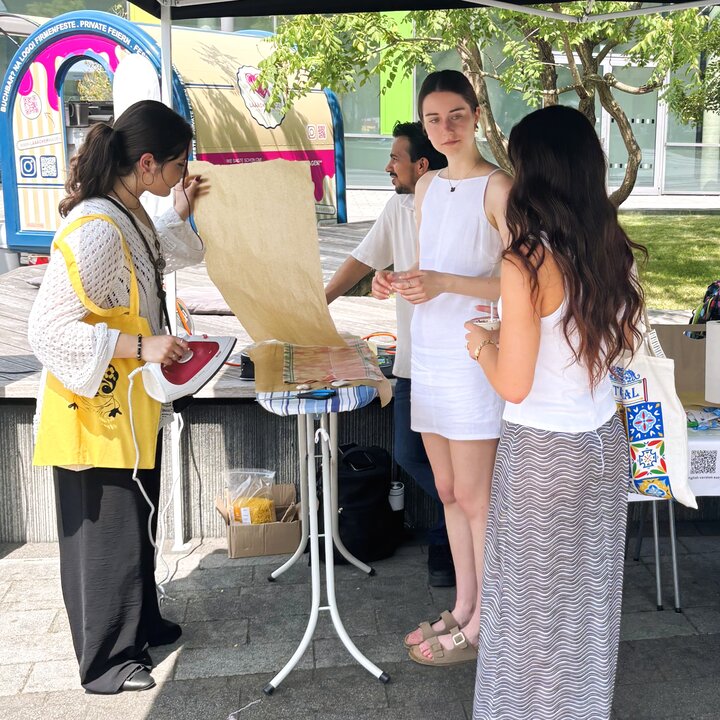
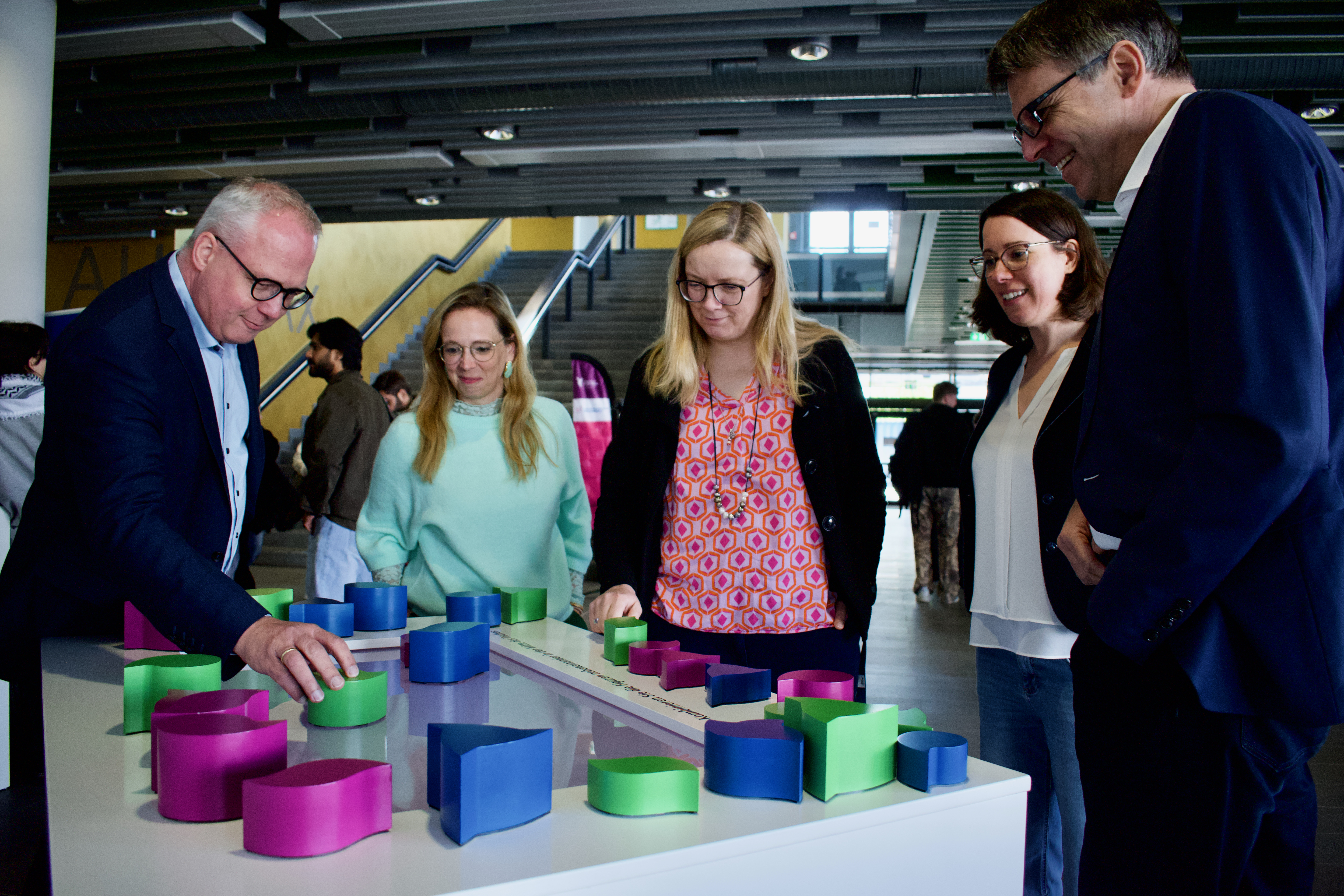
Combining an information hub, a performance stage, playground, thinking space and think tank, the DiversityParcours® exhibition – which has already been hosted by many well-known companies – opened up new perspectives on opportunities, challenges and ways to overcome barriers, whilst drawing attention to a topic of great social and political relevance. At five stations, visitors could ‘test’ their tendency to stereotype, reveal personal facets of diversity, make the sound of their team audible, immerse themselves in the world of numbers, data and facts on diversity, and experiment in the DiversityLab.
Numerous stimulating conversations, spontaneous discussion rounds and guided, moderated sessions revealed that engaging with diversity provides tangible impetus for study, teaching and collaboration. Diversity became more visible and new perspectives for working together were opened up. Through this special format, the university underlines its responsibility for democratic participation and equal opportunities.
Prof. Dr Tatiana Zimenkova, Vice-President for Internationalisation and Diversity, emphasises: “Diversity and participation are not just a ‘nice-to-have’ area. The DiversityParcours® is a necessary intervention against ignorance, exclusion and the creeping normalisation of discrimination in today’s societies.” She emphasises how important sensitivity to diversity and equitable participation is as a cornerstone of safeguarding democracy – without it, a democratic institution loses its credibility, its excellence and, ultimately, its future. As Vice-President, she states clearly: “We are not investing in symbolism, but in attitude, the ability to take action and our university’s resilience against any form of anti-democratic tendencies.”
However, the university does not wish to stop at the DiversityParcours®. It plans to further embed the insights gained in the coming semesters – through workshops, networking opportunities and concrete measures for fair access and active participation. In addition, the exhibition on fundamental rights, “More than just words”, will take place from 7 to 29 May on the Kleve campus (Building 4, 2nd floor), which is also open to the public.
Background
Together with many other German universities, Rhine-Waal University of Applied Sciences (HSRW) is taking a stand for an open, supportive and free academic and university culture by supporting the nationwide campaign “Universities Take a Stand”. A varied programme of events will be offered at both university campuses in Kamp-Lintfort and Kleve during the Summer semester.
As part of the nationwide campaign “Universities Take a Stand”, universities and their members are called upon to champion a democratic, diverse and free higher education landscape. Only where research and teaching can take place independently of political pressure, ideological dictates or individual economic interests can insights emerge that critically question social developments and enable well-founded decisions. At the same time, academia depends on democratic conditions: on freedom of expression, open discourse and the protection of minority views. Together, democracy and academia are fundamental components of an open, enlightened society.