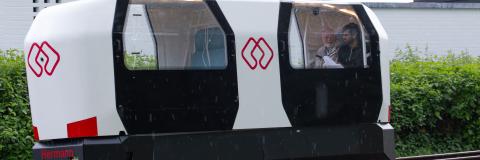
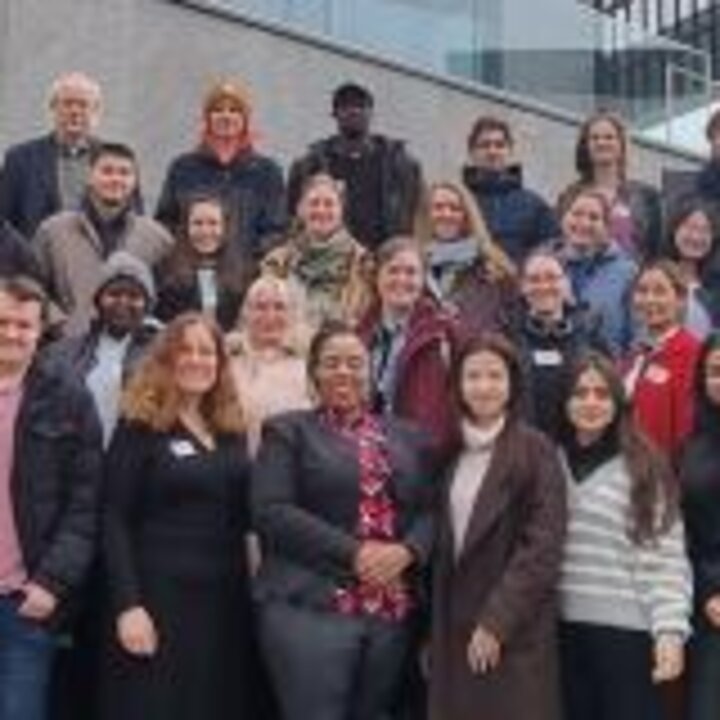
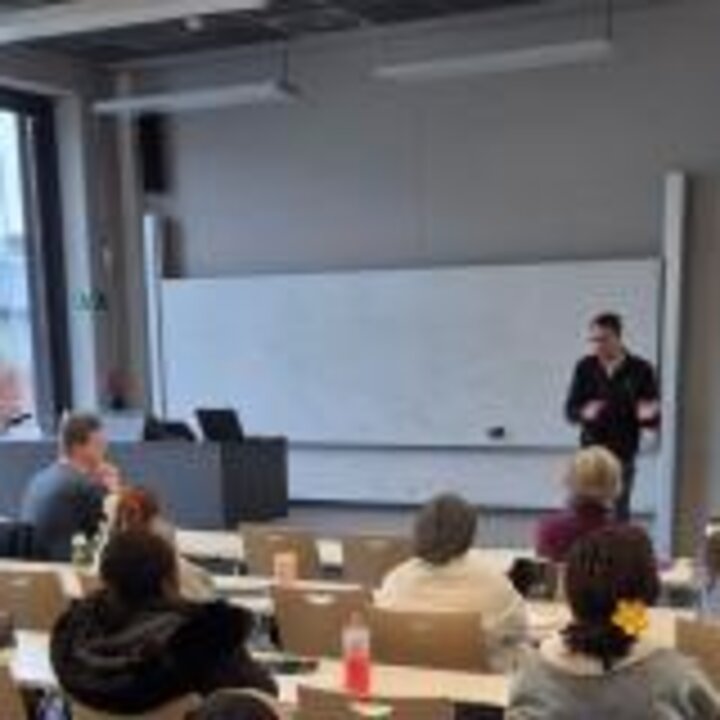
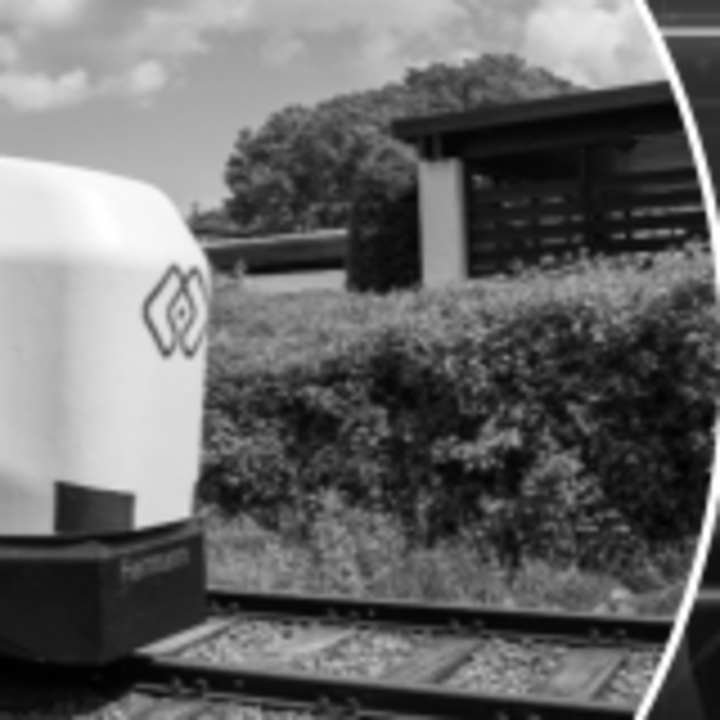
The issues and challenges of rural mobility had already been addressed at the launch event ‘New Mobility in Rural Areas’ on 29 March 2025 at the Kranenburg Community Centre, which featured many interesting presentations by experts. The next step was to involve the local community. Under the motto ‘Away from dry theory, towards a hands-on experience’, the MONOCAB was now available for people to experience first-hand. On 23 May, two coaches set off on a day trip from the Lower Rhine to Extertal in the Lippe region. There, the gyro-stabilised MONOCAB was set to demonstrate its suitability for everyday use on a test section.
The aim of the day trip was to highlight the potential of autonomous monorail vehicles for the reactivation of disused railway lines – including cross-border routes between Germany and the Netherlands. Guests from the Kleve-Nijmegen border region watched the live demonstration of the innovative MONOCAB technology with great interest. This technology is being developed primarily by the Ostwestfalen-Lippe University of Applied Sciences.
The event was open to anyone interested in new forms of mobility for rural areas. The opportunity to take a test ride on a MONOCAB was aimed in particular at groups of people who do not have unrestricted access to a car, such as school pupils, older people or those with disabilities. The invitation was also extended to residents living along the disused Kleve–Groesbeek railway line, particularly those living on the Dutch side of the border. As a result, guests from the Netherlands also made the most of the opportunity. “I was sceptical at first. That’s also why I thought the research project’s offer was a really good idea – to have the chance to experience the technology first-hand,” said one passenger afterwards. “Riding in the MONOCAB was a brilliant experience; I’d love to see something like this as part of everyday life in the Lower Rhine region.”
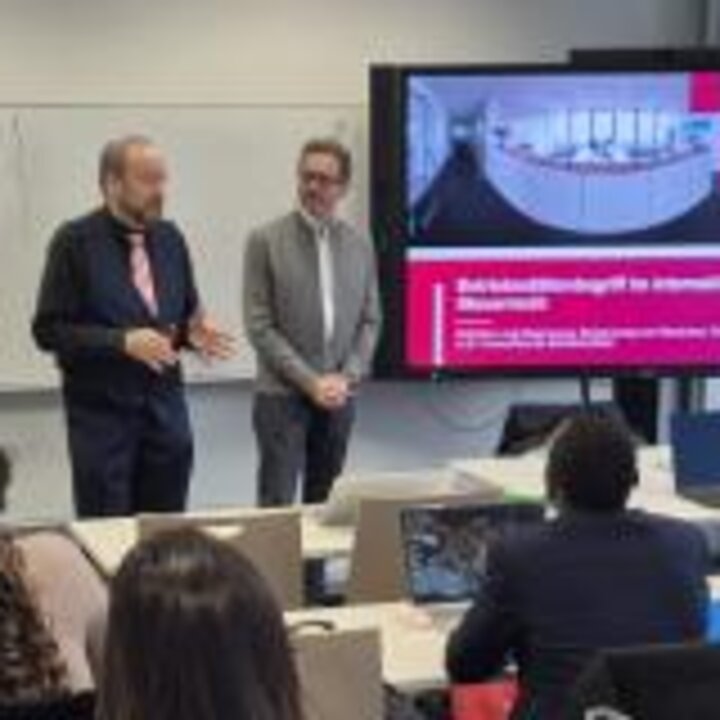
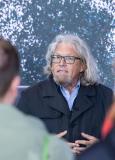 Rhein-Waal University of Applied Sciences, represented by Prof. Dr Ralf Klapdor, organised the event in collaboration with mobility expert Ruben Loendersloot from Nijmegen and a dedicated group of supporters from the region. “MONOCABs offer a realistic prospect for regions with limited public transport coverage – particularly where traditional rail links cannot be economically reactivated or would not be accepted by the local population,” emphasised Prof. Klapdor. The planned operations on the disused line between Kleve and Groesbeek represent a promising pilot project for the mobility of tomorrow.
The old saying ‘You don’t eat what you don’t know’ also applies when it comes to technological innovations. As part of the research project, Rhine-Waal University of Applied Sciences is therefore also investigating the social acceptance of this forward-looking technology. Through extensive surveys, the researchers are seeking to determine the conditions under which a new technology – such as the autonomous, AI-controlled MONOCAB vehicle – might be accepted by users. Results are expected this autumn. However, one researcher involved has already reported that many passengers subsequently described their experiences as positive, and that initial concerns thus largely proved to be unfounded. This already demonstrates that direct experience of new technologies can foster acceptance – an approach the research project aims to pursue further.
The event was seen not only as a technical presentation but also as an important catalyst for cross-border cooperation. Andreas Lietschulte, co-initiator and representative of the support group for the reactivation of the Kleve–Nijmegen railway line, emphasised the project’s importance for accessible, environmentally friendly and staff-independent mobility in rural areas. A pilot project for the 2029 State Garden Show in Kleve is being considered. The successful demonstration in Extertal marked a significant step towards a sustainable mobility transition – across national borders.
Further information here. Please send any questions or comments to: monocab-rijn-waal@hochschule-rhein-waal.de
Dr Wolf Gardian
, Research Associate
, Faculty of Society & Economy
Tel.: 02821 80673313
Email: wolf.gardian@hochschule-rhein-waal.de
Ruben Loendersloot
Loendersloot Consultancy, Nijmegen
Email: ruben@loenderslootconsultancy.nl
The project is made possible by the Interreg Germany–Netherlands programme and its programme partners, and is co-funded by the European Union.