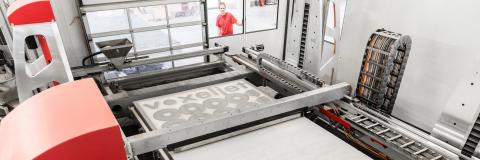
The Lower Rhine 3D Competence Centre at Rhein-Waal University of Applied Sciences and wir4 Business Development are organising a series of events at which local companies that are already using the new 3D technologies will present their work. Lectures, field trips and workshops are designed to demonstrate where additive manufacturing processes are already being used today and where their potential lies.
On 8 November 2017 at 5.00 pm, Herbert Marschall, a research assistant at the University of Duisburg-Essen in the Faculty of Educational Sciences at the Institute for Vocational and Continuing Education, will give a talk on the topic of ‘Staffing for additive manufacturing’.
The event will take place at the Kamp-Lintfort campus of Rhine-Waal University of Applied Sciences, Friedrich-Heinrich-Allee 25, in Building 1, Audimax, Room 01 00 115.
The lecture offers guidance for businesses, schools, universities and prospective engineers on the necessary skills and the various vocational training options available. Among other things, it will explore the following questions: What knowledge do staff need for 3D printing? In which professions is additive manufacturing already being used? What opportunities are available in initial and continuing vocational training? What strategies can companies adopt?
In addition, there will be up-to-date information for anyone looking to recruit or train specialist staff in additive manufacturing. After all, the new 3D processes are already transforming the world of work. Digitalisation – from the initial product idea right through to realisation – affects all production processes. It will further automate 3D printing and, in particular, replace jobs requiring low-level skills.