For Ferris State University and Rhein-Waal University of Applied Sciences, the successful dual degree programme marks a milestone in their long-standing and close collaboration. Alongside other exchange projects, such as a joint summer school, Prof. Dr Jakob Lempp, Dean of the Faculty of Society and Economics, and Prof. Dr Philipp Schorn, Vice-Dean of the Faculty, initiated and spearheaded the dual-degree programme together with colleagues from the USA. Selected students from both universities now have the opportunity, after eight semesters, to obtain both a recognised American degree from Ferris State University and a German degree from Rhein-Waal University of Applied Sciences.
“Even whilst studying for my Abitur, I was very interested in economic topics and came across the ‘International Business and Social Sciences’ degree programme,” says graduate Sabaghi, explaining his decision to study at Rhein-Waal University of Applied Sciences. For Sabaghi, who was born in Iran and grew up in Emmerich, the programme’s English-language instruction and international focus were the deciding factors. As part of the exchange programme between Rhein-Waal University of Applied Sciences and Ferris State University, Sabaghi studied in Big Rapids, Michigan, from August 2015 to August 2016. “I was interested in the USA because it is the world’s largest economy. I also wanted to live and study in an English-speaking country to improve my language skills and gain an insight into a different culture.”
A double degree at two universities demands considerably more from students than just a few semesters abroad. “It is primarily achieved by recognising the examination results obtained at the partner institution towards the degree at the other institution,” explains Vice-Dean Schorn. “A prerequisite for this was that the curricula of the two degree programmes in question were comprehensively aligned with one another.” And that was certainly a time-consuming process, confirms graduate Sabaghi. As the first student on the joint double-degree programme with Ferris State University, he had to take a few extra modules at the start until there was definitive clarity regarding mutual recognition. “It was certainly demanding, but it was also great fun, as I was able to play an active part in the process and learnt a great deal.”
“Demand amongst students is already high and continues to grow steadily,” says President Naderer. “A total of five places are available each year for the exchange with Ferris State University, which can be filled by double-degree students.” Another particular success of the programme is that, as part of the double-degree scheme, German students do not have to pay any tuition fees at the partner university in Big Rapids.
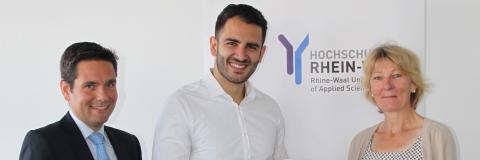
Arshiya Elias Sabaghi has successfully overcome the challenges of the double-degree programme and now has another reason to celebrate. Both universities honoured the graduate with a joint certificate, which was presented to him in person by President Dr Heide Naderer following his colloquium on 23 August 2017. Sabaghi looks back with satisfaction: “I would highly recommend this degree programme because it is very practice-oriented and, thanks to the manageable class sizes, we received excellent support from the lecturers. The international focus of Rhine-Waal University of Applied Sciences equips students with essential skills that prepare young people well for an increasingly interconnected and international labour market.” In the long term, Sabaghi is aiming for a career in international sales.
Rhine-Waal University of Applied Sciences will continue to expand its dual-degree programme. “The programme successfully implemented with Ferris State University in the ‘International Business and Social Sciences’ degree programme can serve as a model for other degree programmes,” says President Naderer, praising this pioneering achievement. “Furthermore, we are also in contact with other international universities to find further suitable partners for collaboration.”