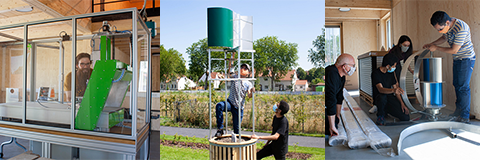
The Green FabLab (Fabrication Laboratory) at Rhein-Waal University of Applied Sciences, situated on the grounds of the 2020 Kamp-Lintfort State Garden Show, is opening its doors for guided tours, talks and discussions. It all kicks off on 25 July. At 11.00 am, Professor Dr Ute Hansen, Professor of Biology and Environmental Monitoring, will speak on the topic ‘The global carbon cycle and climate change’. On 26 July, also at 11.00 am, Professor Dr Irmgard Buder, Professor of Renewable Energy and Electromobility, will address the question ‘Hydrogen: energy of the future or a dead end?’. Further exciting lectures will follow. Subsequent discussion sessions with visitors are intended to explore the topics in greater depth.
At the Green FabLab, the focus is on the environment and the sustainable use of its resources – combined with digital manufacturing, this opens up entirely new possibilities for producing ‘green’ products. The emphasis is on bringing innovative ideas to life that can contribute to sustainability: conserving resources, using renewable raw materials, making optimal use of renewable energy, and reducing or even avoiding environmental impacts such as emissions. Conceived as a practical learning space and an open, high-tech workshop for school pupils and students from the region, as well as for the general public, the Green FabLab serves to facilitate the joint development of environmentally friendly and resource-efficient solutions to the diverse challenges of climate and environmental protection.
Environmental technologies are a key component of North Rhine-Westphalia’s economy. In terms of corporate turnover, the federal state is the most successful location for the environmental sector in Germany. Furthermore, the Lower Rhine region boasts a strong energy and environment sector, encompassing all (sub-)sectors within this field. Companies in these sectors face major challenges, such as increasing pressure to innovate and the need to recruit suitable skilled workers.
Against this backdrop, Rhein-Waal University of Applied Sciences has established the Green FabLab. It aims to strengthen North Rhine-Westphalia as both an educational and technological hub in the long term by optimising local economic development and employment through improved knowledge and technology transfer of resource-efficient, green technologies. To this end, the primary aim is to address the shortage of skilled workers through training programmes in schools and at university, whilst promoting the innovative capacity of the region’s businesses in a way that is tailored to their needs. Furthermore, the FabLab model supports the development of products and business ideas by small and medium-sized enterprises in the agricultural, environmental and energy sectors, thereby helping to secure North Rhine-Westphalia’s pioneering role in the long term.
The Green FabLab in Kamp-Lintfort is the first accredited FabLab in Germany to focus primarily on ‘green’ technologies and is therefore entitled to call itself a ‘green’ FabLab. It will strengthen North Rhine-Westphalia’s role as a pioneering region in Europe for extracurricular learning centres and school laboratories. The Rhine-Waal University of Applied Sciences in Kamp-Lintfort offers excellent conditions in terms of both content and infrastructure for this purpose.
The Faculty of Communication and Environment trains specialists on the ‘Environment and Energy’ Bachelor’s degree programme who understand the complex scientific issues in the fields of environmental sciences and energy, whilst at the same time being able to integrate the requirements of clients from business and industry. The programme provides students with a broad knowledge base in the natural and engineering sciences, the fundamentals of economics, and information technologies. This broad scope opens up career paths for graduates in the technical and operational aspects of environmental and energy engineering, as well as in project management at the interface between administration and practice.
Furthermore, close collaboration with the faculties in Kleve ensures the incorporation of further knowledge, for example from the fields of ‘Sustainable Agriculture’, ‘Agribusiness’, ‘Bioengineering’ and ‘Biological Resources’ (Faculty of Life Sciences), ‘Science Communication and Bionics’, ‘Biomaterials Science’ (Faculty of Technology and Bionics), ‘Sustainable Tourism’ and ‘Sustainable Development Management’ (Faculty of Society and Economics).
In addition, the Faculty of Communication and Environment’s facilities include the zdi school laboratory ‘FabLab Kamp-Lintfort’. As one of the largest FabLabs in Germany at present, it has enabled the acquisition of a wide range of expertise in digital production processes, whilst also providing many years of experience in the pedagogical practice of digital-creative design (‘making’). Numerous successful projects have already been carried out, such as the Fab Academy, the Fabricademy, various workshops, FabLab@school and OpenLab days for the general public. As the home of the Lower Rhine 3D Competence Centre, the facility has also forged numerous links with the business community. The FabLab Kamp-Lintfort has now earned an excellent reputation within the FabLab and maker communities. The Green FabLab aims to build on this legacy and further expand the international network.
The laboratories of the Faculty of Communication and Environment also provide ideal conditions for the Green FabLab and can contribute both in terms of content and experimentation. “Our laboratories can be seen as the jewels in our faculty’s crown, which complement our degree programmes effectively and enhance them with a practical focus. We will now continue to breathe life into the Green FabLab, and in doing so it will increasingly come to resemble an emerald,” explains Professor Dr Andreas Schürholz, Dean of the Faculty of Communication and Environment.
In terms of content, the Green FabLab focuses on the following areas: digital manufacturing using renewable raw materials; the production of renewable raw materials and agribusiness; renewable energy for production and transport; and waste and closed-loop material cycles. To this end, overarching themes such as ‘climate change’, ‘biodiversity’, ‘biological resources’, ‘energy’, ‘environmental monitoring’ and ‘urban gardening’ are addressed. In line with this, individual experiments take place in the Green FabLab and on the outdoor grounds, and exhibits are displayed or produced. These include, for example, digital manufacturing, drones, a wind turbine, a pumped-storage power station, a photovoltaic system, a drum composter and an algae race track. All topics and experiments can be found on the Green FabLab’s website. “The Green FabLab sees itself as an open, interdisciplinary meeting place and workshop. We would therefore like to invite anyone who is interested or simply curious to join us in discussing and bringing green ideas to life, ranging from ecological research and biological materials to technologies for monitoring and improving environmental conditions,” says Professor Dr Kai Jörg Tiedemann, Professor of Ecology and the Environment and Head of the Green FabLab.
From 25 July, guided tours of the Green FabLab and the outdoor grounds will take place daily at 11.00 am. On Saturdays and Sundays, an additional guided tour will be offered at 12.00. Informative talks at the weekends, also at 11.00, provide an opportunity to listen and discuss. The number of participants on the guided tours is limited to 10 people. A maximum of 20 people can take part in the talks and discussions. Registration is via the Green FabLab website. However, in most cases, a few places may still be available a quarter of an hour before the event begins.
This project is funded by the European Regional Development Fund (ERDF)