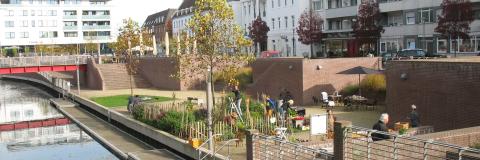
The urban area of Kleve is characterised to a particularly marked degree by ‘greenery’. This includes more than 60 gardens and parks, foremost among which are the historic parks. Allotments are currently being rediscovered and are playing an increasingly important role in the town. Particularly encouraging is the interest in fruit, vegetables and herbs, which are grown both in private gardens and on land managed by gardening associations. Residents from a wide variety of backgrounds and with diverse levels of experience interact with one another whilst gardening, and local authorities ultimately stand to benefit from these gardening activities. A more recent phenomenon in Kleve and other German cities is community gardens, which are set up by a group – often neighbours – on what is usually public land. In other major European cities such as Amsterdam and Vienna, these community gardens are also enjoying growing popularity and are sometimes even open to the public for ‘harvesting as you go by’.
Whilst in Germany and Europe gardening is mostly practised as a hobby and the harvest contributes only a small part to daily meals, in many major African cities urban agriculture is vital for the survival of poorer sections of the population. Fruit and vegetables are unaffordable for many families due to high market prices, and a garden, however small, can make a significant contribution to a healthy and more varied diet for the families who tend them. Consequently, gardens of all sizes and uses can be found in African cities – along streets, rivers and canals; on derelict building plots; in parks and on traffic islands; in front gardens; on balconies and roof terraces; and even in the most cramped spaces in slum areas. As such urban gardens not only serve the purpose of self-sufficiency but also often make a significant contribution to the supply of fresh fruit and vegetables at city markets, many local authorities – after initial resistance – have recently begun to promote urban gardening. However, there are also some downsides that need to be critically discussed and positively addressed.
In view of a steadily growing global urban population and increasingly scarce agricultural land in peri-urban areas, urban gardening – from Kleve to the tropics – offers a promising and, to date, far too underutilised opportunity to combine sustainable fruit and vegetable production with healthy eating and an improved environment in our cities.
The lecture forms part of the Studium Generale programme. The lecture series is aimed at the general public, as well as students, lecturers and staff at Rhine-Waal University of Applied Sciences, and presents current topics in a way that is relevant to everyday life and informative. The series also offers the opportunity to engage with current issues. “We invite everyone, regardless of age, to attend these fascinating lectures,” says the university’s President, Dr Heide Naderer.
Attendance at the Studium Generale lectures at Rhine-Waal University of Applied Sciences is free of charge for all members of the public.