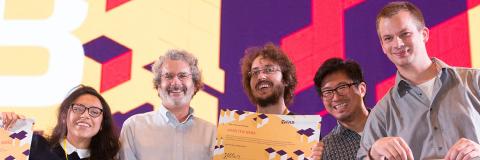
Under the motto “How to make (almost) anything”, Neil Gershenfeld, a professor at MIT and founder of the FabLab movement, is leading the international training programme on digital fabrication. From 25 January to June 2017, Professor Gershenfeld’s lectures will be broadcast live from MIT to the project partners’ FabLabs. A virtual campus connects Fab Academy students with their peers worldwide, enabling them to collaborate on projects.
Course participants rediscover the ‘do-it-yourself’ ethos and learn 3D design and printing, how to operate computer-controlled machines and how to work with a variety of materials. Knowledge from the fields of electronics and computer science complements the design and manufacturing aspects. The aim of the course is for all participants to be able to produce a functional prototype of their project independently. The course thus imparts the skills and knowledge that play a crucial role in the digitalised economy – known as ‘Industry 4.0’.
This is precisely where the Lower Rhine 3D Competence Centre comes in. The project partners (Rhein-Waal University of Applied Sciences, Ruhr West University of Applied Sciences and RWTH Aachen University) aim to develop a framework for teaching the key qualification ‘Digital Manufacturing Technologies’ and for embedding digital production skills more firmly within the curricula of universities and schools in the region. Furthermore, they aim to provide training programmes for industry and the skilled trades, act as an advisory service for businesses, and support start-ups.
“The Fab Academy promotes innovative forms of interaction between technology, science and society, explores interdisciplinary working and strengthens our international networks,” says Dr Heide Naderer, President of Rhein-Waal University of Applied Sciences. “We are delighted to be able to enable up to twelve students across all three universities to take part in the programme each year through a scholarship. And we are proud to be the first, together with FabLab Munich, to run the Fab Academy in Germany.”
According to Professor Karsten Nebe, FabLab Kamp-Lintfort even plays a special role in this. As a so-called ‘supernode’, it is the central point of contact for all German FabLabs running the Fab Academy. The fee-paying training programme is open to everyone, including staff from companies or educational institutions. All participants who successfully complete the course will receive the Fab Academy diploma. It will be presented to the graduates at the next World Fab Lab Conference in Santiago de Chile.
This project is funded by the European Regional Development Fund (ERDF):