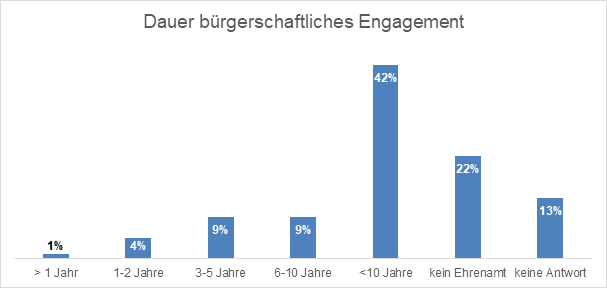
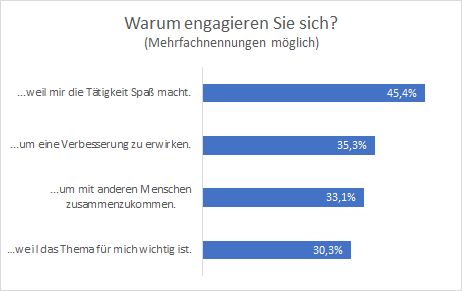
The aim of the student project ‘Private Public Partnership’ at Rhein-Waal University of Applied Sciences during the 2020/21 winter semester was to investigate how civic engagement is supported by the local authority and politicians in the district of Kleve. Of those surveyed, two-thirds have been volunteering for several years and are aged between 19 and 80. Many carry out their voluntary work alongside full-time employment, and on average around 20 per cent commute to a workplace outside the district. In addition to their professional commitments, these citizens are involved in their local community for a variety of reasons, but above all because they regard their activities as important for themselves and their local environment.
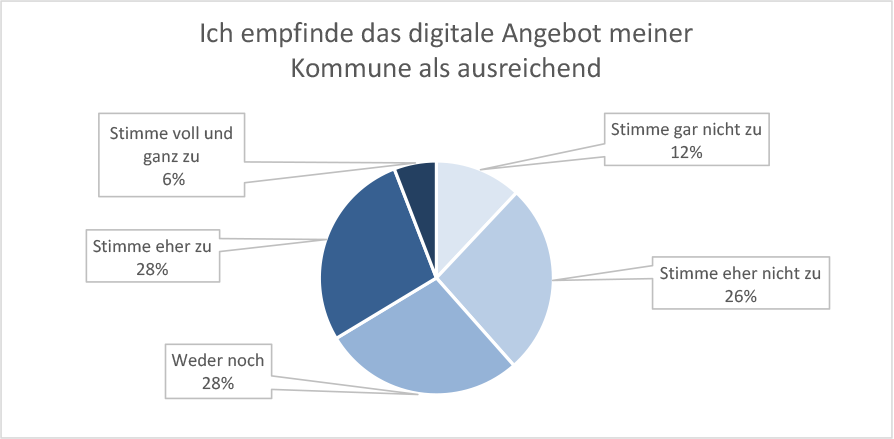
When analysing support for civic engagement, the students were initially interested in perceptions regarding the provision of information by local councils in the district of Kleve. Half of those surveyed stated that they were adequately informed by their local authorities about current issues or developments. There is also a prevailing impression that it is indeed possible to find the right points of contact for specific concerns. Satisfaction with the way information is conveyed by local authorities is further enhanced by the high regard in which personal contact is held – for example, through feedback explaining the reasons behind decisions made regarding individual concerns. Furthermore, there is a growing trend towards digital communication or participating in meetings online.
Unlike the work of local authorities, local politics tends to be viewed more critically. Here, citizens seem to draw a clear distinction. Participation in various forms of citizen engagement processes does not, as the students expected, lead to a more positive perception of the role of local politics: “This is a contradiction in terms, as one would expect that actively safeguarding one’s own interests would lead to a correspondingly positive perception. This therefore raises the question of whether people are familiar with the (communication) processes within local authorities and which areas might, if necessary, be ‘tackled’. Local authorities could, for example, address the fact that only a third of those surveyed consider the opportunities for participation to be sufficient. Another area for potential improvement is the provision of digital forms of participation, to which citizens are increasingly open,” says the project leader, Prof. Dr Klaus Hegemann.
A third key aspect of the analysis is the extent to which people identify with their respective local community. A sense of belonging motivates people to take on community-based tasks for their immediate local environment. Here, the students observed that committed citizens identify strongly with their own social groups and clubs; however, interaction between clubs or neighbourhoods is already perceived as insufficient within their own local authorities. This is where local government and politicians could take action, for example, by placing greater emphasis on networking and the exchange of experiences amongst volunteers. One approach to creating new synergies could be to first of all familiarise oneself with the existing resources within one’s own town or municipality. Having access to these resources would also contribute significantly to the sustainability of voluntary work. Once a local authority has successfully implemented an idea, it can be shared with other towns and parishes to support civic engagement across the entire district of Kleve and, where necessary, further developed.
The findings on cooperation between local authorities, citizens and politicians are now being incorporated directly into the work of the INTERREG V A project ‘Volunteers 2.0’, in which project participants are examining how civic engagement can be sustainably strengthened in collaboration with local government.
Further findings from the survey
- 16 per cent of respondents find it difficult to get in touch with the local authority
- 31 per cent agreed ‘somewhat’ or ‘fully’ with the statement ‘It is not clear to me which body I can take my personal views to’
- 50 per cent agreed ‘somewhat’ or ‘completely’ with the statement, ‘I think that my opinions or ideas are treated with respect by staff in the city or local authority administration, even when we have differing views’
- 30 per cent of respondents agreed ‘somewhat’ or ‘completely’ with the statement ‘I think my opinions and ideas are not taken seriously by staff in the city or local authority administration’
‘Volunteers 2.0’ cooperation project
In the ‘Volunteers 2.0’ project, ten German and Dutch towns are collaborating with one neighbourhood each to strengthen the sustainability of citizen participation across borders. In addition to Rhine-Waal University of Applied Sciences, the Dutch HAN University of Applied Sciences, with campuses in Arnhem and Nijmegen, is also involved. Through this German-Dutch exchange, participants learn from one another and build new networks.
The ‘Volunteers 2.0’ project is co-funded under the INTERREG V A Germany–Netherlands programme with funding from the European Regional Development Fund (ERDF) and the Ministry of Economic Affairs, Innovation, Digitalisation and Energy of the State of North Rhine-Westphalia (MWEIMH NRW) and the Province of Gelderland.
Further information:
INTERREG VA project “Volunteers 2.0” | Rhine-Waal University of Applied Sciences (hochschule-rhein-waal.de)