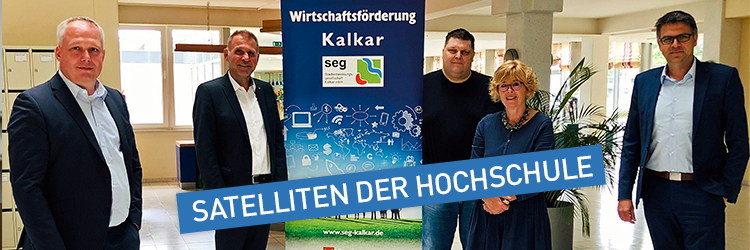
At the invitation of Dr Bruno Ketteler, Kalkar’s business development officer, University President Dr Oliver Locker-Grütjen and Vice-President Prof. Dr Peter Kisters met with Mayor Dr Britta Schulz and Christian van Aarßen at the Kalkar-Kehrum Industrial Park. “The university’s Executive Board decided a good two years ago to proactively expand our contacts with business stakeholders in the region,” Locker-Grütjen explained. “The start-up centre in Kalkar-Kehrum is therefore very welcome to take on the role of a local ‘satellite site’ for us. We have state-of-the-art technical facilities at the university which could be shared with companies from the region. This ‘extended workbench’ is available to firms as and when required. We need to communicate this effectively.”
Contact between Kalkar’s business community and the university is therefore to be facilitated in future. “We need low-threshold initiatives to start with. The initial aim must be to significantly lower the perceived barrier for tradespeople, SMEs or farmers to make enquiries to Kleve University of Applied Sciences,” says Mayor Britta Schulz with conviction. Companies can benefit from the university, but the university can also benefit from the companies in return when it comes to work placements or bachelor’s theses. Peter Kisters sees it exactly the same way. “We urgently need a local network that we can draw on when necessary. That is why the initiative from Kalkar is very much to be welcomed.”
As a first step, an event is planned for small and medium-sized enterprises, which will focus on practical examples of collaboration between companies and universities. “We want to break down reservations and encourage smaller businesses in particular to approach the university for help in solving problems,” say Christian van Aarßen and Bruno Ketteler, setting the direction. The Kalkar Business and Start-up Centre features, amongst other things, 30 offices, eight modern production halls, three seminar rooms, a co-working area and a bistro.