Kleve/Kamp-Lintfort, 4 October 2016: In cities around the world – and, of course, in major German cities too – car-sharing has long since become an integral part of transport. In small towns with lower population densities – such as in the more rural Lower Rhine region – however, the availability of vehicles for short-term hire is rather limited or virtually non-existent. And this is where students at Rhine-Waal University of Applied Sciences, in collaboration with the Minrath car dealership, are aiming to make a difference.
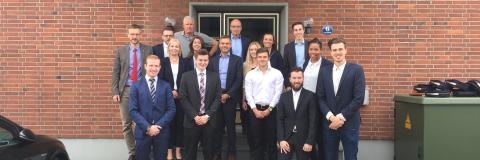
As part of a semester project, 28 students in their second semester of the Bachelor’s degree programme in ‘Psychology’ and 9 students from the fourth semester of the Bachelor’s programme in ‘International Business and Social Sciences’ at the Faculty of Communication and Environment investigated the benefits and potential of car-sharing schemes in the Lower Rhine region. Car-sharing is the organised, shared use of motor vehicles.
In collaboration with the company Minrath GmbH & Co. KG, the students analysed the possibilities for getting around via car-sharing against the backdrop of the specific mobility needs of students in the Lower Rhine region. To this end, around 270 questionnaires were distributed and 42 structured interviews were conducted at the Rhein-Waal University of Applied Sciences campuses in Kleve and Kamp-Lintfort.
Just under 60 per cent of respondents live within a radius of less than 15 kilometres of their respective campus in Kleve or Kamp-Lintfort. 34 per cent of these respondents make their daily journey to campus on foot (17 per cent) or by local public transport – buses and trains (17 per cent).
As the distance between home and campus increases (to more than 15 kilometres), the car becomes a more important means of transport for the daily commute. For almost 40 per cent of respondents who live more than 15 kilometres from the campus, the car is the primary means of transport, followed by public transport buses and trains. Other modes of transport, such as car-sharing, remain relatively insignificant across all distances, accounting for just 3.5 per cent.
There appears to be potential for alternative modes of transport: 35 per cent of respondents currently have no access to a car. However, although many students are aware of car-sharing, only a small number have any experience of the ‘car-sharing system’. Nearly two-thirds of respondents have never used car-sharing.
“Although many people value the car highly as a means of transport, particularly for covering longer distances, the students were able to highlight the potential for alternative options in their study, given the high level of dissatisfaction with public transport – over 65 per cent,” explains Prof. Dr Thomas Heun, Professor of Consumer Behaviour and Market Research at Rhine-Waal University of Applied Sciences. “35 per cent of those surveyed do not have access to a car. Furthermore, the survey clearly showed that car-sharing in the region must be affordable, easily accessible and environmentally friendly for young people.”
Thomas Borusiak, Managing Director of the Minrath car dealership group, was delighted with the professional approach taken by the students from Rhine-Waal University of Applied Sciences. “We were very impressed by the quality of the project work. We were equally impressed by the students’ professional demeanour; they presented themselves and their work exceptionally well.”