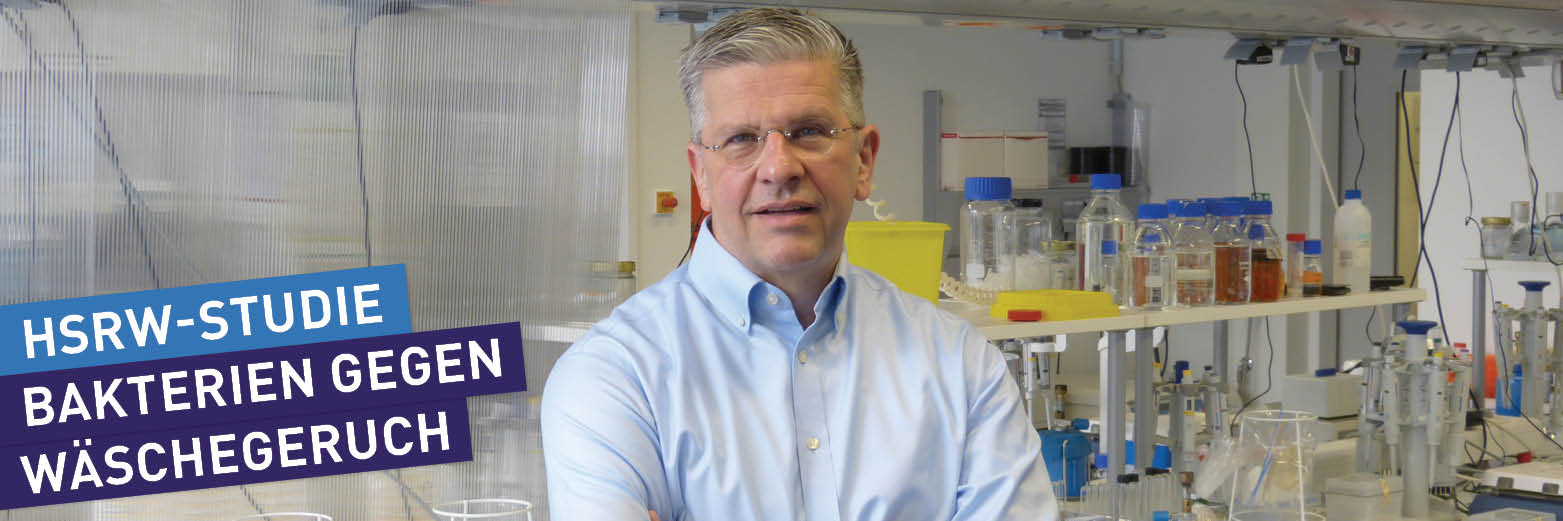
If we run the washing machine at low temperatures – for good reason – this saves electricity at first. Unfortunately, however, there are also drawbacks: more and more washing machines are developing unpleasant odours, which can also be detected on freshly washed laundry. This is mainly due to bacteria, which find ideal conditions in the washing machine at temperatures of around 30 degrees. Whilst these bacteria used to be reliably killed by regular wash cycles at 60 or even 90 degrees, most now survive the washing process and cause the laundry to smell musty. Researchers from the ‘Hygiene and Microbiology’ research group at Rhine-Waal University of Applied Sciences have investigated this phenomenon and, in comparative studies of households with and without laundry odour problems, have made a surprising discovery: Whilst, in principle, all washing machines harboured odour-causing microbes, soil bacteria such as rhizobia were found in greater numbers in the machines, particularly in households without problems with laundry odours.
“We had previously isolated these bacterial genera from washing machines,” explains project leader Prof. Dr Dirk Bockmühl, “and we were always somewhat surprised to find these microorganisms – which are otherwise mainly found in the root zones of plants, where they regulate nitrogen exchange – in household appliances. However, it remained unclear exactly what function these bacteria served within the biofilms in washing machines.” In the current study, which was also recently published in the journal ‘Microorganisms’, a possible protective effect against laundry odours has now been demonstrated for these organisms. “This could mean,” says Bockmühl, “that unpleasant odours in the washing machine are not only due to the presence of odour-producing bacteria, but primarily to the absence of protective soil bacteria. If we can harness this phenomenon, it would be possible in future to prevent laundry odours biologically.”
Background
The project was partly funded by: AC Marca (Barcelona, Spain), AVT GmbH (Wuppertal, Germany), Brauns-Heitmann GmbH & Co. KG (Warburg, Germany), Henkel AG & Co KGaA (Düsseldorf, Germany), Nouryon (Amsterdam, the Netherlands), Reckitt Benckiser (Hull, United Kingdom) and Unilever UK Ltd. (Leatherhead, United Kingdom).
Publication of the study: Zinn, M.-K.; Flemming, H.-C.; Bockmühl, D. A Comprehensive View of Microbial Communities in the Laundering Cycle Suggests a Preventive Effect of Soil Bacteria on Malodour Formation. Microorganisms 2022, 10, 1465. https://doi.org/10.3390/microorganisms10071465
About the author: Prof
. Dr Dirk Bockmühl is a microbiologist who obtained his PhD on pathogenicity mechanisms in Candida albicans; from 2001 to 2010, he worked at Henkel AG & Co. KGaA. In his final role there, he was responsible for the development of microbiological methods and microbiological research in the field of detergents and cleaning agents. Since 2010, he has held the Chair of Hygiene and Microbiology at Rhine-Waal University of Applied Sciences in Kleve, with a research focus on household hygiene. From 2011 to 2013, he was Dean of the Faculty of Life Sciences. He is a member of the Executive Committee of the GDCh’s ‘Detergent Chemistry’ division and of the extended Executive Committee of Sepawa. Bockmühl is also the author of numerous scientific publications and two non-fiction books, including *Unsichtbarer Tod* (Invisible Death), published in October 2021.