More and more people in Germany are becoming increasingly inactive. This has clear consequences for their health. A lack of physical activity is now regarded as one of the main causes of lifestyle-related diseases. It is not only an individual’s lifestyle that influences their behaviour, but also the way in which opportunities for physical activity and sport are organised. For this reason, with a view to promoting health, a growing number of local authorities, public institutions and companies see it as their responsibility to ensure that appropriate provision is made for citizens and staff respectively.
In this context, students on the Master’s programme in Health Sciences and Management at the Faculty of Life Sciences, under the supervision of Professor Dr Robert Renner, Professor of Health Promotion and Nutrition, and in collaboration with Heike Holtappel, a research assistant at the Faculty, have addressed the social issue of how to counteract a lack of physical activity and the potential negative health consequences that may result from it. In doing so, they are putting the theoretical content of the programme on ‘Health Promotion and Prevention’ into practice. In response to this question, the students devised walking routes taking in many of Kleve’s sights, with the aim of inspiring people to be more active. Walking is an endurance-based form of exercise that places gentle physical strain on the body whilst offering numerous positive health benefits. It is suitable for everyone – regardless of age, from complete beginners to those returning to exercise.
The routes start and end on the university campus and are intended as a freely accessible health-promoting initiative for different groups of people. University staff and students, local residents and visitors to the town therefore have the opportunity to choose the route that suits them best. The routes focus on the Kleve urban area in order to incorporate cultural aspects as well as health benefits. Depending on age, state of health or fitness level, the routes can be used for strolling, walking, jogging or even cycling.
Various age groups and health conditions were taken into account during the planning stage. A total of three routes, ranging from three to eight kilometres in length, have been developed to encourage as many people as possible to get active. One route was deliberately chosen to be of low difficulty. Another route is an extension of the ‘Brunnentour’ (Fountain Tour), which, as it passes by Kleve’s many fountains, offers significant cultural value and can be extended after the introductory tour to include a nature and leisure route at Kermisdahl.
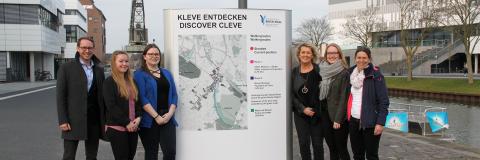
It is not only the students who can look forward to the fact that, thanks to the collaboration with the City of Kleve and the financial support of the Friends of Rhine-Waal University of Applied Sciences, an information board explaining the routes has now been permanently installed on the university campus. “The walking routes are a successful example of how practice-oriented teaching at the university can create added value for all Kleve residents and their guests. Through targeted project funding, our association members support committed students and lecturers in bringing their ideas to life,” says Stefan Finke, Managing Director of the Friends’ Association.