The docking of articulated lorries or long lorries at logistics centres is a key sub-process within the overall logistics chain. The process often takes longer than planned and can quickly lead to traffic congestion. Furthermore, property damage occurs time and again. Although a robotic lorry could prevent this, it is likely that, in the medium term, lorries will continue to be driven by human operators. An appropriate assistance system would be helpful here. It should not require any modifications to existing lorries and trailers, so that the system can be used across the entire fleet.
To develop such a system, a German-Dutch consortium comprising 13 partners has now been formed as part of the VISTA project. VISTA stands for Vision Supported Truck Docking Assistant and is a solution aimed at Technology Readiness Level 7. The system will be demonstrated in a complex real-world scenario. The project is funded through the European INTERREG V A ‘Germany-Netherlands’ programme with a budget of 2.1 million euros. In addition to the European Union, which contributes 50 per cent, the state of North Rhine-Westphalia and the Dutch province of Gelderland each contribute 8.87 per cent. The remaining funding is provided by the project partners, which include Rhein-Waal University of Applied Sciences, Hogeschool van Arnhem en Nijmegen (HAN), other institutions, technology companies, as well as service providers and end-users from the logistics sector. The project will run for three and a half years and ends on 30 June 2022.
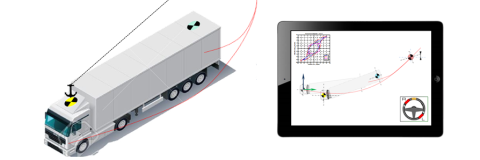
The aim is to develop a vision system that localises the position of articulated lorries in real time using high-mounted cameras. Based on the resulting location data, the system calculates a series of manoeuvres that enable precise docking. This takes into account both the articulated lorry’s kinetic capabilities and any obstacles that may need to be navigated around. Based on the calculated route, a special algorithm specifies the appropriate vehicle movement and steering angle. This information can be viewed via a user interface. Although the driver continues to control the vehicle themselves, they follow the instructions of the assistance system during the docking manoeuvre. The user interface is a key element in this process. The precise design of this interface forms part of the research work.
Rhein-Waal University of Applied Sciences will support the project in the planning, implementation and evaluation of usability engineering methods. Furthermore, it will use agile development methods to support the planning and execution of user tests, thereby enabling it to provide early recommendations for optimising the natural design of human–system interaction. The aim is to incorporate these findings into further development. The university uses mobile eye-tracking to record and analyse the driver’s conscious and unconscious perceptual and behavioural processes during the docking manoeuvre. The subsequent comparison of this data with that of the other project partners serves to create computer models for predicting the decision-making behaviour of lorry drivers. In this way, the VISTA system can be designed to be more intelligent and user-centred. Furthermore, Rhein-Waal University of Applied Sciences is contributing to the development of a VR (virtual reality) simulator for the docking process, as well as to the use of AR (augmented reality) guidance for drivers, for example via AR glasses. “This is a fantastic project for our university. It gives us the opportunity to demonstrate our forward-looking expertise in a concrete way and to work in an interdisciplinary manner not just within the university,” says Professor Dr Rolf Becker, Professor of Physics specialising in sensor technology and mechatronics, expressing his delight. And Professor Dr Kai Essig, Professor of Human Factors and Interactive Systems, adds: “The fact that so many and such diverse partners are involved in the project shows just how complex the subject matter is. It’s a real challenge for everyone involved, but also a boon for the Lower Rhine logistics region.”
Rhein-Waal University of Applied Sciences is also indirectly involved in a completely different capacity: the company CODUCT GmbH, based at the Dieprahm Start-up Centre in Kamp-Lintfort, is also a partner in the project. It was founded in November 2017 by a former student of Rhein-Waal University of Applied Sciences. The team led by founder Rafael Regh also consists mainly of former students from the Media and Communication Informatics degree programme. CODUCT is responsible for the development and implementation of the user interface and provides support with position detection, orientation and vehicle distance measurements for the subsequent calculation of the optimum articulation angles of the lorry for the docking process via computer vision, as well as with integration and demonstration.
About INTERREG
INTERREG, or as it is officially known, ‘European Territorial Cooperation’, forms part of the European Union’s structural and investment policy. For more than 20 years, it has been used to support cross-border cooperation between regions and cities that affects everyday life, for example in transport, the labour market and environmental protection. The funding area of the Germany–Netherlands INTERREG programme stretches from the North Sea coast to the Lower Rhine. The area comprises parts of the German federal states of Lower Saxony and North Rhine-Westphalia, as well as the Dutch provinces of Friesland, Groningen, Drenthe, Flevoland, Overijssel, Gelderland, North Brabant and Limburg.