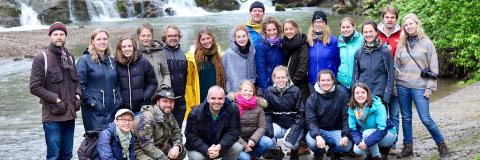
The annual excursion organised by the Faculty of Life Sciences has become something of a tradition. This extracurricular activity has been taking place since 2012. Its aim is to teach interdisciplinary content in an international context that is not covered in the standard syllabuses. Furthermore, this excursion also serves to build on existing contacts and collaborations and to strengthen academic ties. On this occasion, two students from the Bachelor’s programme in International Relations at the Faculty of Society and Economics even took part. The students were accompanied by Professor Dr Jens Gebauer, Vice-President for Research and Knowledge Transfer; Professor Dr Matthias Kleinke, Professor of Environmental Engineering; Professor Dr Dietrich Darr, Professor of Agribusiness; and Professor Dr Steffi Wiedemann, Professor of Livestock Science and Environmental Impacts.
The main focus of the field trip was the tension between nature conservation and species protection, land use and the political framework. The aim was to apply the insights gained during the field trip from a regional to an international context, so that the students could identify or develop approaches suitable for a wide variety of regions. In Poland, the students learnt about the distinctive features and, in some cases, marked differences between certain remote regions, thereby gaining an understanding of the controversies surrounding them. They also learnt how local people and policymakers deal with these issues. For example, the wildlife population has increased in recent years. However, for many years now, certain breeds of dog, such as the Tatra Shepherd Dog, have been used to guard flocks of sheep, whilst unusual measures have been employed in animal husbandry. The visit to the Bieszczady National Park – an area of unspoilt forest habitats home to wildlife such as brown bears, bison and wolves, where these species come into conflict with the interests of forestry and agriculture – provided the students with substantial insights into this very conflict. Discussions with farmers, biologists, environmentalists and representatives of NGOs helped to explore the topic in greater depth.
Furthermore, the students learnt a great deal about the commitment of people who have consciously chosen to live in one of these regions, adapted to local conditions and, for example, produce and market sustainable agricultural products from the region. Production is aimed at tourists, regional markets and restaurants, as well as supermarkets. This regional focus strengthens a sense of belonging to the region and its image, whilst also helping to highlight possible ways out of specific conflict situations. “The experiences the students have had in Poland are important for understanding regional characteristics and the tensions between them, but also for developing potential solutions for other regions,” said Professor Kleinke.