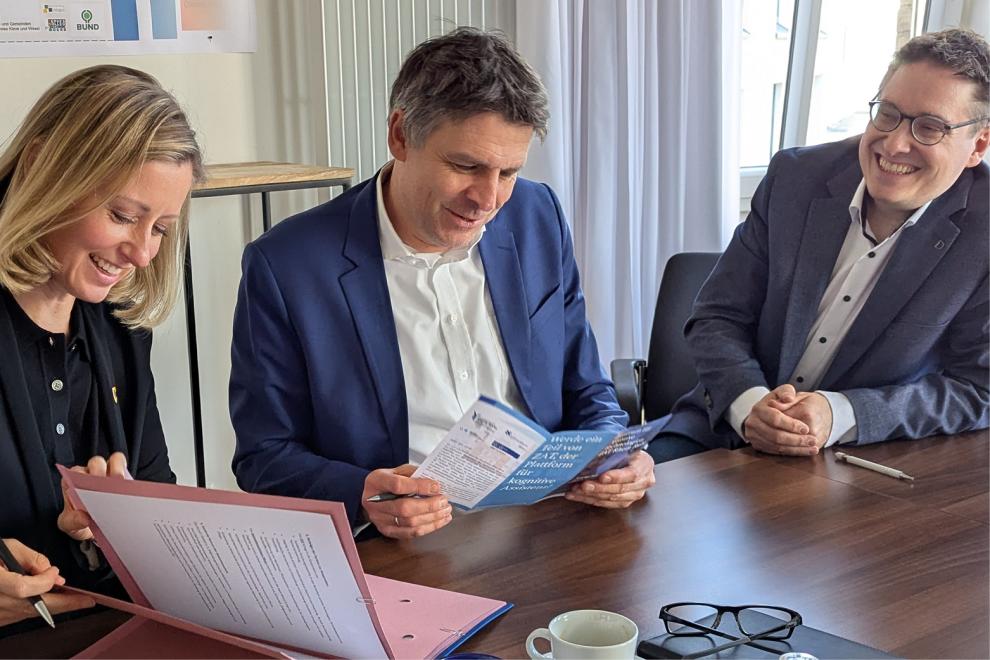
This partnership aims to drive forward the development of digital assistance systems for health and care in the Lower Rhine region. The Rhine-Ruhr Centre for Assistive Technologies (ZAT) at Rhine-Waal University of Applied Sciences (HSRW) plays a key role in this.
To develop and test innovative solutions for the health and care sector, the Moers Innovation Campus brings together the university, the city and regional businesses. “In doing so, we are strengthening Moers as a business location and creating new opportunities for businesses and residents,” emphasises Mayor Julia Zupancic. Prof. Dr Oliver Locker-Grütjen, President of Rhine-Waal University of Applied Sciences, adds: “This collaboration demonstrates how research and practice can work together to shape innovation. Digital assistance systems will provide long-term support for care provision in the region.” At HSRW, Prof. Dr Christian Ressel, Head of the ZAT, has been the driving force behind the collaboration. He emphasises the benefits for those affected: “Whatever the technology, it’s always about people in the end. Digital assistance systems can ease the burden on carers whilst helping those in need of care to remain independent for longer and enjoy greater safety in their everyday lives. Particularly in view of the shortage of skilled staff, such solutions will be crucial in the future for ensuring high-quality care.”
The partnership brings together scientific expertise, technical know-how and support from local authorities. The ZAT contributes research and a strong network spanning science and technology, whilst the City of Moers provides infrastructure and strategic visibility. Together, they will launch specific pilot and transfer projects to test digital assistance systems, actively involving regional companies, care facilities and stakeholders in the healthcare sector. Events, workshops and networking opportunities will be organised to facilitate the exchange of knowledge and practical experience. At the same time, Moers is set to become widely recognised as a centre of innovation for health and care.
Background information
The Rhine-Ruhr Centre for Assistive Technologies (ZAT), a collaboration between Rhein-Waal University of Applied Sciences, Niederrhein University of Applied Sciences, Bonn-Rhein-Sieg University of Applied Sciences and the University of Duisburg-Essen, promotes participatory research, development and the practical application of digital cognitive assistance systems. Furthermore, a key focus is on supporting early-career researchers in this forward-looking field of research, enabling the participating universities to jointly develop a research profile that extends beyond the region. The ZAT serves as a regional point of contact and platform for exchange for researchers, developers, manufacturers, providers, as well as other organisations and stakeholders working with people who require assistance.
The Rhine-Ruhr Centre for Assistive Technologies (ZAT) is funded by the Ministry of Culture and Science of the State of North Rhine-Westphalia.