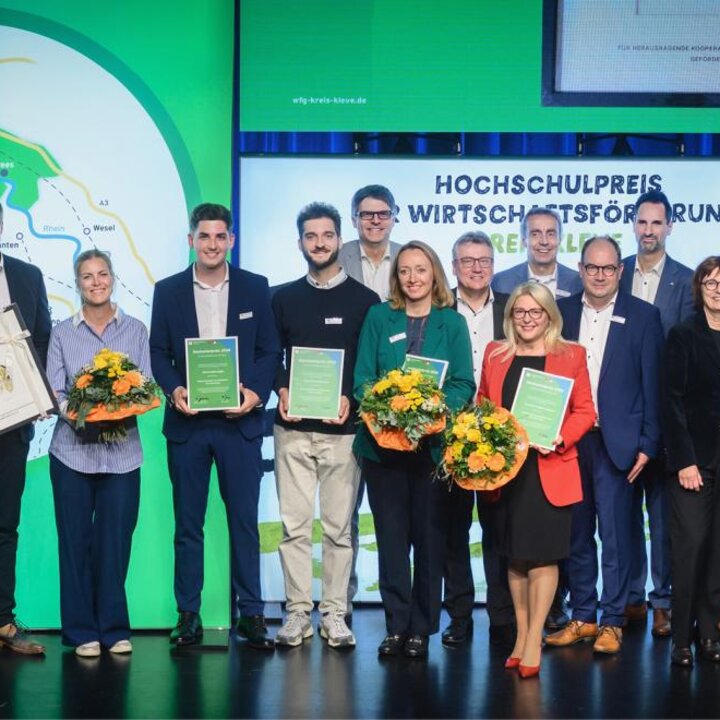
The university president, Prof. Dr Oliver Locker-Grütjen, was delighted to welcome Minister Silke Gorißen to the campus. “The transfer of applied research into business practice is a key priority for our university,” said Locker-Grütjen. “I am proud to be driving forward the field of agriculture and innovative technologies in close collaboration with our partners.” Also present were Ingo Brohl, District Administrator of Wesel; Dr Anke Schirocki, Managing Director of Agrobusiness Niederrhein; and other project partners.
“Agriculture in North Rhine-Westphalia faces major challenges: climate change, increasing demands in environmental protection and nature conservation, and economic pressure. At the same time, the aim is to produce high-quality and affordable food,” said Minister Silke Gorißen. “All of this must be brought together. The answers do not come from behind a desk, but out in the field on the farms – and through dialogue between practitioners, researchers and businesses.”
The HSRW is investigating just how versatile AI technologies already are today through the following specific research projects, which Prof. Dr.-Ing. Rolf Becker and his team presented on-site in an interactive and illustrative manner. In the “AgriTech Innovation – TreeDigital” project, funded by Interreg VIA Deutschland-Nederland, AI is used to improve agricultural processes – particularly in horticulture, mainly in tree nurseries – in a data-driven way. By jointly analysing environmental, sensor and horticultural data, yields can, for example, be optimised and resources deployed in a more targeted manner.
The ‘Smart Green Wall’, also funded by Interreg VIA Deutschland-Nederland, combines modern greening concepts with intelligent control systems. Here, AI ensures that watering, nutrient supply and maintenance are automatically adapted to prevailing conditions – resulting in healthier plants whilst reducing resource consumption.
Another example is the ‘Digitalised Watering Trolley’, funded by the European Innovation Partnership for Productivity and Sustainability in Agriculture in North Rhine-Westphalia (EIP-Agri), which is designed to help save water in ornamental plant cultivation. With the help of smart systems, the location of the plant pot is precisely determined and watering is controlled with pinpoint accuracy. This saves water whilst also reducing the workload on staff.
The “Irristaud 2.0” project, funded by Interreg VIA Deutschland-Nederland, is also working on innovative solutions for efficient and sustainable management. The aim is to further optimise water consumption through the use of AI whilst simultaneously increasing security of supply.
These projects impressively demonstrate how AI not only has theoretical potential but is already creating tangible added value today – particularly in the areas of sustainability and resource efficiency. For example, water, fertiliser and plant protection products can be applied more precisely and thus in a way that is gentler on the soil and conserves resources. Early-warning systems for yield losses or forest damage help to prevent economic losses.
About the Green FabLab Integrating the digital
technologies of the future into teaching and schools in the Lower Rhine region, whilst at the same time helping small and medium-sized enterprises (SMEs) to secure the next generation of talent – that is the aim of the Green FabLab. At the HSRW’s Green FabLab (short for Digital Fabrication Laboratory), the focus is on digital manufacturing for energy and environmental technology. In this high-tech workshop, a wide variety of objects, sensors and machines can be produced in-house using computer-controlled machines.