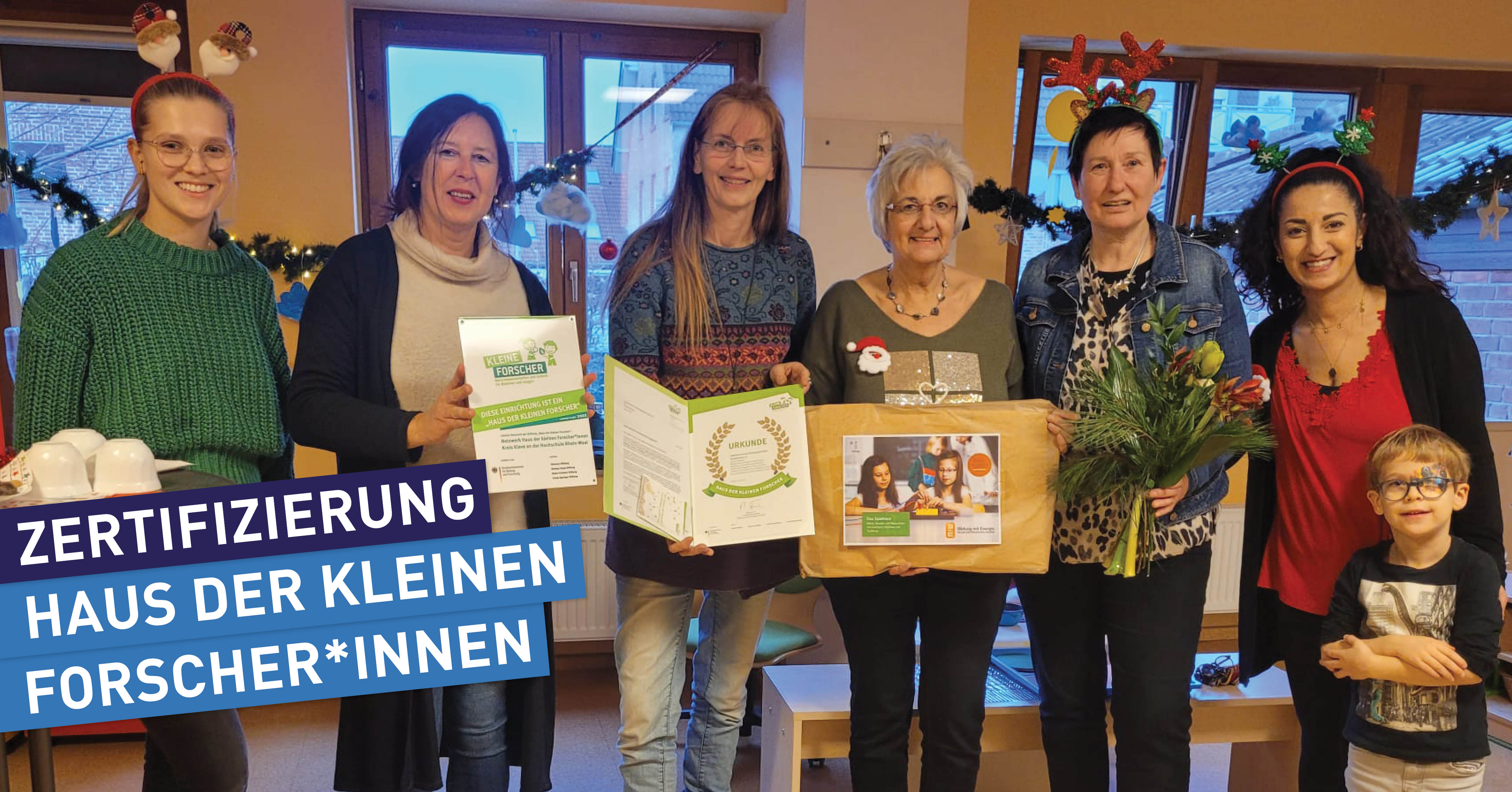
A ‘Haus der kleinen Forscher*innen’ certification is valid for two years. The criteria include, amongst other things, that the nursery or primary school has firmly embedded independent research into everyday topics from the STEM subjects into its daily routine and regularly carries out, reflects on and documents in detail at least one children’s research project focusing on mathematics, computer science, natural sciences and technology (STEM) or Education for Sustainable Development (ESD), and documents at least one of them in detail. In addition to the quality of the process as described above, the quality of guidance and structure are two further pillars of the certification requirements. These include, for example, not only regular professional development for educators in the areas of STEM and ESD, but also ensuring that enquiry-based learning is embedded as an educational component within the nursery’s educational philosophy, and that sufficient space, time and materials are made available for this purpose.
Alongside the Pusteblume nursery, the Abenteuerland nursery in Kalkar, the SOS InKita in Kleve, the Miteinander Family Centre/St. Marien nursery in Wachtendonk and the Marienwasser Primary School in Weeze have been (re-)certified as ‘Houses of Little Researchers’.
There are around 170 primary schools and nurseries in the district of Kleve. Through participation in further training and conducting research with the children, around 130 of these are active in the network; furthermore, a total of 31 institutions are certified as ‘Houses of Little Researchers’.
“It is wonderful that more and more nurseries and primary schools are taking the initiative to take part in training courses and to freely explore STEM subjects and topics related to sustainable education with the children in nurseries and primary schools. In this way, we can work together to promote sustainable STEM education for children. Particular mention must be made of the high level of commitment shown by those nurseries and primary schools that prioritise this area and seek certification as ‘Houses of Little Researchers’,” says Barbara Maué, network coordinator at Rhine-Waal University of Applied Sciences.
Other nurseries and primary schools that are also interested in integrating exploration into their daily routines, or even in becoming certified as ‘Houses of Little Researchers’, are welcome to contact the network coordinator.
Educators at the nurseries and primary schools within the district-wide network undertake regular professional development to support the girls and boys on their daily journey of discovery into the world of science, maths and technology, using everyday materials. The critical thinking and creativity that play a significant role in inquiry-based learning are vital skills for the children’s future, in which new strategies for sustainability and transformation will be crucial.
The next training dates for the ‘Haus der kleinen Forscher*innen’ (Little Scientists’ House) in the Kleve district, open to all interested teachers from nursery and primary schools for both curricular and extracurricular activities, are:
| 31 January 2023 | ‘Researching Electricity and Energy’, Emmerich, registration: www.vhs-kleve.de |
| 23 February 2023 | ‘Cluck, cluck – egg! Exploring chickens and eggs’, Geldern, registration: www.vhs-gelderland.de |
| 9 March 2023 | ‘Exploring the human body’, Kleve, registration: www.vhs-kleve.de |
| 26 April 2023 | ‘ESD Symposium – Opening Doors’, online, registration: barbara.maue(at)hochschule-rhein-waal.de |
| 3 May 2023 | ‘Workshop: Space Adventure – Come Along!’, Kevelaer. Registration: www.vhs-goch.de |
About the ‘Haus der kleinen Forscher*innen’ network in the Kleve district
The non-profit foundation ‘Haus der kleinen Forscher’ is committed to high-quality early education in the fields of mathematics, computing, natural sciences and technology (STEM) – with the aim of equipping girls and boys for the future and empowering them to act sustainably. Together with its local network partners, the foundation offers a nationwide educational programme that supports specialist educators and teachers in providing expert guidance to children of nursery and primary school age as they explore, investigate and learn.
‘Haus der kleinen Forscher’ enhances educational opportunities, fosters an interest in STEM subjects and provides professional development for educational staff. The foundation’s partners are the Siemens Foundation, the Dietmar Hopp Foundation, the Dieter Schwarz Foundation and the Friede Springer Foundation. It is funded by the Federal Ministry of Education and Research.
The ‘Haus der kleinen Forscher*innen’ at Rhine-Waal University of Applied Sciences has been the local network for the district of Kleve since 2010. The majority of nursery schools and a large number of primary schools in the district of Kleve are now part of the network. Educators receive training in science education and education for sustainability through workshops organised by the ‘Haus der kleinen Forscher*innen Kreis Kleve’. The aim is to integrate science education into the daily routine of childcare centres by supporting and nurturing children’s joy of discovery regarding the everyday phenomena around them, and thus their enthusiasm for STEM subjects, always with a view to sustainability. Projects and the annual ‘Young Scientists’ Day’ raise awareness of the network and its objectives amongst a wider public.
Further information