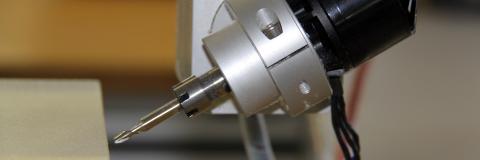
Computer-controlled milling machines (CNC milling machines) are used to carve a specific, pre-designed shape out of a block of material – such as wood, plastic, ceramics or metal – by removing (milling away) material. The three-dimensional design of this shape, developed on a computer, is recorded in a data set which – once converted and processed accordingly – sets the milling machine in motion and controls it. For example, any kind of recess can be milled into a wooden cube, or a relief can be carved out of a smooth surface. Such comparatively simple shapes can be produced using standard three-axis milling machines. However, to produce complex shapes (with many corners and edges), a milling machine with additional axes is required, such as the newly acquired five-axis milling machine at Rhein-Waal University of Applied Sciences. It enables the milling tools to be positioned optimally against the workpiece from all sides, allowing, for example, the production of complex machine parts.
“We regard the link between research, study and teaching as a key component of knowledge exchange, knowledge renewal and knowledge transfer. To achieve this, we need excellent facilities equipped with state-of-the-art manufacturing technologies. With the recent acquisition of the five-axis milling machine, we can further expand the university’s technical infrastructure and enhance application-oriented and practical teaching for our students,” says Dr Heide Naderer, President of Rhein-Waal University of Applied Sciences.
The five-axis milling machine will initially be used primarily for teaching purposes. Students can gain their first experience of modern manufacturing technologies in the Rhein-Waal University of Applied Sciences’ FabLab, whilst also learning how to operate the milling machine. “We chose this machine because it is user-friendly and rarely breaks down, which is an important requirement for its use in teaching. The knowledge students gain from using this machine can be applied to other, larger machines,” says Prof. Dr Karsten Nebe, Director of the FabLab at Rhein-Waal University of Applied Sciences.
A donation from Sparkasse Duisburg made the purchase of the new milling machine possible. “Through our commitment to Rhein-Waal University of Applied Sciences, we are investing in education and, in doing so, making a sustainable investment in the structural transformation of Kamp-Lintfort. We are particularly keen to support investment in the FabLab’s equipment, as not only students but also local residents benefit from it and can make use of the FabLab,” says Ulrich Schneidewind, Deputy Chairman of the Board of Sparkasse Duisburg.