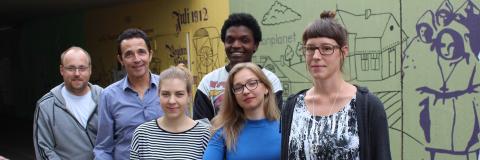
Kleve/Kamp-Lintfort, 22 September 2016: The underpass leading to the school complex on Moerser Straße is set to become more colourful: Under the guidance of Prof. Jörg Petri, Professor of Media Production, and Jana-Lina Berkenbusch, research assistant in Communication Design at Rhine-Waal University of Applied Sciences, students Marija Piliponyte, Vera Baranets and Mohamed Diallo are bringing scenes from Kamp-Lintfort’s local history to life on the walls.
In keeping with the project’s title, the students have selected various aspects of Kamp-Lintfort’s history and illustrated them, such as the Friedrich Heinrich coal mine or Isabella Clara Eugenia, the Spanish governor of the Netherlands, after whom the Fossa Eugeniana is named. The students created the illustrations based on old photographs from the town archives and then assembled them on the computer. The concept involves dividing the walls into three sections representing different periods in time. Starting in the year 856 with the first recorded mention of Kamp-Lintfort, through the era of the Cistercian monks and coal mining, right up to the modern era, the present day and the future. The walls should feature not only clear motifs, but also events and moments that will surprise the residents of Kamp-Lintfort.
“We want to broaden the students’ perspective on design: how do the level of detail, colours or line work change when I transfer a drawing from paper onto a wall,” explains Petri. “How do the sharpness of detail, colours or line work change when a drawing is transferred from paper onto a wall,” adds Berkenbusch. “As Kamp-Lintfort is, and will continue to be, a town in flux, the theme ‘History of Kamp-Lintfort’ was the obvious choice for the project. It is intended not only to remind the older generation of Kamp-Lintfort’s history, but also to show the younger generation just how much has changed in Kamp-Lintfort over time. Many of the passers-by whilst the painting was being done, for example, were very surprised to learn that there used to be a tram in Kamp-Lintfort. “Residents generally felt a strong connection to the motifs on the bridge, as they recognised many of the buildings depicted,” says Berkenbusch.
“Projects like this bring the work of the university and its students right into the heart of the town and allow people to experience it for themselves,” said Mayor Prof. Dr Christoph Landscheidt, emphasising the decision to support the project.
Members of the public who are interested are warmly invited to find out more about the project on site and to see the mural for themselves.