Kleve/Kamp-Lintfort, 22 February 2016: There are around 500 animals to see at Kleve Zoo. As well as the red panda, the zoo’s star attraction, visitors can also spot an arctic fox, seals, raccoons, horses and the African porcupine.
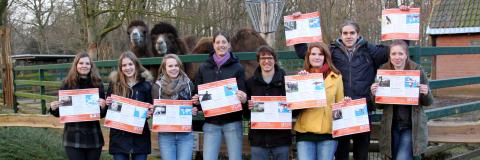
Following its launch last year, the ‘zoological information boards’ project within the ‘Bio Science and Health’ degree programme at the Faculty of Life Sciences – in which new signs are designed for the park’s animal residents – has now been carried out once again. Working in collaboration with project leaders Axel Hinnemann and Ramona Kirsch, research assistants at the university, and Marie-Christine Kuypers, deputy manager of Kleve Zoo, ten students created new informative and eye-catching signs for ten different animal species. As well as gaining experience of working in a team, the main focus for the students during the project was on conducting scientific research into the facts and figures relating to each animal species. The signs were then produced in accordance with the layout developed last year and the zoo’s corporate design guidelines.
For visitors to the zoo, the new orange information boards are a real eye-catcher. From the common raven to the bald eagle and the common buzzard, right through to the red woolly pig and the Asian pygmy otters that recently arrived at the zoo, visitors can now enjoy the new, modern signs at the enclosures. As well as describing the animal species and illustrating information about its distribution using a world map, the signs have been supplemented with a photograph of the animal. The photographs were taken by wildlife photographer Lisa Hanke.
To ensure the new animal signs meet today’s technological standards, a QR code has been placed on each sign. The QR code provides further information about the various animals and their habitats, as well as images. This modern feature is located on the sign and can be scanned using a smartphone. By scanning the code, it is also possible to listen to the information text as an audio recording, which is particularly beneficial for children and people with visual impairments.