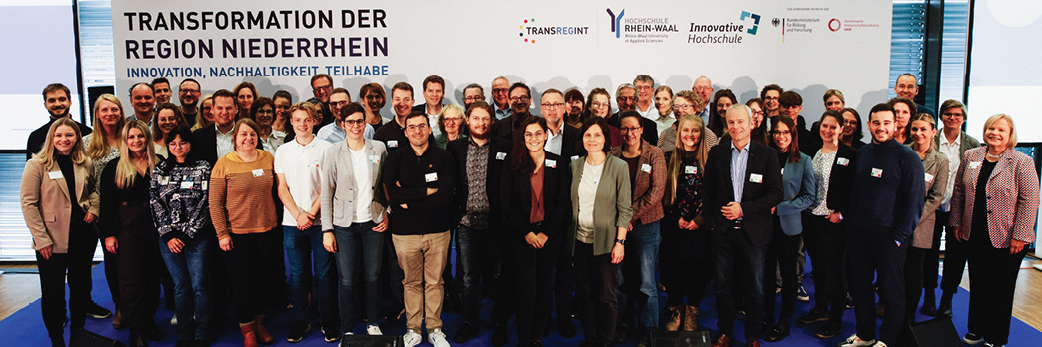
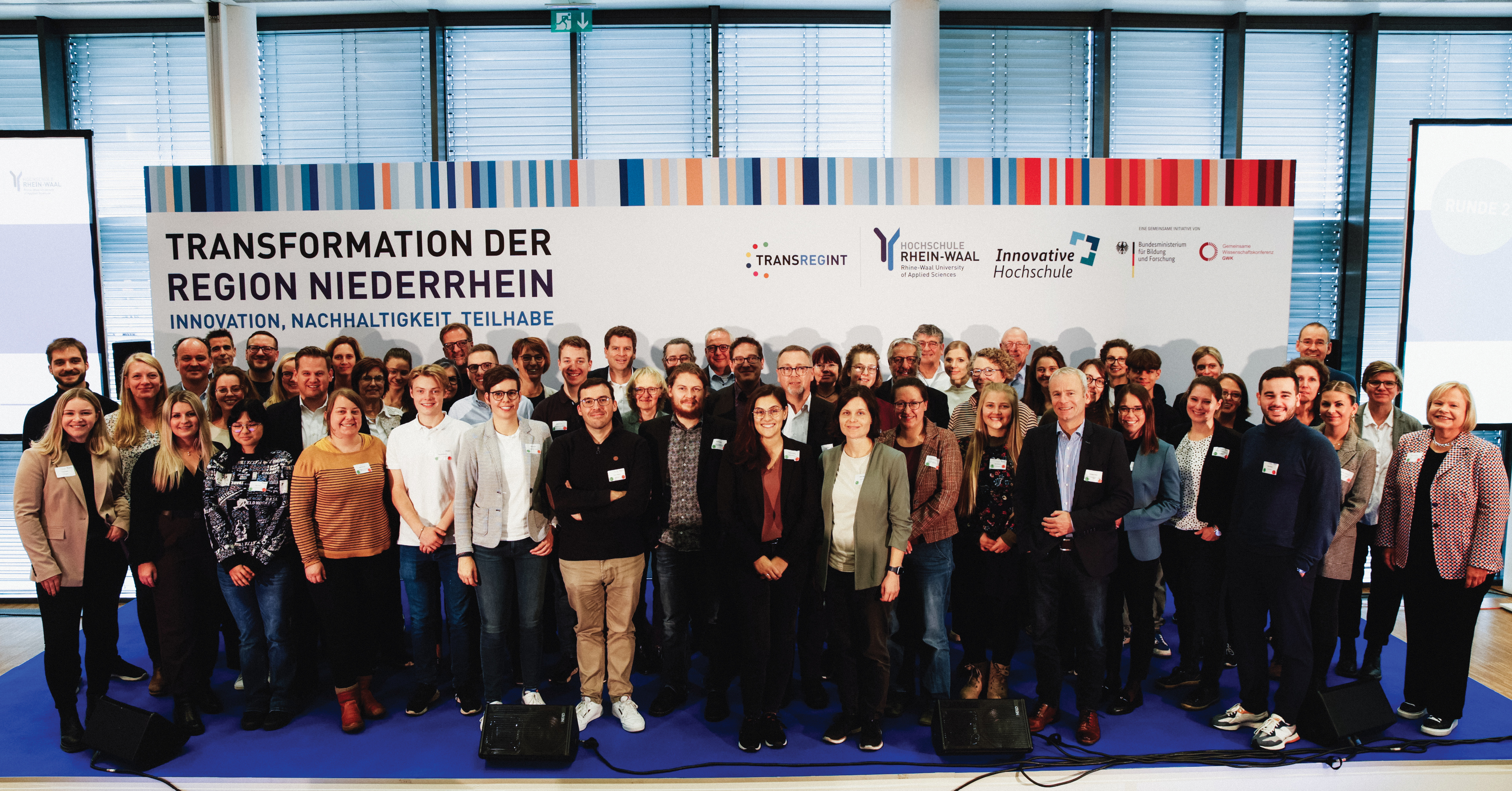
With the support of the ‘City2Sciene’ agency, the first day was spent identifying current challenges and areas for action in various thematic areas – such as ‘Education for Sustainability’, ‘Environment and Ecology’ and ‘Sustainable Economy and Innovation’ – with different groups of participants: Issues such as regional mobility, energy supply, the circular economy and sectors such as the housing market were explicitly highlighted. It was made clear that, across all these areas, one of the key requirements for a sustainable transformation is targeted communication and collaboration amongst all stakeholders in the region. An understanding of the current challenges must be fostered throughout society as a whole, and the public must also be involved in finding solutions. This can be achieved in particular through broad participation and real-life models such as so-called ‘real-world laboratories’. Dr Barbara Hendricks, former Federal Minister for the Environment, Nature Conservation, Building and Nuclear Safety, also emphasised the importance of effective communication and the involvement of all stakeholders during the event’s opening session. She stressed that policymakers must be aware of the extent to which society can reasonably be expected to undergo transformation.
The aim of the second day was to develop concrete ideas and projects to be undertaken as part of the five-year TransRegINT project. To this end, participants were assigned specific tasks, such as building a prototype for an immersive and self-sufficient building or creating AI-powered vehicles and mobile communication hubs. The tasks were to be tackled in four phases: brainstorming and formulating ideas; developing solutions and visualising them through the joint construction of models; assessing funding and feasibility; and finally presenting the results to the other working groups.
As a solution for a mobile communication hub, the idea of a communication bus was put forward, which could also visit small villages in the Lower Rhine region and thus reach a wide variety of target groups across the different communities. The aim is to facilitate participation in the exchange of knowledge. To create a tangible, self-sufficient building, the idea was developed to construct a block of flats comprising apartments, meeting spaces and seminar rooms, as well as other modular facilities designed to foster exchange. Equipped with self-sufficient technology such as photovoltaic modules for electricity and hot water supply, combined with a heat pump and a water storage tank, a wind turbine and a hydrogen storage system, new energy systems will not only be brought to life but also further developed and tested through scientific monitoring. In this way, energy data could also be made accessible to visitors and future residents, helping to raise awareness of energy consumption.
At the ‘ZukunftsLab’ Lower Rhine, numerous ideas and solutions for the sustainable transformation of the Lower Rhine region were developed. However, the focus was not on developing projects that could be implemented immediately. According to Vanessa Meinen, coordinator of the competence hub within the TransRegINT project, the aim was rather to identify the ideas that the various stakeholders have for the future, to determine which initiatives already exist in some cases, and to bring these together. Rainer Benien, Deputy Mayor of the City of Wesel, also gained insights from his participation in the ‘ZukunftsLab’ that could be applied to the City of Wesel, such as an innovation centre or the involvement of the local community: “These projects could be trialled in the City of Wesel’s real-world laboratory,” said Benien. The interdisciplinary event format, with its innovative approach, left a lasting impression on the participants.
In conclusion, Prof. Dr Locker-Grütjen made it clear that the ‘ZukunftsLab’ had provided the impetus to drive forward the themes of innovation, sustainability and participation for the Lower Rhine region. According to Prof. Dr Peter Kisters, HSRW Vice-President for Research, Innovation and Transfer, the aim of a further Zukunftslab in 2026 is to reflect on the changes that will have taken place by then and build on them. The enthusiasm and creativity of all participants served as an inspiration for the further development of the TransRegINT transformation project.
Information on the TransRegINT
project The stated aim of the five-year project ‘TransRegINT – Transformation of the Lower Rhine Region: Innovation, Sustainability, Participation’ is to transfer scientific findings into the economy and society. It addresses current challenges that can only be overcome through joint efforts. The aim is for the university, as a scientific institution, to contribute to developments that support both regional and global solutions and thus enable sustainable change. In doing so, Rhein-Waal University of Applied Sciences (HSRW) is guided by the United Nations’ 17 Sustainable Development Goals.
To put this into practice, the university utilises a wide variety of approaches and goes beyond the mere transfer of knowledge: for example, researchers collaborate with stakeholders from the agricultural sector; the HSRW incorporates citizens’ ideas through competitions and workshops; and it imparts skills in the field of sustainability in creative ways. HSRW also collaborates with regional businesses and is investigating, amongst other things, the potential of hydrogen as a new energy source for the Lower Rhine region. There are also plans to open up the university through laboratory networks or a walk-in digital real-world laboratory. Social transformation processes, for example in the labour market, are also being studied.
The project is funded through the ‘Innovative University’ programme by the Federal Ministry of Education and Research. ‘Innovative University’ is a federal-state initiative to promote the research-based transfer of ideas, knowledge and technology. In particular, it aims to support universities of applied sciences as well as small and medium-sized universities in distinguishing themselves in the areas of transfer and innovation and in strengthening their strategic role within the regional and supra-regional innovation system. In total, the federal and state governments are providing up to 285 million euros for the second funding round. Ninety per cent of the funding is provided by the federal government and ten per cent by the federal state in which the respective university is located. In 2022, a total of 55 universities were selected for the second funding period, nine of them in North Rhine-Westphalia, including the HSRW. The TransRegINT project will receive funding of just under ten million euros until the end of 2027.