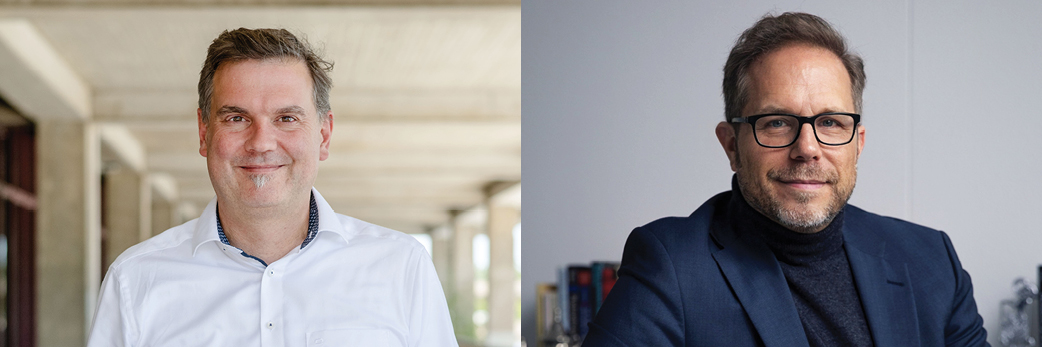
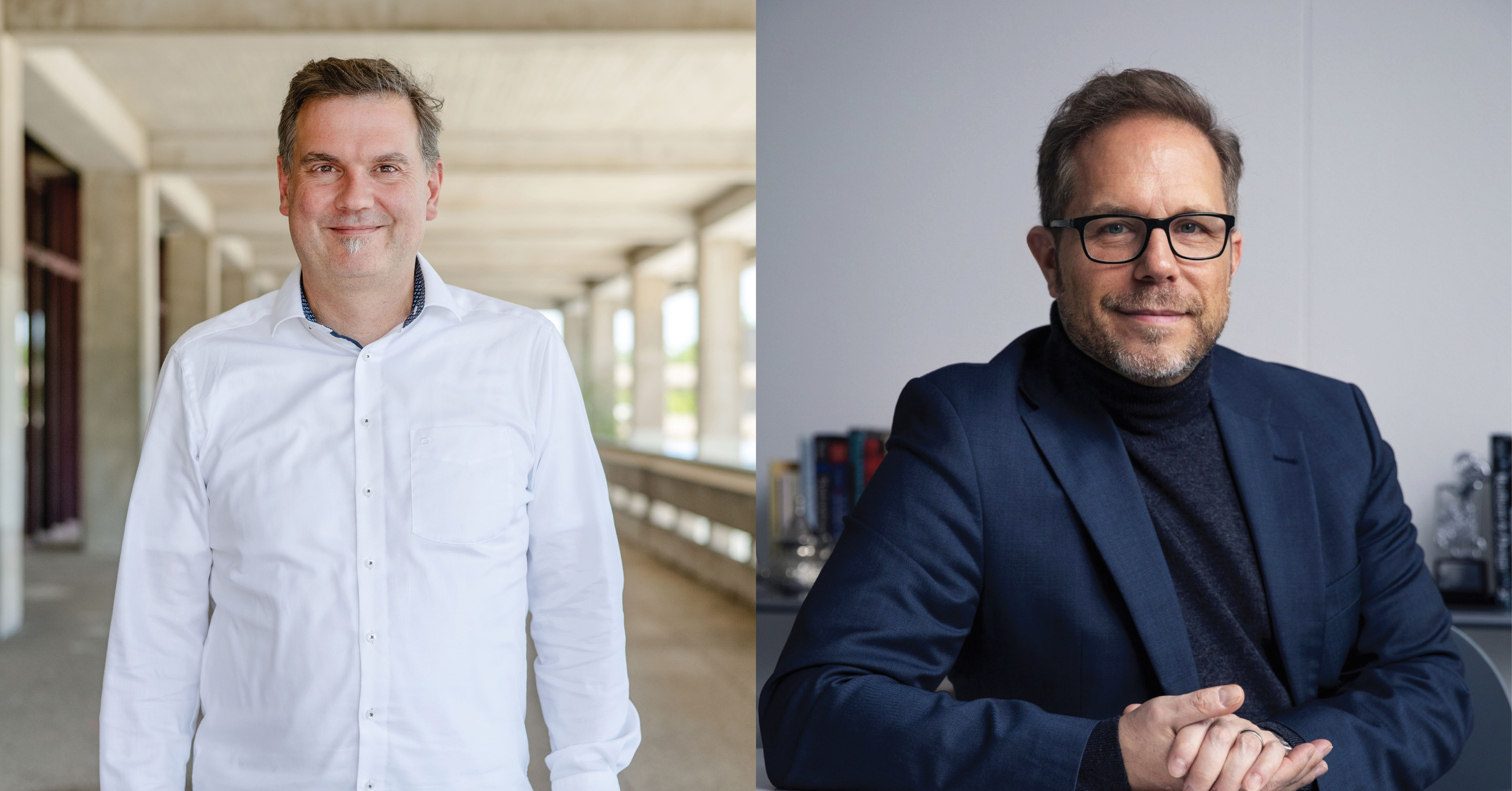
Both academics have many years’ experience in a wide range of sustainability-related fields. Prof. Dr Jan-Hendrik Kamlage was previously the Research Director of the Centre for Environmental Management, Resources and Energy (CURE) in Bochum. He has spent many years working on interdisciplinary and transdisciplinary research into sustainability and transformation, focusing on various aspects of socio-ecological transformation such as the sustainable bioeconomy, grid expansion, regions undergoing structural change, and the mobility transition in German cities.
Prof. Dr Klaus Krumme most recently headed the Joint Centre for Urban Systems (JUS), an interdisciplinary institution dedicated to the research and sustainable development of cities and metropolitan areas, as part of the Metropolis Research competence area. Throughout his career, Krumme has (co-)led various sustainability-oriented projects, including in the fields of logistics, mobility and supply, resource cycles, consumption and trade, as well as regional and urban development.
The two visiting professorships, funded by the Herne-based company E-Gruppe, thus complement their roles as founding directors of EUZENT (European Centre for Sustainability Transformation) at the university, a position they have both held since March 2023. HSRW President Prof. Dr Oliver Locker-Grütjen is delighted to welcome the two new visiting professors: “The themes of sustainability and transformation are firmly embedded in the university’s objectives. The visiting professorships will strengthen and support this in teaching and research, as well as in the development of EUZENT at the HSRW.”
Krumme and Kamlage see the focus of their work as being to firmly establish EUZENT in the region and to place strong emphasis on academia playing an active role in the field of sustainability. “It is important to me that, through EUZENT, we create new structures and momentum within the university, whilst also providing active support for those who wish to dedicate themselves to the task of sustainability transformation, whether they come from academia, business, civil society, the public sector or politics,” emphasises Krumme. Kamlage adds: “I see this as a unique opportunity to bring a truly exciting idea from the Lower Rhine to the world: that of a European Centre for Sustainability Transformation.”
European Centre for Sustainability Transformation (‘EUZENT’)
The planned European Centre for Sustainability Transformation (‘EUZENT’) is set to become a centre of regional, national and international prominence in the coming years. To this end, the HSRW plans to develop and expand systemic, ecological and participatory-democratic capacities for renewability and resilience in the economy and society – anchored in the Euregio, with a national and international reach and network.
‘EUZENT’ forms part of the funding provided under the federal-state ‘Innovative University’ initiative, in which the university prevailed this year against numerous competitors with its ‘TransRegINT’ concept (Transformation of the Lower Rhine Region – Innovation, Sustainability, Participation). A cornerstone of the submitted concept is the idea of ‘EUZENT’. This also forms part of the university’s development plans in the context of drawing up the University Development Plan 2030.