Microplastics have so far been added to cosmetic products (e.g. shower scrubs or facial scrubs) or detergents (laundry and cleaning products) as abrasives and opacifiers. These are water-insoluble, solid plastics measuring five millimetres or less.[1] Whilst dermatologists[2] sometimes emphasise that exfoliants are not necessary for healthy skin, we’ve all experienced that pleasantly soft feeling on the skin after exfoliating.
The problem with added microplastics is that the particles enter the wastewater during the washing process. The particles that are flushed into the sewer system as a result are so small that sewage treatment works cannot filter them out. At sewage treatment works, wastewater undergoes a multi-stage treatment process: solids are removed, UV light kills germs, and membrane systems filter out bacteria and viruses. However, sewage treatment works, with their multi-stage treatment process, are not designed to deal with micro-contaminants. These include, amongst other things, microplastics. For this reason, the EU, through the REACH chemicals regulation, has banned the use of microplastics in products whose residues enter the wastewater but nevertheless pass through the treatment plant after the treatment process and end up in water bodies.
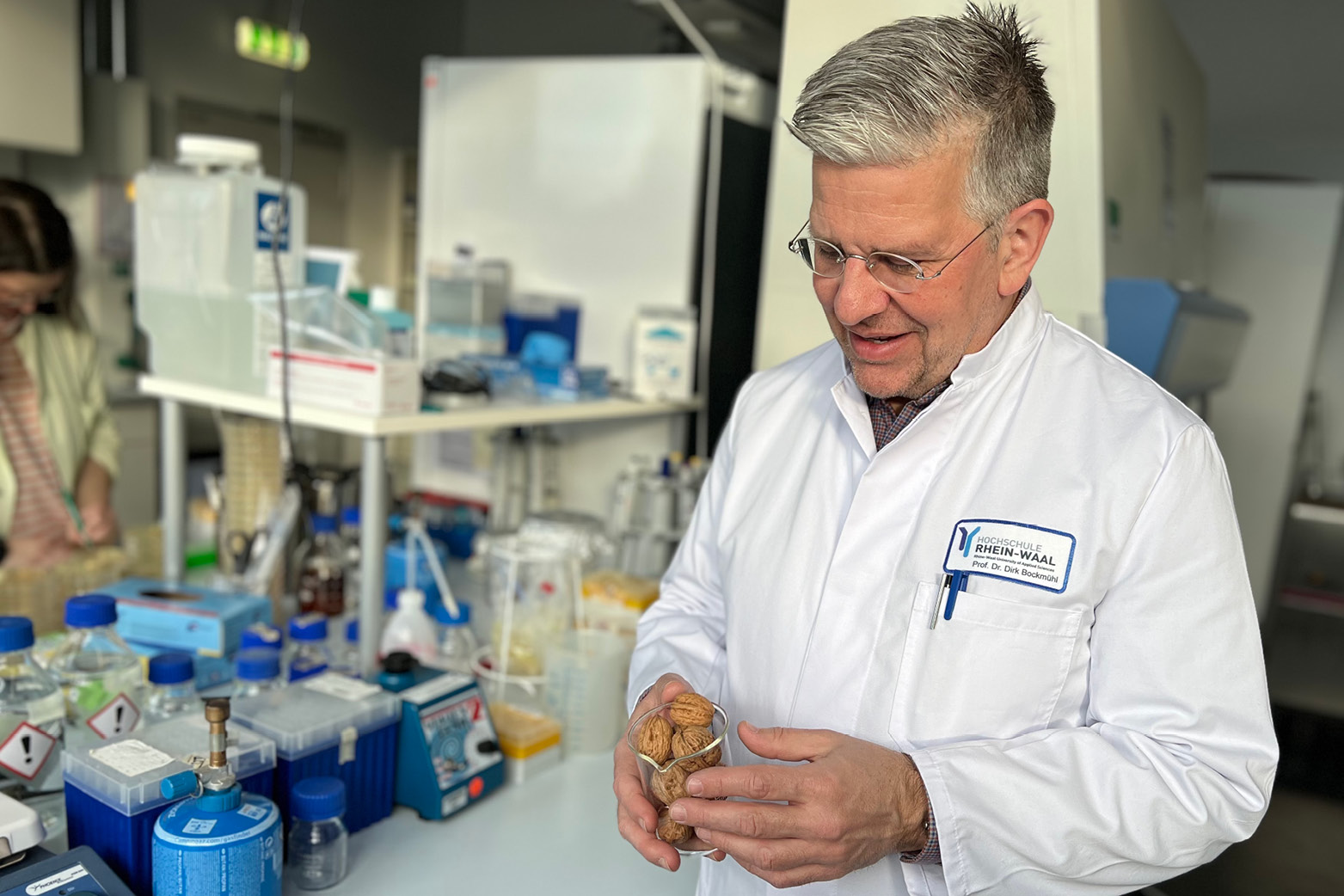
Although the proportion of microplastics entering wastewater via exfoliants or detergents is quite low, research into alternatives is a step in the right direction. Robert Beinio, Managing Director of bb med., is aware of this responsibility: “We stopped using microplastics a long time ago. Furthermore, the umbrella organisation for European cosmetics associations recommended as early as 2015 that plastic particles should no longer be used in cosmetics,” he emphasises. Nevertheless, Robert Beinio and Dr Dirk Bockmühl, Professor of Hygiene and Microbiology at HSRW, have set themselves the goal of using natural alternatives. “We are taking a closer look at one of these in our project: walnut shells,” says the professor from the Faculty of Life Sciences.
To understand this better, our journey takes us to Kyrgyzstan: “The country has magnificent, natural walnut forests, the sustainable use of which we can ensure through the SUFACHAIN project. In doing so, we also want to make use of the by-products of the walnut harvest. As part of the project, we intend to investigate the technological challenges associated with this potential use – notably the grinding process to produce particles without sharp edges and the microbiological quality – and find solutions,” says Bockmühl, explaining the research project’s approach.
There are, however, a number of hurdles to overcome in order to support Kyrgyz farmers. Bockmühl is well aware of this: “Walnut shells, as well as the apricot kernel shells also being considered in the project, are repeatedly exposed to microbial contamination – for example, from mould – during growth, harvesting and further processing. To obtain a safe cosmetic ingredient, these microbiological problems must be identified and resolved. We aim to achieve this within the project in such a way that the products can be processed using as few biocides as possible and without resorting to potentially problematic treatment methods such as irradiation. To this end, we primarily aim to optimise process steps in Kyrgyzstan with our local partners, whilst also developing potential, low-risk preservation methods,” said the HSRW professor.
And even before such a product can be brought to market, there are a number of product safety considerations to bear in mind: “In the case of an exfoliating product containing stone fruit flours, for example, the sharpness of the particles is crucial. Depending on the origin of the particles and the degree of grinding, they may be suitable for use on the face or better suited to a foot scrub,” explains Beinio, the entrepreneur from Kalkar. “The product must also pass a storage test at various temperatures, known as a stability test. This involves accelerated ageing. Microbiological safety is then assessed through a preservative stress test. To ensure the safety of consumers using the product, a toxicological report is drawn up and a dermatological test is carried out,” explains Bockmühl. Beinio adds that the various natural cosmetics labels and their certification requirements also play an important role.
According to Bockmühl, the aim of the project is, on the one hand, to develop a cosmetic ingredient, not a finished cosmetic product. Thanks to the project design, which involves working with final formulations, the product could in fact be brought to market quite quickly once the project has been successfully completed. On the other hand, the project also aims to “create marketing opportunities for Kyrgyz farmers to sell walnut shells, which would otherwise be nothing more than waste. In doing so, we intend to explore possibilities – from both a scientific and industrial perspective – to overcome the aforementioned technological hurdles by mapping out and providing scientific support for the entire product development process, from the walnut shell ingredient right through to the finished cosmetic product, with a focus on Kyrgyz products. Ultimately, the aim is for farmers to optimise their value creation in future by marketing high-quality products – including those made from what is currently waste from food production,” says the HSRW professor, summarising the project.
The SUFACHAIN project aims to create a win-win-win situation in line with the three pillars of sustainable management: ecology, economy and social considerations. A waste product is processed further, thereby providing economic support to farmers. And a company from Kalkar in the Lower Rhine region stands to benefit from being able to bring more sustainable products to market in the near future.
Although the development of a cosmetic product, including all the necessary tests, can take a year or even longer, the insights and experience gained from the project are significant not only in the Lower Rhine region and in Kyrgyzstan – manufacturers across Europe could benefit from them.
About the SUFACHAIN project – Sustainable agroforestry value chains
The agricultural sector is a vital source of livelihood for the rural population in Central Asia. At the same time, the region’s agricultural and forest landscapes are threatened by degradation (permanent alteration and, in some cases, loss of soil structure), a situation exacerbated by population growth and economic development. The SUFACHAIN project therefore aims to analyse agroforestry systems and integrate them into local land use, as well as to develop products and technologies that contribute to sustainable resource use and local value creation.
Agroforestry systems are defined as land-use systems in which woody plants (trees or shrubs) are combined with arable crops and/or livestock farming on a given area in such a way that ecological and economic benefits arise between the various components.
The project is funded with just under 1.4 million euros by the Federal Ministry of Education and Research (BMBF) as part of the ‘CLIENT II – International Partnerships for Sustainable Innovation’ initiative, with a project duration of two years. Regional priorities have been set in Kyrgyzstan, Tajikistan and Uzbekistan.
The development of more efficient technologies for utilising waste materials from the processing stage – such as walnut shells or apricot kernels – is one of the project’s six work packages. The project partners are the companies bb med. Product GmbH from Kalkar in North Rhine-Westphalia and A+S Biotech from Völklingen in Saarland.
Further information: www.sufachain.org
[1] https://www.umweltbundesamt.de/themen/mikroplastik-in-kosmetika-was-ist-das, accessed on 6 December 2023
[2] For example, the dermatologist and author Dr Yael Adler, who is frequently quoted in the media; see, amongst others, here: https://www.deutschlandfunknova.de/beitrag/diy-kosmetik-worauf-wir-achten-sollten