This year, the ‘Klever Birne’ Sustainability Award, presented by the City of Kleve and the TransRegINT project (Transformation of the Lower Rhine Region: Innovation, Sustainability and Participation) at the Rhine-Waal University of Applied Sciences (HSRW), is entirely dedicated to the sharing economy. The aim is to find creative solutions that encourage Kleve’s residents to make sensible and collaborative use of resources in areas such as water, transport and energy, as well as unused items, knowledge or time.
Using things better, less, differently, more fairly and sustainably – sharing initiatives introduce themselves
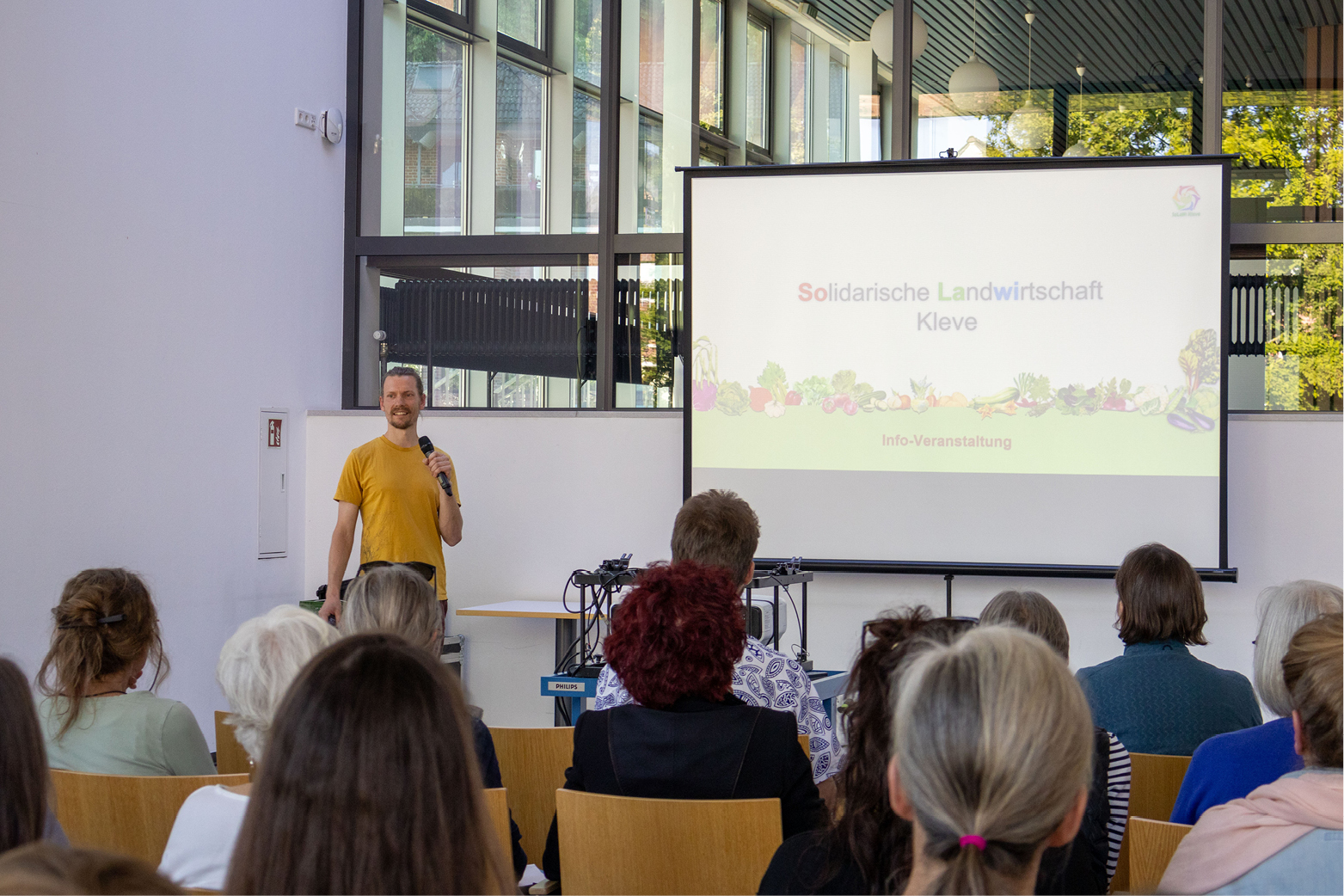
In line with this, on 19 May the City of Kleve and the TransRegINT project organised an information event at DialogPunkt Kleve for interested residents, offering them a glimpse behind the scenes of the sharing economy concept. In a 20-minute presentation, Prof. Dr Oliver Stengel from Bochum University of Applied Sciences explained the link between climate change and consumer behaviour. Whilst advertising suggests that buying things is normal, a matter of course and necessary, science speaks of overconsumption, as the associated use of resources increases the pressure on the Earth and the climate. Sharing, as the cornerstone of a sustainable society, should be made as easy as possible.
Relevant initiatives then introduced themselves in a brief presentation. The mini-fair that followed provided an opportunity for further discussion. Among those present were Andreas Münnig from the Solidarische Landwirtschaft Kleve e.V. (Solawi) association and Andrea Joosten, head of the Emmerich am Rhein municipal library, who presented the seed library she had set up. Pascale van Koeverden, the cycling officer, presented the city of Kleve’s cargo bike-sharing scheme; Jonas Lamik, head of the HSRW library, spoke about the ‘Library of Things’, which is currently being set up. Here, tools, household items – ranging from pots to contact grills – as well as play and sports equipment can be borrowed. Barbara Maué from the ‘Kinder forschen’ Foundation provided information on education for sustainable development in nurseries and schools.
Ideas sought for community-based swapping and lending in Kleve
Will these and other initiatives spread far enough to bring about a tangible change for the climate? The outcome is uncertain, as it depends on each and every one of us: can we, as a society, move away from individual consumption and towards greater communal sharing? In Kleve, residents, private groups, students, educational establishments, businesses, clubs, start-ups and organisations have until 30 June to submit their own ideas. Whether it’s spaces and areas, the contents of overflowing second-hand boxes, transport, artistic ideas or practical suggestions, this is a chance to think outside the box and let your imagination run wild. The main thing is that competition entries should be feasible in Kleve, follow the principles of the sharing economy and address at least one of the 17 Sustainable Development Goals. In addition to three prizes, each comprising a cash sum of between €1,000 and €2,000, coaching and a certificate, there is also the chance to win a people’s choice award.
Further information is available on the website www.kleverbirne.de.
Press contact for TransRegINT
: Christina Martens
, ‘Interaction Hub’ coordinator for the TransRegINT project
Rhein-Waal
University of Applied Sciences, Kleve
Campus, Marie-Curie-Straße 1
, D-47533 Kleve
Tel.: +49 (0) 2821 806 73-9637
Email:transregint@hochschule-rhein-waal.de
Website: www.hochschule-rhein-waal.de