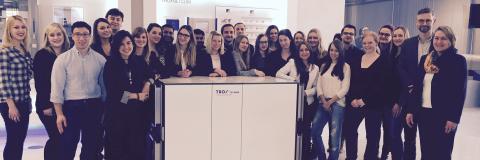
Kleve/Kamp-Lintfort, 27 April 2016: As part of a semester-long project, 26 first- and second-semester students on the ‘International Management and Psychology’ Master’s programme at the Faculty of Communication and Environment investigated the influence of indoor climate and heating, ventilation and air-conditioning (HVAC) systems on well-being.
In collaboration with the company ‘Trox GmbH’, the students analysed the range of factors influencing individual well-being in private households. To this end, over 80 owners of houses or flats in the region were surveyed using qualitative psychological methods. In addition to individual perceptions of ‘comfortable indoor temperatures’, the research revealed a strong influence of social factors.
‘Achieving an optimal indoor climate at home proves to be a difficult undertaking given the number of people involved. As soon as the home also becomes a social space where people of different generations, with differing ideas and sensibilities, live together in a confined space, reaching a consensus on climate conditions becomes difficult. Practices such as airing rooms in bursts, constantly turning the heating up and down, or fleeing rooms and houses in a hurry illustrate the difficulty of agreeing on a uniform indoor climate’, explains Prof. Dr Thomas Heun, Professor of Consumer Behaviour and Market Research at Rhine-Waal University of Applied Sciences.
“Trox GmbH has been developing components, units and systems for the air-conditioning and ventilation of rooms for around 65 years. In addition to well-being and comfort, this also involves the issue of safety. Over this long period, we have observed a shift in individual perceptions of climate and ventilation. Whilst air conditioning in cars used to be largely unacceptable, it is now almost impossible to imagine life without it. Against the backdrop of this shift in perception – and consequently a change in attitude amongst flat and house owners – this study was carried out as a semester project,” says Christine Roßkothen, Head of Marketing at Trox GmbH.
Individual perceptions are also strongly influenced by culture. Despite the perception of ‘rising temperatures’, the test subjects reacted rather cautiously to air-conditioning solutions. According to Prof. Heun, many people have “also had negative experiences with air-conditioning technology” in public spaces or whilst travelling. When air-conditioning systems produce low temperatures, fears of falling ill increase, particularly if people feel they have little control over these systems.
“Another finding from the study for Trox GmbH is that many people equate pure cooling in residential buildings – for example, using split-system units – with air-conditioning technology. However, this is often viewed rather critically due to draughts and locally low temperatures. Technically, however, these systems differ greatly from the comfort air-conditioning systems for which Trox GmbH is known, and which make it possible to ensure a pleasant indoor climate with a high level of thermal comfort – without draughts – and good indoor air quality. “Our close collaboration with Rhein-Waal University of Applied Sciences, and consequently our use of newer methods – for example from the field of psychology – promotes the development and transfer of knowledge in both directions: between academia and industry,” concludes Christine Roßkothen.