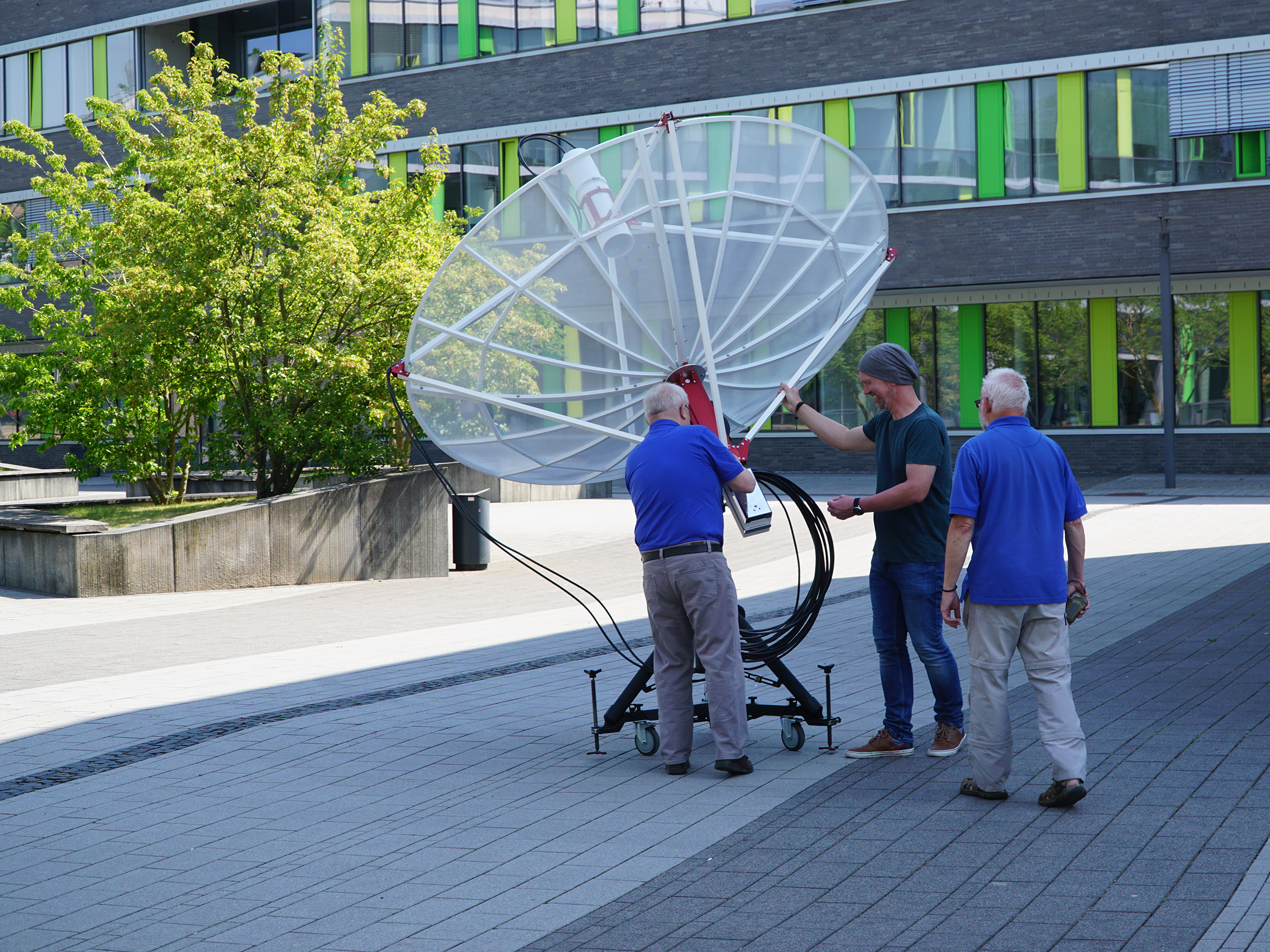
 An inaugural course for computer science students, entitled ‘Methods and Tools of Modern Astronomy’, is already taking place this summer term under the supervision of Dr Monika Marx-Zimmer and Prof. Dr Frank Zimmer. This course not only provides fundamental knowledge about radio telescopes and how they work, but also demonstrates ways in which radio astronomy can be practised using simple equipment. In experiments developed largely by Moritz Prüm, a research assistant at the Faculty of Communication and Environment, students learn, for example, how to measure neutral hydrogen in our own galaxy using a waveguide on the research terrace, or how to ‘tap into’ data from a weather satellite using a simple antenna and analyse it on a computer. In addition to fundamental astronomical knowledge, the course also teaches methodological skills such as the measurement and analysis of data, the application of machine learning algorithms, scientific visualisations and computer simulations. As well as being used for teaching, the radio telescope is to be made available to all students at the university – for example, in cross-degree-programme courses or interdisciplinary projects – so that further experiments can be set up and developed.
In addition, school pupils will also be given the opportunity to use the telescope, for example as part of summer schools. Through simple measurements such as the rotation curve of the Milky Way, they could work directly on key questions in physics and astronomy, such as: Does dark matter exist? Does the theory of gravitation need to be revised? These questions and experiments already attracted considerable interest in June at the faculty’s open day in Kamp-Lintfort.
The use of the radio telescope also opens up the possibility of further expanding collaboration with the Astropeiler Stockert e.V. association, the Argelander Institute for Astronomy at the University of Bonn and the Max Planck Institute for Radio Astronomy in Bonn. This collaboration enables an intensive exchange of expertise and promotes scientific networking. When the telescope is not being used for measurements, it is available in the university’s FabLab.
With the support of experts from the Astropeiler Stockert Association – notably Dr Wolfgang Herrmann and Thomas Buchsteiner – as well as PD Dr habil. Jürgen Kerp from the Argelander Institute for Astronomy at the University of Bonn, the radio telescope was commissioned on the Kamp-Lintfort campus in June 2023 and the first test measurements were carried out.
Image credit
© Frank Zimmer/HSRW