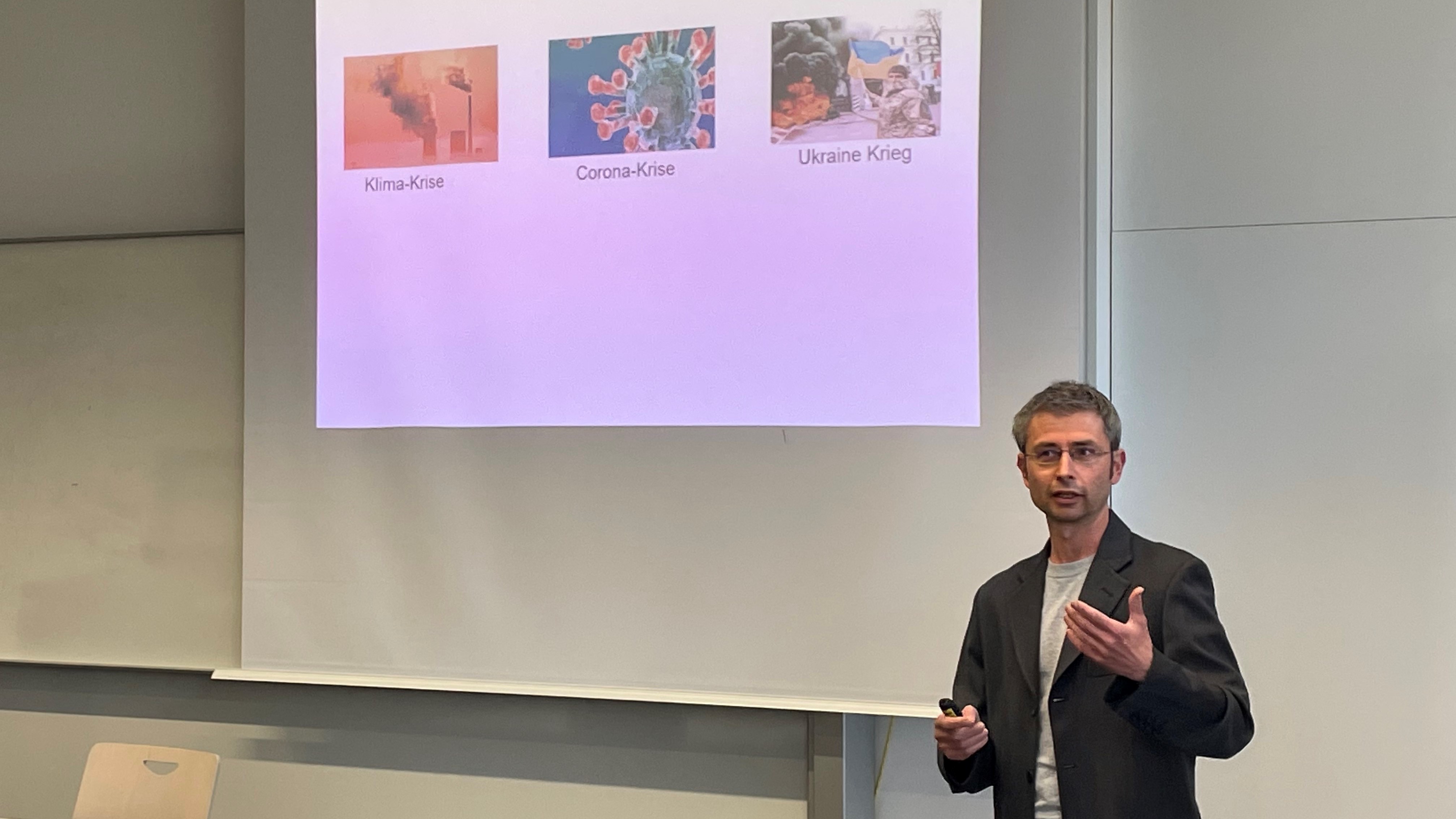
There have always been crises – some long-term in nature, others that strike suddenly. At present, many people feel powerless, as if the Covid-19 pandemic, the climate crisis and the war in Ukraine are dominating their lives more than ever before. However, a lecture evening on 26 April 2022 at the Faculty of Communication and Environment in Kamp-Lintfort demonstrated that people do not have to be entirely at the mercy of the crises that befall them. As part of a ‘Studium Generale aktuell’ event, Professors Nicki Marquardt, Georg Hauck and Freda-Marie Hartung presented strategies for dealing with them. Whilst we have no control over the fact that crises affect us, we do have control over how we deal with them and the extent to which they actually weigh on us.
Crises are unforeseeable events that entail significant negative consequences for those affected. Coping with crisis situations – whether they are personal in nature (such as a serious illness, job loss or the death of a loved one) or on a global scale, such as the current war in Ukraine (including its knock-on effects, such as supply bottlenecks or price rises) – is always associated with intense stress, which can manifest itself not only as anxiety and worry, but also as panic.
Dr Nicki Marquardt, a professor specialising in cognitive, occupational and organisational psychology, outlined the neuropsychological perspective at the start of the lecture evening. He described two types of stress response: an acute, short-term reaction that mobilises the body in a fraction of a second. The sympathetic nervous system releases adrenaline and sends electrical impulses (such as an increased heart rate and higher blood pressure), which prepare us for a critical situation. According to Marquardt, this short-term reaction is therefore beneficial, as it enables our body to respond immediately to danger. Stress becomes problematic when it becomes a long-term phenomenon, as this leads to the release of stress hormones that attack our cardiovascular system or destroy nerve cells. After all, our bodies are not designed to cope with this over the long term.
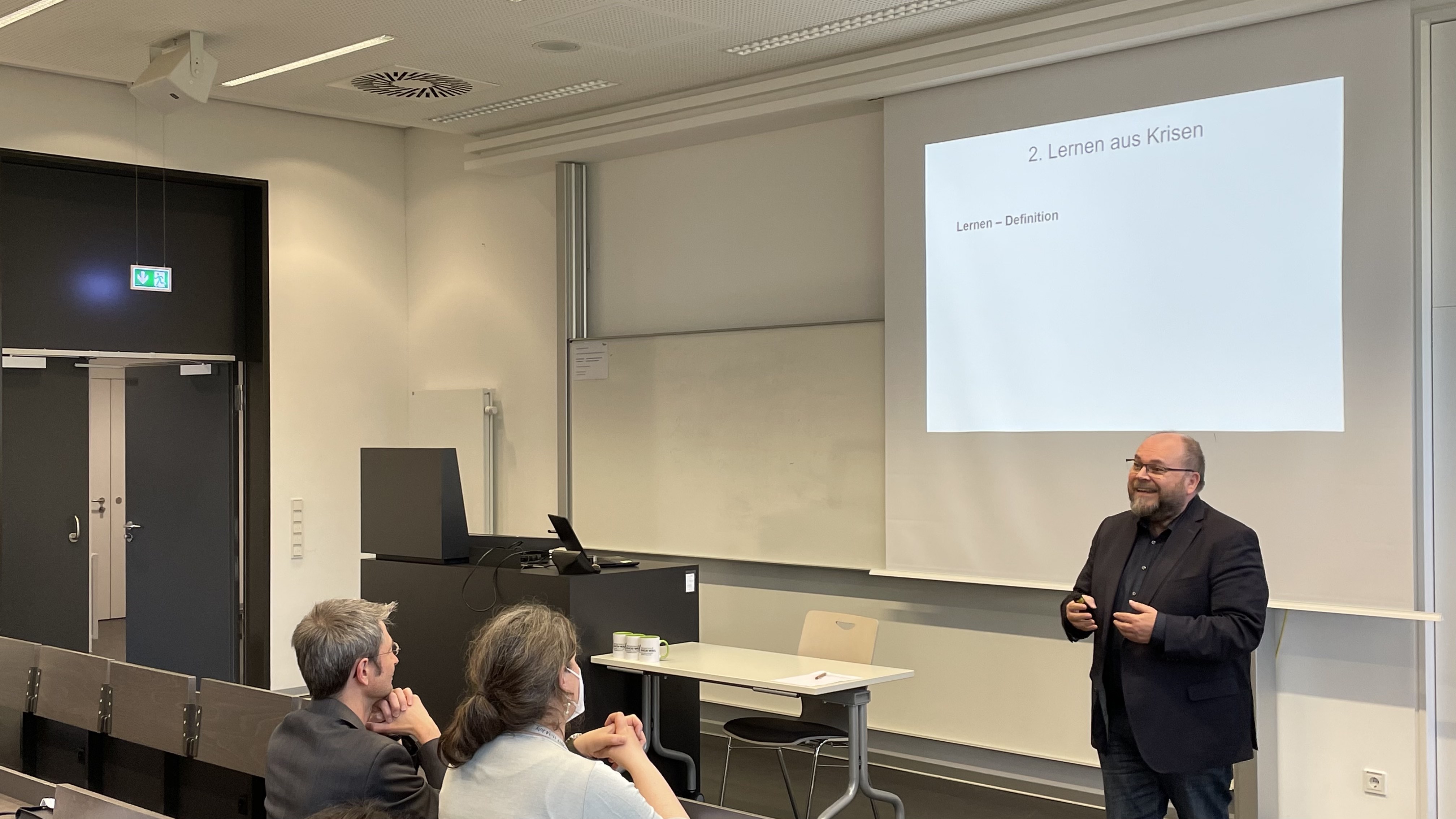
Dr Georg Hauck, Professor of Communication Psychology and Organisational Learning, then discussed the link between crisis management and personal learning history: from an early age, everyone learns to deal with crises. Over time, this learning history provides us with a repertoire that we can draw on unconsciously. When crises are of a novel nature – for example, the COVID-19 pandemic or, for many people, the war in Ukraine – we resort to what is known as ‘model learning’. We observe how our family, those around us, or even our role models and experts featured in the media deal with and assess a crisis. We generally do not do this consciously; rather, it happens implicitly. Unlike conscious learning – for example, when I sit down to study for an exam – this requires less energy: it is, in a sense, a cognitive automatism that helps us learn to cope with (new types of) crises.
Dr Freda-Marie Hartung, Professor of Psychological Diagnostics, Differential and Personality Psychology, spoke about the individual prerequisites a person needs to cope with crises. In doing so, she focused on the concept of resilience – that is, a person’s ability to cope with adverse circumstances in life. This resilience stems from a wide variety of key personality traits, such as problem-solving skills, emotional stability and other abilities. A key characteristic associated with resilience is optimism – that is, holding positive expectations regarding future developments. This is a crucial protective factor that can have a positive effect on both mental and physical well-being. For example, it can mean that optimistic people release fewer stress hormones in crisis situations and are thus better protected in the long term.
The three presentations make it clear: we are not fundamentally at the mercy of our environment; rather, our experiences, our learning behaviours and our resources help us to cope with crises. In times of crisis, focusing on what we can personally influence helps us to deal with them.