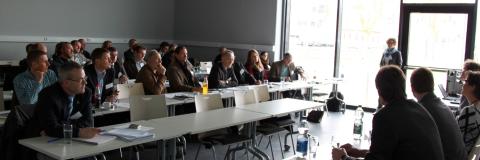
Kleve/Kamp-Lintfort, 18 May 2016: The aim of the workshop ‘Sustainability Assessment and Management in Agriculture’ was to highlight the possibilities and limitations of the models presented for measuring, assessing and managing sustainability on farms. At the start of the workshop, participants were given an overview of sustainability assessments and introduced to life-cycle assessment as a tool to support decision-making on farms. The workshop also examined neighbouring countries, such as Austria, and presented a sustainability programme initiated by the agricultural retail sector. Finally, models for use in agricultural consultancy and an environmental management system for the certification of agricultural holdings were presented.
With regard to sustainability in general, it was noted that this is a dynamic process and that its assessment is a task for society as a whole. In sustainability analysis, there are a number of conflicting objectives, and a distinction must be made between sustainable development and sustainable production. A particular challenge in agriculture is that it involves a multi-product system.
During the discussion, it became clear that it makes sense to draw up guidelines for the indicators. In doing so, the measurement and recording of the indicators should be harmonised. The use of systems for sustainability analysis on agricultural holdings must always be supported by advisers. There is no automatic process involved in the assessment here. So far, these systems have been adopted only to a very limited extent, as they are voluntary and expensive.
Overall, it has become apparent that a number of research questions on these topics remain unanswered. The NRW-Agrar research network will therefore continue to address the issue of sustainability.
The event was funded by the North Rhine-Westphalian Ministry for the Environment and Agriculture as part of the teaching and research focus area ‘Environmentally Sustainable and Site-Appropriate Agriculture’.