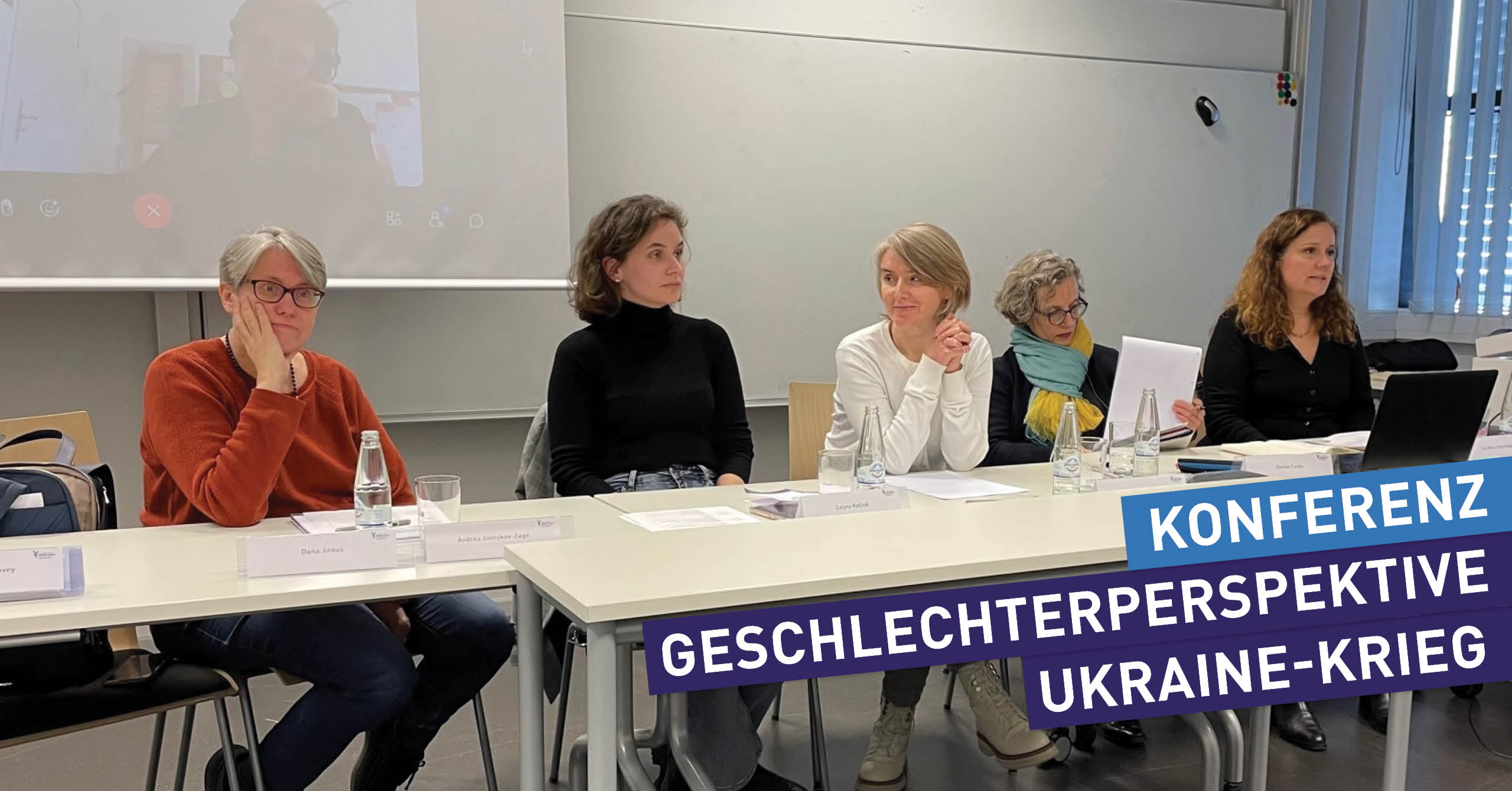
Prof. Dr Eva Maria Hinterhuber began by emphasising how important it is to incorporate a gender perspective when analysing the war, as Putin is promoting a gender policy specifically directed against LGBTIQ+ rights to justify the invasion. The conference focused in particular on the rights and experiences of women and LGBTIQ+ people, as well as on feminism in Ukraine and Russia. Another key theme was the importance of dialogue in times of war and the culture of welcome towards Ukrainian refugees.
Dr Olena Strelnyk from the Technical University of Munich spoke in her keynote address about the impact the war is having on women’s civil and political rights. Strelnyk emphasised that traditional gender roles are further reinforced during wartime. Women are not armed to the same extent as men; it is predominantly men who are expected to fight and die for their country. For women, the war has further increased the burden of unpaid care work, as state-provided childcare is largely no longer available and they must also take on the role of providing emotional support and educational supervision. Public perceptions of women have also fallen far behind those of men in times of war, as the distinction between ‘good’ and ‘bad’ citizens depends on the extent to which one is involved in the fighting. In this context, there is also a growing demand for women to be able to play a role in politics or defence, as women in Ukraine remain severely under-represented in parliaments at all levels.
Yulia Gradskova from Södertörn University in Sweden examined the history and status of women in Russia. According to Gradskova, Russia pursues an anti-feminist and strongly traditional approach, described as ‘maternalism’, which has historically stood for progressive, heterosexual, maternal femininity in European history. Women serve the state by raising working citizens. In this context, various traditional expectations of women take centre stage, such as bearing many children and fulfilling the role of carer. In contrast, few expectations are placed on men or the state with regard to supporting mothers. Another aim is to raise children to be patriotic.
In Ukraine, too, there are websites and organised advertising campaigns designed to promote traditional values amongst Ukrainian women in line with the ‘Russki Mir’ ideology. However, it is not only church organisations that are promoting these traditional values, but also, for example, a state-supported Russian women’s organisation called ‘Woman of Russia’. This propaganda also features in connection with support for the war, where the honouring of mothers – and particularly mothers with many children – is actively promoted. In Russia, state support for traditional families has been significantly stepped up since the start of the war; for example, mothers with more than ten children receive ten million roubles – the equivalent of just under 13,000 euros – and there are dedicated public holidays. Furthermore, due to demographic changes, women are being held responsible for the war effort and economic resources. All of this is reminiscent of the preparations for an imperial war, as in the 1930s. However, this propaganda is countered by the feminist anti-war resistance movement, which asserts, ‘We bring children into the world, so we are also responsible for their survival and well-being.’
Dr Vanya Solovey from Humboldt University in Berlin and Transgender Europe (TGEU) is also examining the issue of feminists in Russia. Before the war, the feminist movement in Russia had been a loosely organised movement without leadership. There had been virtually no engagement with decolonisation prior to the war. Once the war began, Russian feminists were among the first groups to mount anti-war resistance and to express solidarity with Ukraine at an early stage. Anti-colonialism is now being equated with anti-war resistance.
However, anti-colonial rhetoric is also evident in Russian propaganda at the same time. Russia portrays itself as a victim of the West, by which it is being colonised through sanctions. The sanctions are presented as acts of violence and inhumane actions by the West. Alongside pro-Ukrainian feminists in Russia, there are also feminists who support the Russian government and share its imperialist ideology; they view Ukraine as being under American control and, against this backdrop, attack both Ukrainian and Russian feminists. Like the Russian government, these radical Russian feminists spread conspiracy theories, nationalist and anti-trans propaganda. However, this also demonstrates that a debate on anti-colonialism is gaining traction in Russia.
“Today, the prevailing view is that one could die at any moment, and that everyone should therefore have the opportunity to love whomever they wish” – social discourse in Ukraine in flux
Alongside the shift in the role, perception and propaganda surrounding women in Ukraine and Russia, there is also a marked change in the perception of the LGBTIQ+ community in Ukraine. According to Strelnyk, the public debate on homosexuality and same-sex partnerships in Ukraine has changed significantly compared to the pre-war period. Acceptance of these issues has risen markedly, and there are also initiatives for LGBTIQ+ people within the military. Today, the prevailing view is that one could die at any moment, and that everyone should therefore have the opportunity to love whomever they wish, and that this must also be enshrined in law.
Olena Strelnyk emphasised that, in particular, the homophobic and anti-gender propaganda of Russia’s President Vladimir Putin – who describes the war as a struggle against the ‘homosexual West’ – makes it clear that the war also involves a fierce ideological struggle between the two countries.
This view was also shared by Galyna Kotliuk, MA, from the Heinrich Böll Foundation in Ukraine, who spoke about Ukraine’s history caught between Russian colonialism and Western Orientalism, whilst also focusing on the West’s perspective on Ukraine. Ukraine had been classified by the West as a weak country due to its colonial and Soviet past. Russian colonialism had portrayed Ukraine as a singing and dancing, yet uneducated, part of Russia – an image that was likewise adopted by the West, said Kotliuk. The perception of Ukrainian women is also shaped by this. However, despite the war, Ukrainian women and sections of the LGBTIQ+ community are remaining in the country and working as volunteers. Galyna Kotliuk also described the war as an anti-colonial war, through which Ukraine aims to rid itself of all Russian influence. This is also evident in the differing trajectories of the two countries. Whilst the Ukrainian parliament has banned the defamation of queer people since December, their rights in Russia are being increasingly curtailed. “Ukrainians want to be independent and free from Russia,” said Kotliuk.
NATO and EU member states have sided with Ukraine – the significance for peace efforts
Dr Dana Jirous and Dr Andrea Zemskov-Züge from OWEN e.V. (Berlin) explored the concepts of dialogue and empowerment – that is, the promotion of self-determination. The focus here is on understanding why other people think the way they do, and how mutual understanding can be fostered. At the start of their presentation, they first examined the context in Ukraine prior to 2022: the annexation of Crimea and the armed conflict in the Donbas in 2014, and the Minsk Agreement in 2015. This was contrasted with the situation after February 2022: the Minsk Agreements had been terminated, the Russian invasion was underway, the war was in full swing, and NATO and EU member states had sided with the Ukrainians. But what does this mean for peace efforts? In particular, the legitimacy and relevance of cross-conflict contacts and cooperation between the warring parties are being seriously called into question, as a logic of enmity now prevails. The focus on women would also shift, as they would now be perceived as supporters of the war, supporters of the victims, or victims themselves. Consequently, individual and complex needs would also be overshadowed by collective identities and needs.
Why, then, should these dialogues continue? In dialogue between people with different perspectives and positions, the important thing is not to convince others of one’s own opinion, but to understand the reasoning behind it. Recognising differences, they argued, paves the way for building relationships.
The speakers also explained their understanding of empowerment. This refers to the choices and options available at various levels, such as the social and cultural levels. However, this does not primarily refer to the ability to exert political influence. Rather, it refers to reclaiming the power of interpretation, the empowerment to resist, and the expansion of one’s own scope for thought and action, enabling one to make one’s own decisions.
The culture of welcoming Ukrainian refugees
Prof. Dr Gesine Fuchs of Lucerne University of Applied Sciences and Arts examined the issue of private individuals taking in Ukrainian refugees in Switzerland, which, for the first time in recent history, has become a key element of official reception policy. Preliminary results from an ongoing study show that the potential for social integration is considerable. The motives for taking in refugees were often based on moral grounds and seen as an act of solidarity; personal family history also played a role. At the time of the study, 50 per cent of the Ukrainians had already moved out, with over half of them into their own flats. Almost two-thirds of the experiences were positive. Many host families remain in contact after the refugees have moved out or continue to support them.
Prof. Dr Helma Lutz (Goethe University, Frankfurt am Main) and Prof. Dr Elisabeth Tuider (University of Kassel) identified differences in the reception of refugees from various regions and called for the realisation of their rights regardless of their origin.
Alongside the key issues facing women, the LGBTIQ+ community and refugees, Prof. Dr Elizabeth A. Wood from MIT (USA) analysed the early warning signs of the war in Ukraine based on the gender system within Putin’s autocracy. Prof. Dr Janet Elise Johnson from Brooklyn College, City University, offered an outlook on the extent to which Putin’s war against Ukraine will, or should, transform gender studies in Central and Eastern European countries and Eurasia. The second panel concluded with an insight into Prof. Dr Manuela Scheuermann’s ongoing research project on how the war is affecting feminist civil society organisations in Ukraine.
To round off the first day of the conference, there was a student poster exhibition on the theme of ‘Civil society initiatives in the context of Russia’s war against Ukraine’, with a focus on gender-related aspects and concepts of peace.
Overall, by focusing on gender and civil society, the conference addressed aspects of the Russian war against Ukraine that are often given insufficient consideration in both public and academic discourse. Furthermore, by organising the conference, the organisers Eva Maria Hinterhuber and Gesine Fuchs created a space in which academics and participants from the various countries involved in one way or another could express their often differing perspectives and engage in constructive dialogue.