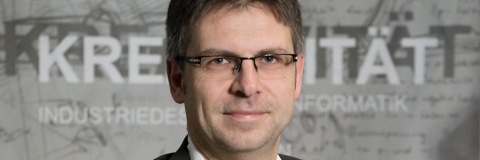
On 13 February 2019, the Electoral Assembly of Rhine-Waal University of Applied Sciences elected Dr Oliver Locker-Grütjen as its new President. He will take up the post on 1 June 2019. His term of office will initially last six years.
“In Dr Locker-Grütjen, we have found a highly competent president. He not only brings significant experience from the higher education sector, but also the necessary qualifications for the tasks ahead at Rhine-Waal University of Applied Sciences,” says Prof. Dr Aloys Krieg, Chair of the University Council and the Selection Committee, with conviction.
Since 2003, Dr Locker-Grütjen has held various positions at the University of Duisburg-Essen, most recently as Academic Director of the Science Support Centre (SSC). “I am delighted to have been elected and look forward to the new challenges as President of Rhein-Waal University of Applied Sciences. I regard the strategic coordination and management of both internal and external processes – whilst taking into account the diversity of disciplines, cultures and members of the university – as a priority. It is very important to me to successfully shape the university as a team and with the input of all its members, in accordance with the principles of transparency and participation,” said Dr Locker-Grütjen following the election.
Born in Duisburg Rumeln-Kaldenhausen on the left bank of the Lower Rhine, Dr Locker-Grütjen completed a teacher training degree at the University of Essen and a degree in ecology at the University of Essen. In 2012, he was awarded a Doctor of Philosophy (PhD) from the Faculty of Educational Sciences. Dr Locker-Grütjen began his professional career in 1999 as a research assistant in the Rector’s Office at the University of Essen. As a personal adviser to the Vice-Chancellor of the University of Essen, he oversaw the merger process between the universities of Essen and Duisburg from 2000 to 2002, where, following the merger, he held various senior positions, most recently as Academic Director of the SSC and as a member of the management team of the Vice-Rectorate for Research, Early-Career Researchers and Knowledge Transfer. He is frequently engaged as a consultant on strategic processes at universities and also serves as an expert assessor in various programmes run by the Federal Ministry of Education and Research and the German Industry Foundation.
Election procedure
The new Higher Education Act (HG NRW) has been in force since 1 October 2014. On the basis of this Act, the University Electoral Assembly was established on 9 February 2017 as a new body of Rhein-Waal University of Applied Sciences. The main task of the University Electoral Assembly is to elect or remove members of the Executive Board.
Half of the University Electoral Assembly consists of all members of the Senate and half of all members of the University Council. Members of the University Electoral Assembly entitled to vote are all Senate members entitled to vote, as well as the external members of the University Council.
On 13 February 2019, the election to fill the post of President was on the agenda at the meeting of the University Electoral Assembly. In preparation for this election, the Senate and the University Council each appointed three members to a selection committee. This committee drew up the call for applications and organised the selection process, and has now presented its proposal to the University Electoral Assembly.
As the Senate has more voting members than the University Council, but the votes of the two bodies are in the same proportion to one another (Section 22a(1) of the Higher Education Act of North Rhine-Westphalia), the votes were weighted by a factor that results in an equal voting ratio.